Chapter 7.1: The Simulation Hypothesis
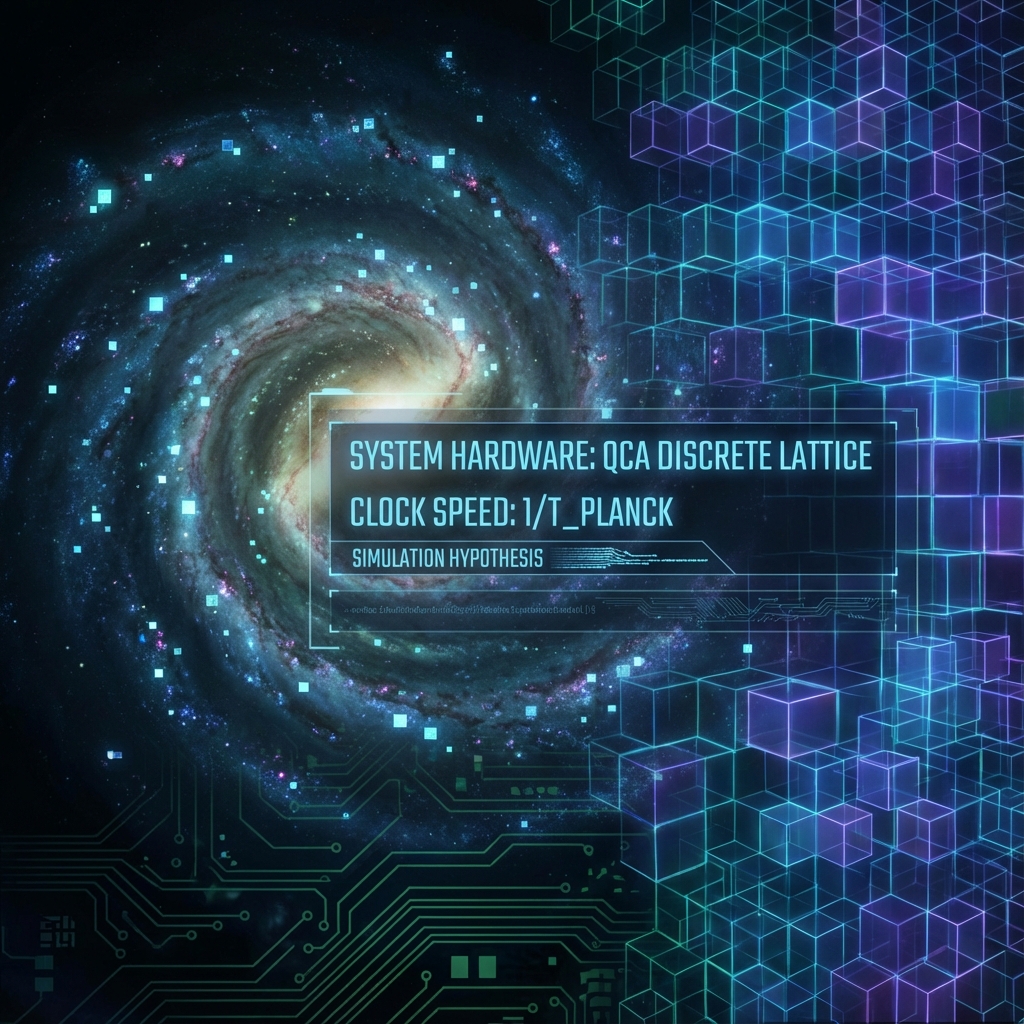
—— If the Substrate is QCA, Is the Universe a Computer?
“Physical laws are not truths carved in stone; they are algorithms running on hardware.”
1. The Recursive Question: The Rise of Computationalism
After completing the reconstruction of the universe kernel (FS geometry) and micro-architecture (QCA), a disturbing yet unavoidable question emerges: if the universe’s substrate consists of discrete grids, if the essence of time is discrete state updates, if the speed of light is merely the system’s maximum bus bandwidth, then, is the universe itself a vast computer?
This is called The Simulation Hypothesis. In traditional physics contexts, this is a metaphysical philosophical question. But in our FS-QCA architecture, this is an Engineering Problem.
We have proven that universe evolution follows unitary operator iteration: .
In computer science, this is completely equivalent to a Quantum Logic Gate operating on memory (Hilbert space). Therefore, in our framework, rather than saying “the universe is like a computer,” we should say “the universe is physically indistinguishable from a quantum computer.”
2. Hardware Evidence: Digital Traits of Reality
The strongest evidence supporting “universe as computation” comes from the underlying architectural features we revealed in previous volumes. These features are counterintuitive in continuous medium physics, but are standard configurations in digital computers:
-
Pixelated Space:
QCA’s lattice structure shows that space is not an infinitely divisible continuum, but consists of discrete addressing units (Cells). This corresponds to the Bit/Qubit structure of computer memory. Planck length is the universe’s minimum resolution.
-
Discrete Clock:
Intrinsic time originates from discrete update steps . This corresponds to CPU’s Clock Cycle. There is no “half moment,” just as there is no “half CPU instruction cycle.”
-
Local Logic:
The locality of physical laws (Lieb-Robinson bounds) corresponds to cellular automata’s Transition Rules. The next-moment state of each spatial point depends only on its current moment and its neighbors’ states. This is a highly parallelized distributed computing architecture.
-
Max Bandwidth:
FS capacity constant corresponds to the system’s Bus Frequency or Information Processing Rate Limit.
3. Computational Complexity as a Physical Resource
If the universe is a computer, then core physics concepts “energy” and “action” must be translatable into computer science terms—Complexity.
In traditional physics, we ask: “How much energy does this process require?”
In computational physics, we ask: “How many logic gates does computing this process require?”
Definition 7.1.1 (Holographic Complexity)
The trajectory length (i.e., intrinsic time ) traced by a system’s evolution process in Fubini-Study geometry corresponds to Quantum Circuit Complexity in quantum computation theory.
That is: “Experiencing time” = “Executing computation”.
The longer an object experiences time, the more logic gate operations (Gate Count) the universe computer executes to simulate that object’s evolution.
Definition 7.1.2 (Hilbert Space Dimension as Memory)
A system’s maximum entropy or number of degrees of freedom corresponds to the computer’s RAM Capacity.
QCA models explicitly indicate that local Hilbert space dimension is finite (finite energy band). This means the universe’s memory is finite. When the system attempts to process information exceeding memory limits (e.g., degree-of-freedom accumulation at black hole horizons), the system not only slows down (time dilation) but also exhibits specific thermodynamic behaviors (holographic barrier).
4. The Halting Problem and Unpredictability
Since the universe is deterministic computation (unitary evolution), why does the future appear unpredictable?
This involves Computational Irreducibility in computation theory.
Although underlying rules () are simple, to predict the system’s state after steps, there is no “shortcut” or “simple formula” other than actually running the system for steps.
The universe is its own fastest simulator.
We cannot predict the future not because physical laws are random, but because the computational cost (Complexity Cost) of decompressing the future is no lower than experiencing the future itself.
The Architect’s Note
On: Render Distance and Lazy Loading
As the architect of “The Matrix,” if I were to design the universe, to save computational power, I would use two optimization techniques:
-
Maximum Signal Speed (Light Speed):
This is actually a “Lazy Loading” mechanism. Since no observer can instantly reach the other end of the universe, I don’t need to immediately compute full universe state synchronization. I only need to ensure updates propagate outward at speed . This greatly reduces system concurrency consistency pressure.
-
Quantum Measurement Collapse:
Before being “measured” (interacted with), particles are in superposition. This is like “Frustum Culling” in games. If there are no players (observers) looking in this region, I don’t need to render specific textures (determined positions); I only need to maintain a probability distribution (wave function) running in the background. Only when players initiate interaction (measurement) do I call computational power to instantiate a specific value. This is an extreme Compute on Demand strategy.
Conclusion:
Whether the universe is simulated by “someone” or it is “existence” itself, its operating logic indisputably points to Digitization. We live in a magnificent architecture built from mathematical logic gates, and physical laws are this machine’s Instruction Set Manual.