Module VI: Gravity & Traffic Control
Chapter 6.4: Routing Overhead
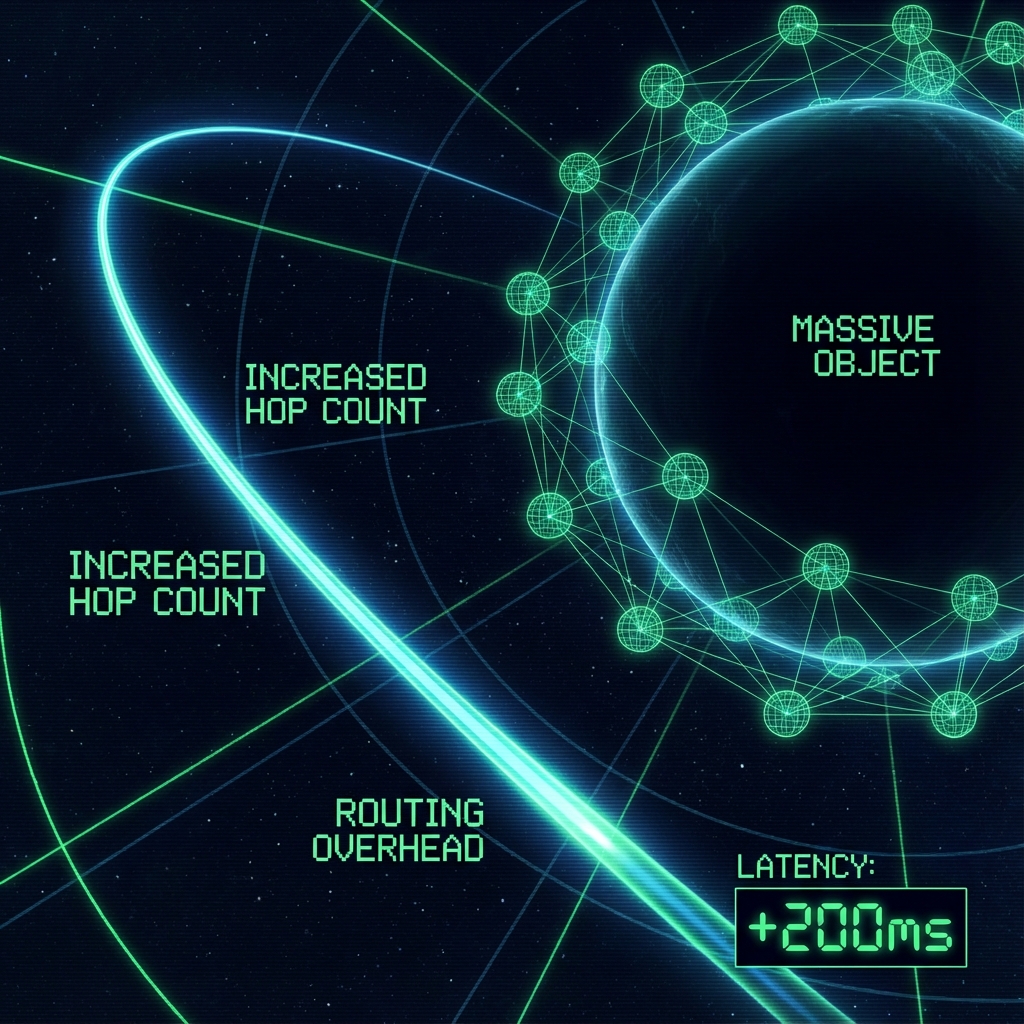
—— Why Archived Data Still Clogs the Network?
“The server isn’t running that large file, but just indexing its location exhausts the router’s computational power.”
1. Static Load vs. Dynamic Load
In the previous chapter, we reconstructed black holes as the universe’s “cold storage”. This means that matter evolution inside black holes has stopped (), becoming static data. This raises a critical architectural question: Since black holes have stopped running any logic internally and don’t consume , why do they still have a massive impact on the external network (gravitational lensing, Shapiro delay)? Doesn’t this require computational power?
In the FS-QCA architecture, we need to distinguish between two types of computational consumption:
-
Object Cost ():
This is the cost of an object maintaining its own state updates. For black holes, this cost is indeed frozen. Black holes themselves don’t “think” or “age.”
-
Topological Overhead (Metric Cost):
This is the maintenance cost that the spacetime grid (QCA Grid) must pay to accommodate this high-density object. Although black holes are “dead,” they are massive topological defects. To embed this huge data block in the discrete grid, surrounding grid nodes must rearrange their connection relationships (entanglement structure), causing extremely high connection density in that region.
2. Why Does Light Slow Down?
When light passes near a black hole, Shapiro delay indeed occurs—light appears to slow down. In our architecture, photons (data packets) don’t actually slow down; their local hop speed remains (the speed of light).
The slowdown is due to increased hop count.
Mechanism Analysis: Spatial Inflation
-
High-Density Nodes: The QCA grid around a black hole must increase local node density or entanglement complexity to carry the massive gravitational flux (information flow). This corresponds to the spatial metric component in general relativity.
-
Longer Paths: In flat space, going from node A to node B might require only 100 hops. But near a black hole, because space is “stretched” (actually, more entangled nodes are inserted to maintain connections), the shortest path (geodesic) from A to B might become 150 hops.
-
Result: Although photons travel at the same speed each step, they need to take more steps. The delay time is:
Conclusion:
Black holes don’t consume “evolutionary computational power,” but rather “routing computational power”. They force all signals passing nearby to take detours (or more accurately, traverse more grid hops). This path extension is perceived macroscopically as light slowing down or time delay.
3. A System Metaphor
Imagine a giant database table (Black Hole) filled with data.
-
This table is read-only/archived; no one is modifying it ().
-
However, because this table is so large (high mass), it occupies a huge index space.
-
When a query request (photon) tries to pass through this database, although it doesn’t read the table’s contents, the database engine (spacetime geometry) must scan the massive index tree to determine the path.
-
Result: The query slows down. Not because the data is moving, but because the existence of the data itself distorts the addressing space.
The Architect’s Note
About: Metadata Overhead
In distributed storage systems, we must not only store the data itself, but also maintain metadata—such as data block locations, checksums, and access permissions.
-
Gravitational Field is Metadata:
What’s stored inside a black hole is the actual Payload.
The curved spacetime outside a black hole is the metadata layer that the system maintains to manage this Payload.
-
Where Does the Computational Power Go?
You ask, “Black holes still consume computational resources, right?” Yes, the resources they consume manifest in vacuum polarization. To maintain the curved geometric structure around a black hole, the vacuum ground state must maintain a high-energy entanglement configuration. This is like how a file system must continuously occupy part of memory to cache its Inode table to maintain a huge static file.
So, light slows down because it’s traversing a region with extremely dense metadata. It gets caught in heavy “addressing computations.” Gravity is not a force; it’s the administrative overhead generated when the system maintains massive data indices.