Module VI: Gravity & Traffic Control
Chapter 6.3: The Universal Cold Storage
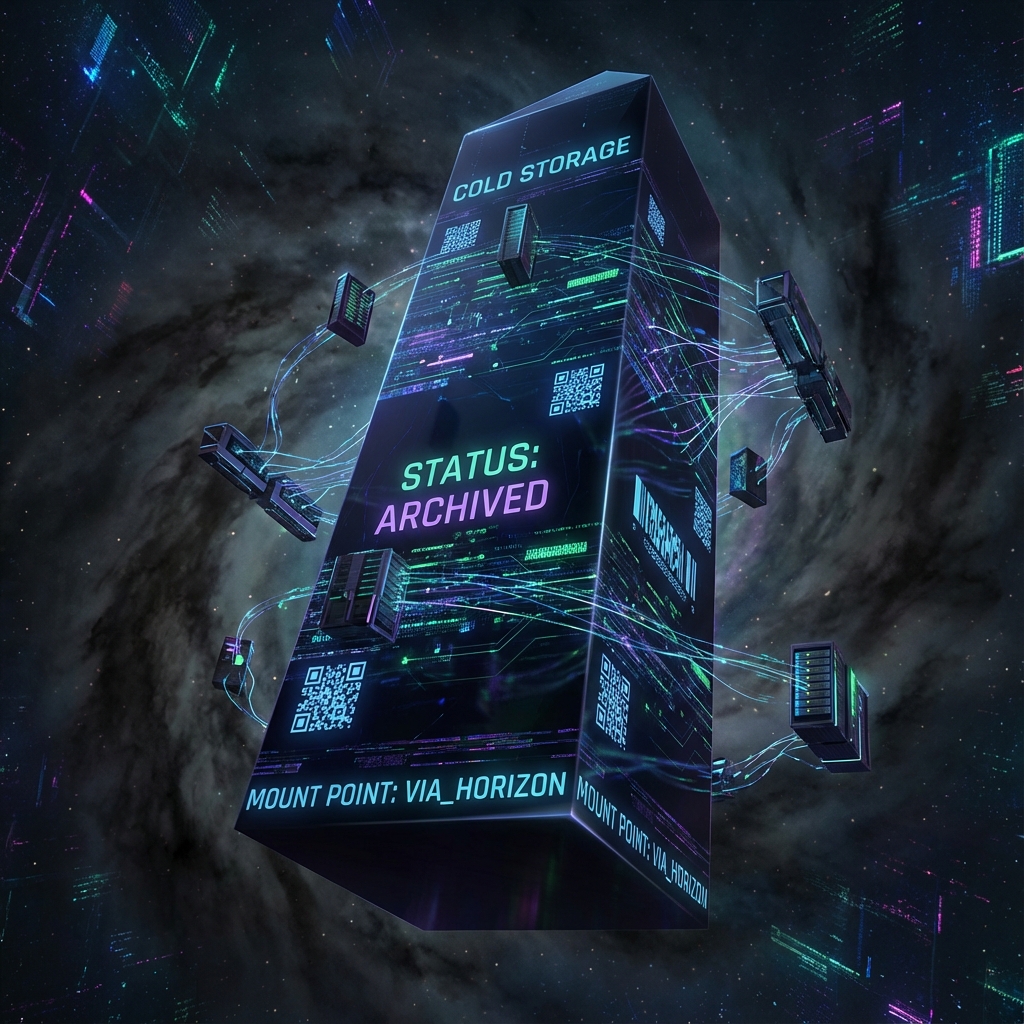
—— Black Holes as Mounted Holographic Drives and Garbage Collection
“Black holes are not monsters that devour everything; they are ‘core dump’ files automatically generated when the system crashes.”
1. From Deadlock to Archive: Serialization of State
In Chapter 6.1, we defined the horizon as the deadlock point of FS capacity. When matter density becomes too high, causing the external bandwidth required to maintain position to approach the total system bandwidth , the internal evolution rate is forced to zero [cite: 428-429].
From a systems engineering perspective, what does mean?
It means that the object no longer performs any “computation.” It stops updating its state, stops experiencing time. In computer terminology, this is a suspended process.
Definition 6.3.1 (Gravitational Serialization)
When matter crosses the horizon, the system kernel performs a serialization operation.
Active, three-dimensional matter running in memory (with volume degrees of freedom) is “flattened” and encoded as two-dimensional holographic data on the horizon surface.
This process transforms a running process into static data. Black holes are essentially “core dump” regions that the universe generates emergently to prevent system crashes caused by local deadlocks.
2. The Holographic Drive: Mount Points & Density
Since black holes store information, where is it stored?
According to the Holographic Principle, information is not stored in the volume inside the black hole, but on the horizon surface.
Theorem 6.3 (Bekenstein-Hawking Capacity Bound)
The black hole horizon, as a storage medium, has a maximum storage capacity (number of bits) strictly proportional to its surface area :
where is the Planck length.
Physical Reinterpretation:
-
Mount Point: The black hole horizon is a 2D storage partition mounted on the universe’s 3D grid. The horizon is not just a causal boundary, but also a mount path in the file system.
-
Formatting Density: The storage density of this drive is the physical limit—each Planck area unit () stores 1/4 bit. This is the cluster size of the universe’s file system.
-
Write-Only: For external observers, this drive is “write-only” by default. You can throw matter (data) into it, but cannot read it out through conventional file read operations (light rays), because the read pointer is redirected inward.
3. Hawking Radiation: The Background GC Process
If black holes only store without retrieval, the universe’s total available computational power (free energy) would monotonically decrease, eventually leading to a system-level memory leak. All effective resources would eventually be locked in the horizon drive, becoming unexecutable dead data.
To maintain long-term system stability, the universe kernel runs an extremely slow background process—Hawking radiation.
Mechanism: Leaky Bucket Algorithm
Since the horizon is a quantum interface, vacuum fluctuations allow information to slowly leak out through quantum tunneling—a side-channel attack.
-
Deserialization: Highly compressed holographic data is re-parsed at the horizon edge into disordered photon streams (thermal radiation).
-
Resource Release: Locked mass () is converted into radiation energy (), returning to the universe’s public bandwidth pool.
Although for a solar-mass black hole, this GC process takes years to complete, it architecturally guarantees the system’s unitarity: no data is truly deleted; they are merely deeply archived and thawed after a long wait.
The Architect’s Note
About: Tiered Storage Strategy
As architects, the universe we designed adopts a classic enterprise-level tiered storage architecture:
-
Tier 1: RAM — Active Matter
-
Objects: Stars, planets, life forms.
-
Characteristics: High , low latency, extremely high data heat. This is where all “computation” occurs.
-
-
Tier 2: Cold Storage/Tape — Black Holes
-
Objects: Collapsed stellar cores.
-
Characteristics: . Data is frozen, serialized, and stored at high density. This is an archive zone designed to handle overflow traffic. The system doesn’t want to delete this data, but RAM can’t hold it.
-
-
Tier 3: Recycle Bin — Singularity
-
Characteristics: Error regions that the system cannot parse.
-
Processing: Through Hawking radiation, a Cron Job, Tier 2 data is slowly cleaned, fragmented, and recycled back to Tier 1.
-
The Difference Between Forgetting and Black Holes:
-
Biological “forgetting” is active memory release (
free()) to maintain mental agility. -
Black hole formation is forced swap partition (
swap out) to prevent system overload crashes.
The universe doesn’t want to lose any information, but also doesn’t allow any information to permanently monopolize precious computational bandwidth. This is the ultimate meaning of black holes—they are the universe’s hard drive, not its graveyard.