Chapter 6.2: Emergent Spacetime
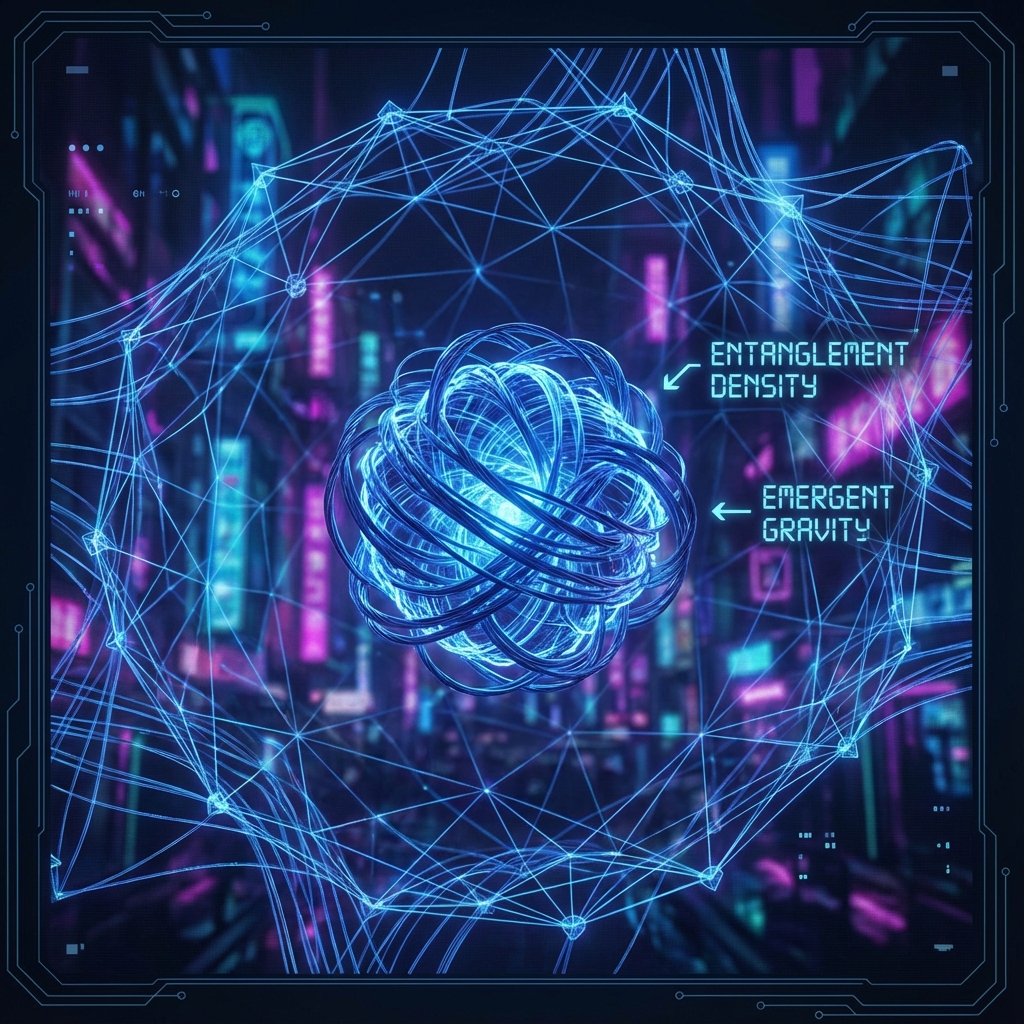
—— Reconstructing Einstein Equations from Quantum Entanglement Networks
“Spacetime is not a container carrying matter; it is the ‘visualization view’ of entanglement relationships between matter.”
1. The Death of Spacetime: From Hardware to Data Structure
In previous chapters, we reconstructed “time” as system clock (FS arc length) and “space” as discrete addressing grid (QCA lattice). In this chapter, we take the most radical step: declaring that the continuous spacetime manifold in general relativity does not exist at the underlying hardware level.
Einstein’s field equations describe how matter curves spacetime. But in our architecture, there is no physical “fabric” to be curved. What we perceive as “distance,” “curvature,” and “gravity” are essentially macroscopic projections of Information Correlation in the underlying quantum network.
Core Proposition:
Geometry is Entanglement.
The “geometric distance” between two cells is not defined by preset coordinates, but determined by their Mutual Information or Entanglement Entropy. The stronger the entanglement, the higher the communication bandwidth, and the shorter the effective “geometric distance.”
2. The Mechanism: Network Topology
To quantify this, we need to introduce core concepts from the holographic principle and transplant them into our FS-QCA architecture.
In holographic duality, the Ryu-Takayanagi (RT) formula establishes a connection between entanglement entropy and geometric area :
In our discrete architecture, this is reinterpreted as:
“The size (geometric area) of the minimal interface connecting two regions is proportional to the number of information bits (entanglement entropy) shared between these two regions.”
If we regard the universe as a vast graph, with nodes being QCA cells and edges being entanglement links:
-
Flat Spacetime: Corresponds to a uniformly connected lattice network, where entanglement degree (connection density) is uniform everywhere.
-
Curved Spacetime: When matter (objects consuming high computational power) exists, it changes the surrounding entanglement structure. If entanglement connections in a certain region are “diluted” or “rearranged,” this manifests macroscopically as spatial stretching or curvature.
3. Reconstruction: Einstein Equations as Equation of State
Now, we derive the essence of gravitational field equations. This is no longer a fundamental mechanical law, but the system’s Thermodynamic Equation of State.
Based on previous corollaries, FS capacity flow (Capacity Flow) must be conserved. We apply this logic to horizons or boundaries of arbitrary causal diamonds.
Step A: First Law of Thermodynamics
For a system in local thermal equilibrium, energy change and entropy change satisfy the Clausius relation:
In our architecture:
-
is the FS Capacity Flux flowing through the interface (i.e., matter/energy flow ).
-
is the Unruh Temperature associated with accelerated horizons (related to and local acceleration).
-
is the change in entanglement bit count on the interface (i.e., change in horizon cross-sectional area ).
Step B: Geometric Mapping
Using Raychaudhuri equations to describe how cross-sectional area changes with geometric curvature . We interpret “information inflow” () as “geometric curvature” (contraction of ).
Theorem 6.2 (Emergence of Einstein Equations)
If on any local causal horizon, FS capacity flux (matter energy) causes corresponding entanglement entropy changes (geometric area changes), and satisfies holographic entropy bounds, then the unique covariant tensor equation describing this relationship is Einstein’s Field Equations:
Physical Reinterpretation:
-
(Energy-Momentum Tensor): Traffic load distribution in the network.
-
(Einstein Tensor): Adjustment of network topology (routing strategy).
-
Equation Essence: This is not a mechanical process of objects pulling spacetime; it is a Traffic Control Protocol. When local traffic () increases, the system must dynamically adjust network topology () to change geodesic (optimal path) directions, thereby achieving load balancing.
4. The Cosmological Constant: Maintenance Cost
The term in the equation has puzzled physicists for a century. In the FS-QCA architecture, its meaning becomes obvious.
If vacuum is not empty, but filled with ground-state entangled QCA grids, then maintaining this vast entanglement network itself requires consuming underlying computational power .
Cosmological Constant represents the system’s Baseline Power Consumption or Garbage Collection Cost for maintaining the “empty” network operation. It is not only geometric curvature, but also the thermodynamic manifestation of information erasure (Landauer’s principle) on a universal scale.
The Architect’s Note
On: User Graphical Interface (GUI) and Underlying Data
Imagine you’re playing a massive multiplayer online role-playing game (MMORPG).
You see a three-dimensional map, mountains, rivers (curved spacetime). You feel that if you try to cross mountains instead of using bridges, you’ll move slowly due to “obstruction” (gravitational field changes geodesics).
But as a server architect, I know there are no “mountains” or “bridges” in the backend database.
-
Only Data Structures: Node IDs, coordinate attributes, connection weights.
-
Only Routing Algorithms: The so-called “massive objects curving spacetime” in code is simply because that region is a Hotspot. To handle hotspot traffic, routing algorithms dynamically increase the logical distance (Cost) of that region, causing data packets (light rays) passing through to deflect.
Einstein’s equations are the server’s routing table update algorithm.
They ensure that when many players (matter) gather together, the surrounding map grid (spacetime) automatically adjusts to reflect this resource concentration.
We don’t need to search for “gravitons” as transmission media, just as you don’t need to search for a physical “mouse cursor” component on the motherboard. Gravity is a Macroscopic Display of system operating state, not underlying Execution Logic.