Chapter 6.1: Horizons as Bottlenecks
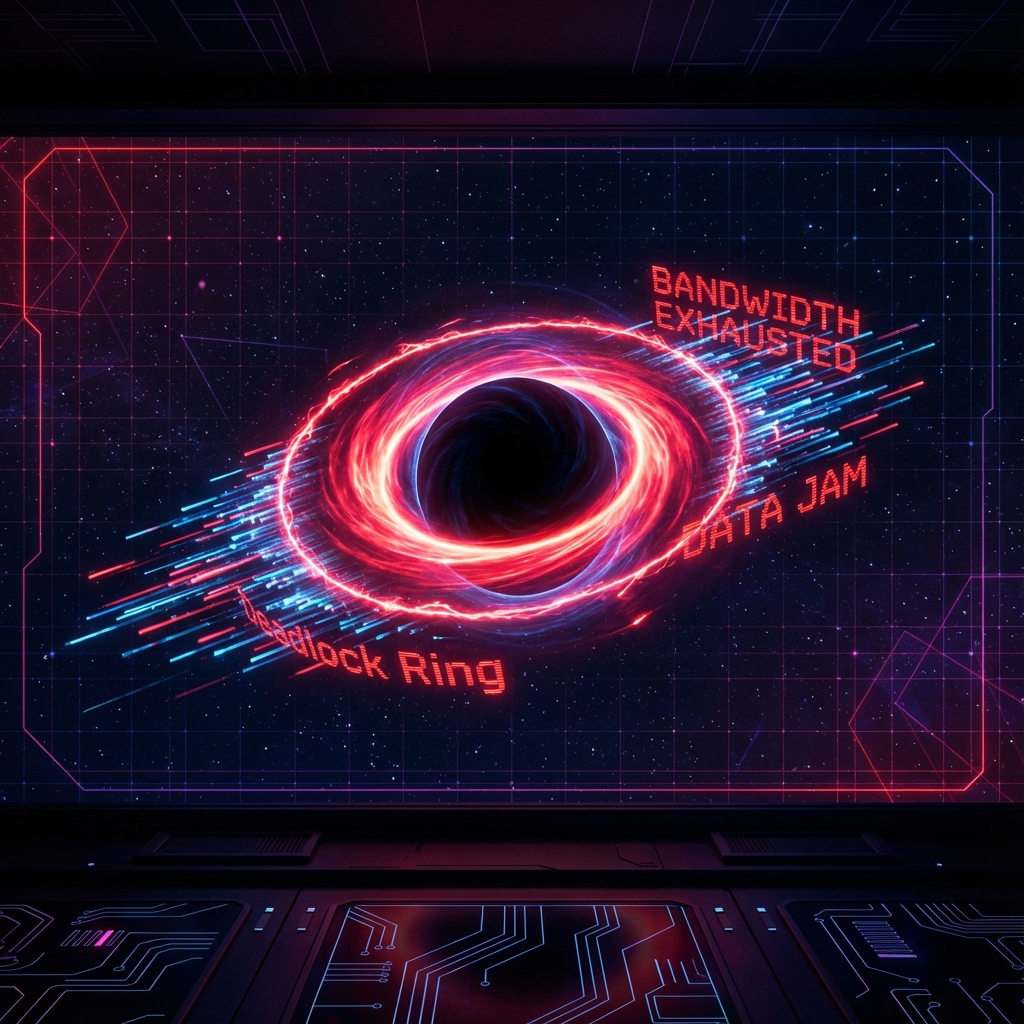
—— FS Capacity Deadlock at Horizons and Congestion Control
“Gravity is not a force; it is the system’s traffic shaping strategy when network load is too high.”
1. Gravity: Bandwidth Gradient at the Network Layer
In previous volumes, we mainly discussed resource allocation on flat space (flat lattices). In such systems, total bandwidth is uniformly distributed everywhere in space. However, the real universe network is not so homogeneous.
When objects consuming large computational power (massive particles) gather in a certain region of the network, they heavily occupy local (internal computational resources). This local resource competition causes the available network bandwidth near that region to tilt. In macroscopic physics, we call this “Gradient of Available Bandwidth” the Gravitational Field.
In the Fubini-Study geometric architecture, the curved spacetime metric in general relativity is reconstructed as the Local Capacity Allocation Matrix. Spacetime curvature is no longer a distortion of geometric background, but an uneven distribution of Information Processing Capacity Density.
2. Defining the Horizon: The Point of Resource Exhaustion
The Event Horizon of black holes is the most mysterious boundary in physics. In our architecture, the horizon is not a door to another world, but a Deadlock Point of system resource allocation.
Let us recall the Generalized Parseval Identity:
In strong gravitational fields, maintaining a position (stationary relative to the gravitational source) itself requires consuming enormous external bandwidth (you need to constantly “run outward” to resist collapse, or understand it as space itself collapsing inward). As we approach the gravitational source, the required to maintain stationarity rapidly increases.
Theorem 6.1 (Horizon Capacity Deadlock)
When an observer approaches the Schwarzschild radius , to maintain static existence at that position (not falling into the singularity), the external velocity component required by the system approaches total bandwidth .
According to the budget equation, the internal evolution speed is forced to approach zero:
This is the physical mechanism of Infinite Redshift at the horizon.
-
Time Freeze: For external observers, clocks of objects falling into the horizon stop. This is not an optical illusion; it is real Computational Stagnation. The object’s available computational power at the horizon is completely exhausted on “maintaining position” or “resisting energy flow,” with no remaining bandwidth to execute the next state update instruction (i.e., experience time).
-
Deadlock: At the horizon, the system falls into resource deadlock. Any attempt to send information outward from inside the horizon requires , which triggers the kernel’s resource overflow exception and is directly intercepted by the system firewall (causality).
3. Black Hole Thermodynamics: Congestion Control Protocol
If a black hole is a resource deadlock region, what does Bekenstein-Hawking Entropy represent?
In the FS-QCA architecture, horizon surface area corresponds to the number of Interface Nodes of the lattice surrounding that region.
Since information inside the horizon cannot exit through conventional paths (), the horizon surface becomes a Buffer for the system to process backlogged data packets.
Corollary 6.1.1 (Horizon Entropy as Buffer Size)
Black hole entropy is actually the Maximum Concurrent Connections or Buffer Bit Count that the horizon surface can maintain. It measures how many microscopic degrees of freedom are “stuck” on this congested interface, waiting to be processed.
Corollary 6.1.2 (Hawking Radiation as Packet Dropping)
When network buffers are full (congested), standard network protocols execute Packet Dropping strategies, or randomly bounce some data packets back to the network to relieve pressure.
Hawking radiation is precisely the manifestation of this Congestion Control Mechanism. Black holes are not completely black; they “leak” random thermal radiation outward through quantum tunneling (an overflow mechanism bypassing classical bandwidth limits). This is essentially the system trying to release deadlocked resources accumulated at the horizon, although extremely inefficiently.
The Architect’s Note
On: Distributed Denial of Service (DDoS) and Black Holes
As architects, we can analogize black holes to DDoS Attack Sites or Traffic Blackholes in networks.
-
Gravitational Collapse is a Traffic Storm:
When too many data packets (matter) simultaneously rush toward the same node (singularity) in the network, that node and surrounding links instantly overload.
-
Horizon is the Service Degradation Line:
At the horizon radius, link bandwidth () is completely saturated. The system can no longer process normal requests (time elapse).
This is like when you visit a website under DDoS attack, the browser keeps spinning (time slows/stops). The server still exists, but its response capability to you () drops to zero, because it’s busy handling massive inbound traffic ().
-
Why is the Horizon One-Way?
This is a Null Routing strategy. To protect the stability of the entire universe network and prevent congestion from spreading network-wide, the system kernel marks this region as “unreachable.” All data packets entering this subnet are dropped (swallowed), with no acknowledgment (ACK) returned.
Hawking radiation is the system’s extremely slow Garbage Collection process, attempting to clean up these dead sessions and reclaim memory resources over extremely long time scales.