Volume III: Microscopic Dynamics and Measurement
(第三卷:微观动力学与测量)
Chapter 6: Lazy Evaluation of State Vectors
(第六章:状态矢量的惰性求值)
6.2 Complementarity Principle and Data Compression
(互补性原理与数据压缩)
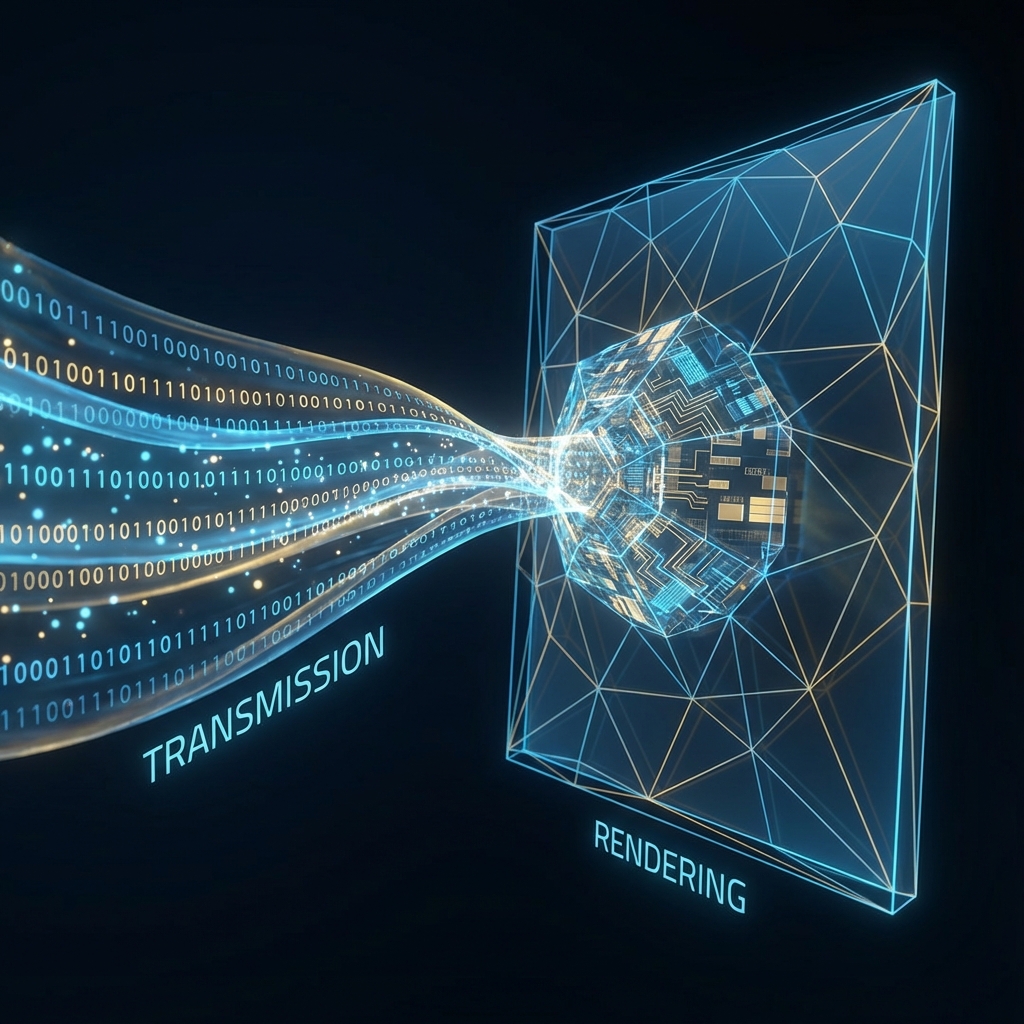
“Waves and particles are not two properties of matter, but two different encoding formats of the same information flow. Just as modern video streams use frequency-domain compression (waves) during transmission and decode into pixel arrays (particles) during playback, the universe dynamically switches data representation between ‘transmission mode’ and ‘rendering mode’ according to the observer’s interaction needs.”
In Section 6.1, we revealed the arithmetic essence of Heisenberg’s uncertainty principle through discrete Fourier transforms. This discovery naturally leads to the most perplexing feature of quantum mechanics: Wave-Particle Duality.
Niels Bohr’s Complementarity Principle states that quantum systems possess mutually exclusive yet complementary properties (such as wave-like and particle-like behaviors), which cannot be simultaneously observed in the same experiment. In traditional physics, this is regarded as a mysterious trait of the microscopic world; but within the framework of Interactive Computational Cosmology (ICC), the complementarity principle is a direct manifestation of Basis Rotation in information theory, and more importantly, an Adaptive Data Compression Strategy adopted by the system to optimize storage and transmission efficiency.
6.2.1 Wave-Particle Duality as Basis Rotation
In Hilbert space , a physical state is an abstract vector. To describe this vector, we must choose a coordinate system, i.e., a Basis.
-
Particle View (Particle Nature): Choose the eigenstates of the position operator as the basis.
In this representation, information is Localized. Each component corresponds to a point in space. This is similar to the Bitmap format in computer images, suitable for handling collisions, interactions, and position measurements.
-
Wave View (Wave Nature): Choose the eigenstates of the momentum operator as the basis.
In this representation, information is Delocalized. Each component corresponds to a plane wave spread across all space. This is similar to Spectrum or JPEG/MP3 encoding in audio or image processing, suitable for handling propagation, interference, and long-range correlations.
Mathematical Essence:
The difference between waves and particles is merely a difference in Data Representation. The transformation from particle state to wave state is mathematically executing a Discrete Fourier Transform (DFT) or Hadamard Transform.
The complementarity principle exists because the same vector cannot simultaneously be parallel to two orthogonal coordinate axes. Just as you cannot simultaneously describe the same piece of music using pure time domain (time points) and pure frequency domain (sine waves), the system also prohibits simultaneously instantiating two mutually exclusive encoding formats at maximum precision.
6.2.2 Compression Optimization for Transmission and Interaction
Why does the universe need these two seemingly contradictory forms? The answer lies in Computational Efficiency. Different computational tasks have different optimization requirements for data structures.
Scenario One: Free Propagation
-
Task: A particle moves from point A to point B.
-
Disadvantage of Particle Encoding: If using particle encoding (position basis), to simulate movement, the system must update all relevant points on the grid at each time step and handle complex diffusion equations. For long-distance transmission, this requires enormous bandwidth.
-
Advantage of Wave Encoding: In momentum space (frequency domain), the evolution of a free particle is extremely simple—merely a linear phase rotation .
-
Conclusion: Waves are the most efficient transmission format. When particles have no interactions (are not observed), the system defaults to converting them to wave mode (frequency-domain data), because this can greatly reduce the complexity of evolution calculations (from partial differential equations simplified to algebraic multiplication). This is like transmitting compressed video streams over the network, rather than transmitting raw .bmp image sequences.
Scenario Two: Local Interaction
-
Task: A particle hits a screen or is captured by a detector.
-
Disadvantage of Wave Encoding: Waves are spread across all space. Computing local collisions requires integrating the wave function over all space, which is extremely inefficient and difficult to determine the specific collision point.
-
Advantage of Particle Encoding: The position basis explicitly specifies the particle’s coordinates. Collision detection is an complexity operation in the particle view.
-
Conclusion: Particles are the most efficient interaction format. When interactions occur, the system must decode data from frequency domain (waves) back to time domain (particles) to execute precise logic gate operations. This is the physical “collapse”.
6.2.3 Observer’s Choice: Decoder Configuration
In the ICC model, observers are not passive bystanders, but Decoder configurators.
When we set up a double-slit interference experiment:
-
Without Detector: We tell the system: “I don’t care about the specific path (position information).” So the system maintains Wave Encoding (frequency-domain mode), data passes through the double slits as waves, and exhibits interference fringes when decoded on the screen (characteristic of frequency-domain superposition).
-
With Detector: We tell the system: “I need to query the specific path coordinates.” This is equivalent to forcing the system to call
Inverse_FFT(), switching data back to Particle Encoding (time-domain mode). In particle mode, data packets can only pass through one slit, and interference fringes naturally disappear.
Theorem 6.2.1 (Context-Dependent Reality)
The manifestation form of physical entities (wave or particle) is not their intrinsic property, but depends on the observer’s (oracle’s) query request for Output Format.
If the observer asks “Where are you?”, the system returns a particle; if the observer asks “What is your frequency?”, the system returns a wave.
6.2.4 Delayed Choice and Data Stream Buffering
Wheeler’s Delayed Choice Experiment further confirms the temporal flexibility of this compression mechanism. Even if a photon has already passed through the double slits, as long as we haven’t read the final result, we can still decide whether it is detected as a wave or as a particle.
From a computational perspective, this is very easy to understand:
-
The photon maintains a Compressed State (wave function) during flight.
-
Logs are lazily generated. Only at the last moment (reading data) does the system decide how to render the historical trajectory based on the current decoder configuration (whether to retain path information).
This is like in video games, where the graphics card doesn’t pre-render objects outside the view frustum. Only when you turn to look at that moment does the system generate images in real-time from the data stream in memory.
6.2.5 Summary: The Coding Theory of Reality
The complementarity principle reveals a core optimization technique of the universe operating system: Dynamic Transcoding.
-
Vacuum is Frequency-Domain: To save bandwidth, undisturbed information flows propagate as waves.
-
Matter is Time-Domain: To handle causality and collisions, interacting information flows are instantiated as particles.
-
Observation is Decoding: The observer’s measurement apparatus determines the decompression algorithm when the data stream is finally presented.
The century-long debate among physicists about “waves” versus “particles” is actually confusing Source Files with Display Formats. The universe has only one thing—quantum information flow—which smoothly rotates and jumps between different bases according to the needs of the computational context.