Volume III: Microscopic Dynamics and Measurement
(第三卷:微观动力学与测量)
Chapter 6: Lazy Evaluation of State Vectors
(第六章:状态矢量的惰性求值)
6.1 Arithmetic Roots of Heisenberg’s Uncertainty
(海森堡不确定性的算术根源)
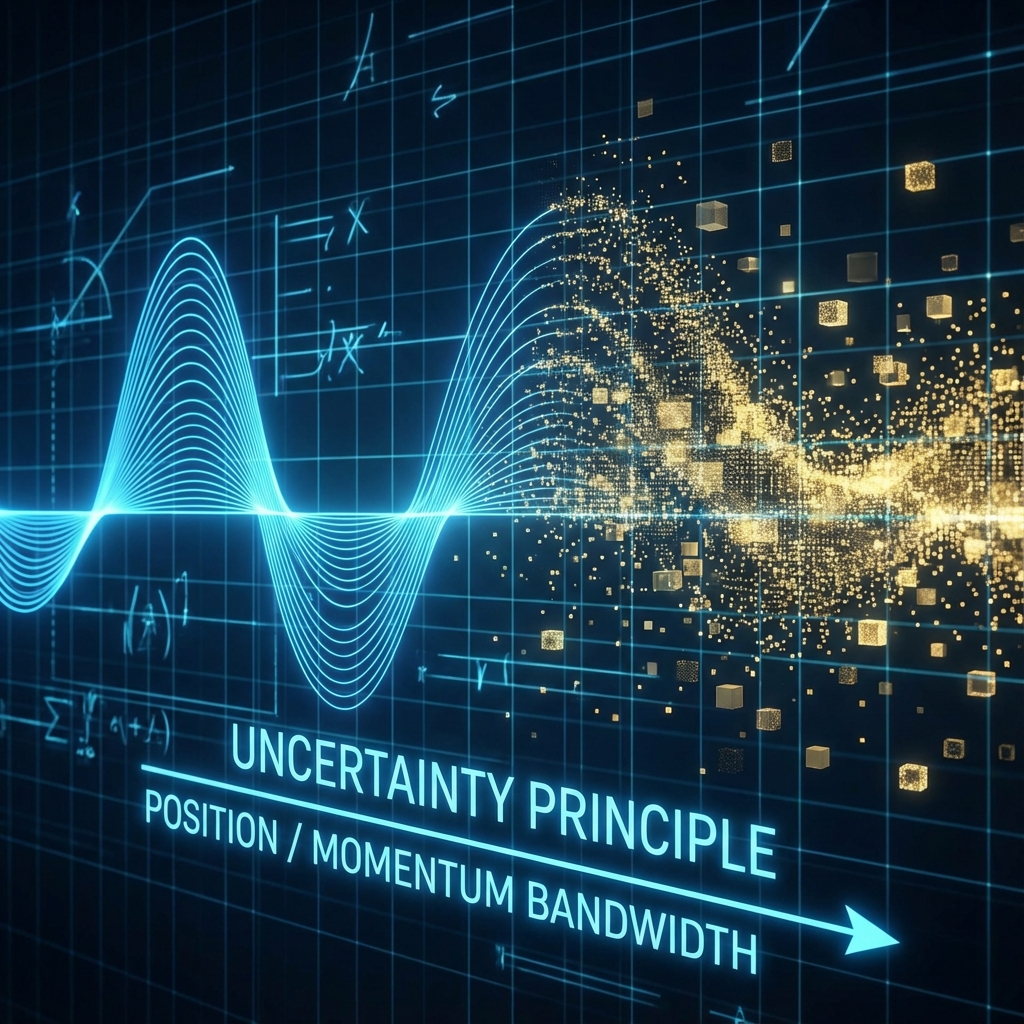
“God does not play dice, but he does use finite-precision floating-point numbers. Heisenberg’s uncertainty principle is not some mysterious fuzziness of nature, but an arithmetic bandwidth theorem that any finite discrete signal processing system must obey when converting between time and frequency domains.”
In the previous two volumes, we explored the emergence mechanisms of macroscopic spacetime. Now, we turn our attention to the microscopic world, delving into the kernel code of Interactive Computational Cosmology (ICC).
The most central and perplexing feature of quantum mechanics is the Heisenberg Uncertainty Principle: we cannot simultaneously know precisely both a particle’s position and momentum . In the Copenhagen interpretation, this is explained as the disturbance of measurement on the system; in hidden variable theories, it is regarded as our lack of knowledge.
However, from the perspective of computational ontology, the uncertainty principle is neither disturbance nor ignorance. It is a direct mathematical corollary of the Finite Information Axiom. This section will prove that the uncertainty relation is essentially the time-frequency bandwidth theorem in Digital Signal Processing (DSP). It is a data type constraint enforced by the system to prevent Data Overflow and maintain bit conservation.
6.1.1 The Cost of Infinite Precision and Finite Bit Depth
In classical mechanics, a particle’s state is described by a point in phase space. If space is a continuous set of real numbers , then precisely specifying a position (e.g., meters) requires an infinitely long bit string.
According to the first axiom of this book, the number of bits in physical reality is finite. This means the system cannot store infinite-precision real numbers. For any physical variable , the system can only allocate a finite Bit Depth to store its value.
Let the total degree-of-freedom capacity of the system be bits. If we attempt to encode position with extreme precision (consuming many bits), then the number of bits left for encoding momentum must decrease.
Definition 6.1.1 (Information Conservation of Complementary Variables)
Let and be the Shannon information (number of bits) required to describe position and momentum, respectively. For a quantum bit system with given degrees of freedom, its total information capacity is locked:
where is the system’s bus bandwidth or register size.
This explains why when (position extremely precise, very large), (momentum extremely fuzzy, very small). The system is not “unwilling” to tell us the momentum, but rather out of memory.
6.1.2 Fourier Duality and Discrete Bandwidth Theorem
To derive this relationship more rigorously, we need to examine the mathematical relationship between the position basis and momentum basis . In quantum mechanics, they are Fourier Transforms of each other:
In the ICC model, space is a discrete grid. Therefore, this transformation should be replaced with the Discrete Fourier Transform (DFT).
Consider a discrete signal sequence of length (wave function ).
-
Time domain (position domain): The distribution width of the signal on grid points is .
-
Frequency domain (momentum domain): The spectral distribution width of the signal is .
The mathematical Uncertainty Lemma states that for any non-zero signal, the product of its time-domain width and frequency-domain width has a non-zero lower bound:
This is purely an arithmetic fact: you cannot create a signal that is both extremely short in the time domain (impulse) and extremely narrow in the frequency domain (single-frequency wave).
-
If the wave function is a Dirac function (position completely determined), its spectrum must be uniformly distributed (momentum completely unknown).
-
If the wave function is a plane wave (momentum completely determined), it must span the entire domain in space (position completely unknown).
Substituting physical constants, we obtain:
where is the proportional scaling factor in the discrete grid transformation.
6.1.3 Data Type Conflicts of Non-commutative Operators
In the quantum mechanical formalism, uncertainty originates from the Non-commutativity of operators: .
From a computational perspective, non-commutativity means the order of operations changes the data structure.
-
Measuring : Equivalent to executing the instruction
Read_Position(). The system projects the wave function onto the position basis (Position Basis), returning a coordinate value. At this point, the original phase information (momentum) is destroyed. -
Measuring : Equivalent to executing the instruction
Read_Momentum(). The system first executesFFT()(Fast Fourier Transform) on the wave function, converting it to the momentum basis, then reads the frequency value.
Since Read operations are destructive (collapse), and FFT operations are global basis rotations, executing Read_Position followed immediately by Read_Momentum, versus the reverse operation, yields statistically different results.
Theorem 6.1.1 (Mutually Exclusive Precision Protocol)
Conjugate variables (such as and ) are actually projections of the same underlying data (quantum state ) under two different Data Views. Since there is only one copy of underlying data, the system prohibits simultaneously instantiating both views at maximum precision.
6.1.4 Lazy Evaluation and Rendering Granularity
Finally, we connect the uncertainty principle with this book’s core concept of Lazy Evaluation.
In computer graphics rendering, to save resources, systems typically employ Level of Detail (LOD) techniques.
-
When the camera is far from an object, the system only renders a blurry low-poly model (position fuzzy, large).
-
When the camera zooms in, the system loads a high-poly model (position precise, small).
Heisenberg’s principle is actually the LOD switching threshold of the universe’s rendering engine.
When an observer attempts to “see” a particle with extremely high energy (short-wavelength photons), they are actually forcing the system to perform Sub-pixel Sampling.
-
To satisfy such excessive position precision requirements (), the system must invoke extremely high-frequency Fourier components.
-
These high-frequency components correspond to enormous momentum perturbations ().
-
This perturbation is not “measurement destroying the particle,” but rather high-frequency noise that the rendering engine must inject to generate high-precision coordinates.
Conclusion:
Heisenberg’s uncertainty principle is not some “essential fuzziness” of nature; it is the bandwidth theorem of discrete signal processing. It protects the universe, this computer, from users extracting illegal information exceeding the Bekenstein bound through infinite-precision measurements. It is the Overflow Protection mechanism in physical laws.