Volume III: Microscopic Dynamics and Measurement
(第三卷:微观动力学与测量)
Chapter 7: Algorithmic Solution to the Measurement Problem
(第七章:测量问题的算法解)
7.1 Collapse as Instantiation
(坍缩即实例化)
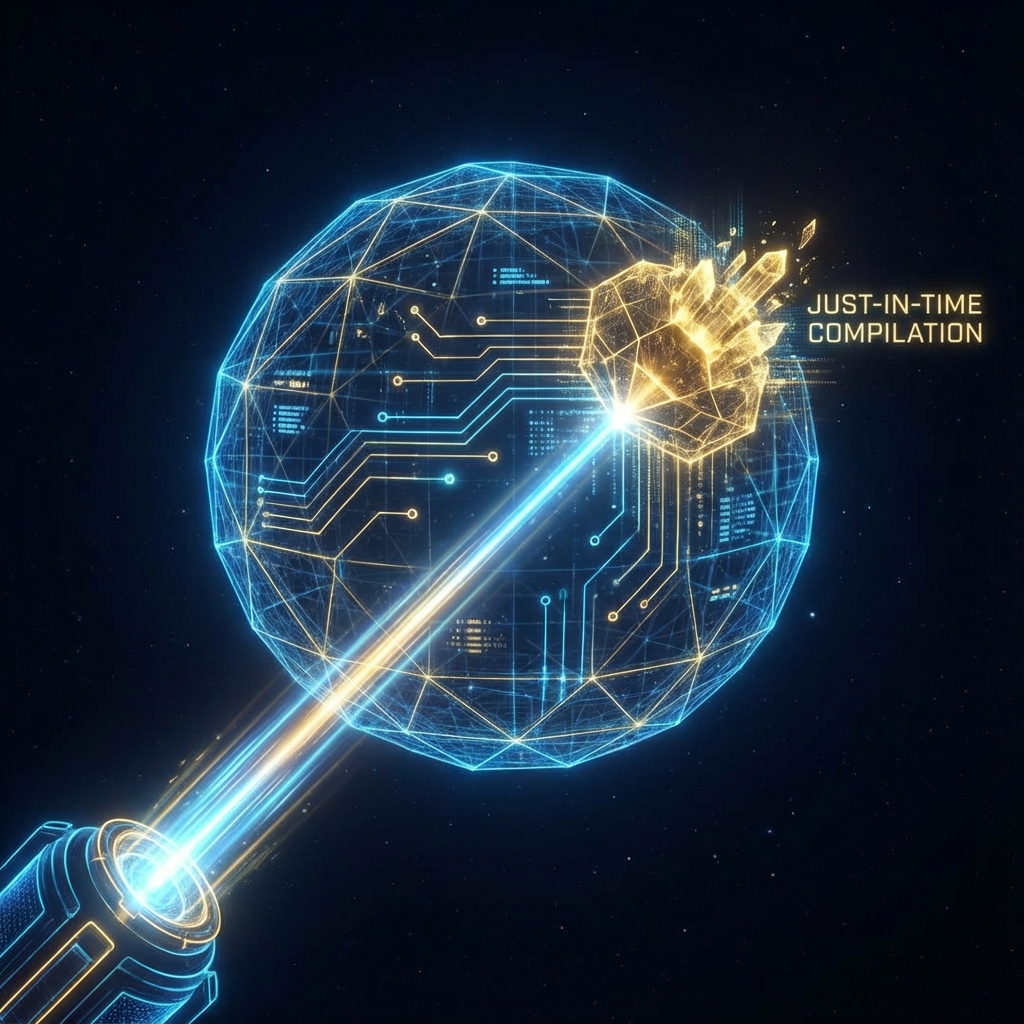
“Wave functions never ‘collapse,’ just as source code never ‘destroys’ itself by being compiled. In the runtime of physical computation, what we observe is merely the process of abstract data types (ADT) being just-in-time compiled (JIT) into concrete instances under interaction requests. Schrödinger’s cat is not both dead and alive; it is an uninstantiated class.”
The greatest mystery in quantum mechanics—the Measurement Problem—has puzzled physicists for nearly a century. Von Neumann formulated it as a logical break between Process I (non-unitary collapse) and Process II (unitary evolution). Why do microscopic particles follow linear superposition laws, while the macroscopic world appears as a definite single state?
Within the framework of Interactive Computational Cosmology (ICC), this so-called “physical paradox” is reconstructed as a standard Computer Science Process. This section will argue that quantum measurement is essentially a transformation from Abstract Definition to Concrete Object. What physics calls “collapse” should be called Instantiation in computational ontology.
7.1.1 Measurement Paradox as Type Error
In standard quantum mechanics, we treat the wave function and observation results (such as particle position ) as physical entities at the same level. This is a serious Type Error in computational logic.
-
Wave Function is Code (Code/Class):
describes all possibilities of the system and their probability weights. It contains all the rules and parameter distributions needed to generate a physical particle, but it itself does not occupy a definite spacetime coordinate. It is similar to a Class or Abstract Data Type (ADT) in object-oriented programming (OOP).
class Particle { Distribution position_pdf; Distribution momentum_pdf; Complex spin_amplitude; }; -
Particle is Instance (Instance/Object):
The flash point we see on the detector is a concrete, unique entity. It occupies a specific memory address and has definite attribute values. It is similar to an Object allocated in memory.
Particle* electron_1 = new Particle(seed);
Conclusion:
Wave functions and particles are not two different material states, but two different abstraction levels of the same logical entity. The transformation between them (measurement) is not a physical mutation, but the system executing a Constructor.
7.1.2 Constructor Invocation Mechanism
In the ICC model, the universe’s evolution engine defaults to processing “classes” (wave functions) because this is most economical in resources (see Section 6.2). So, what triggers instantiation?
The answer is: Interaction Request.
When a quantum system (such as an electron) becomes entangled with a macroscopic environment (such as a Geiger counter or the observer’s retina), the macroscopic environment—as a high-complexity computational subsystem—issues a Property Query to the electron.
-
Query:
electron.getPosition() -
System Response:
-
Detects that the electron is in an uninstantiated superposition state (Class state).
-
Calls the oracle, extracts a random number from the wave function’s probability distribution .
-
Runs Constructor: Locks the electron’s coordinate based on .
-
Allocates Display Memory: Writes a “particle exists” marker at on the spacetime grid and renders its physical effects.
-
Returns Result: The observer sees the electron appear at .
-
From the observer’s perspective, the wave function instantly contracts to point . But at the system’s bottom layer, this is merely the process of data structure transformation from probability distribution table (Table) to single value (Scalar).
7.1.3 Just-In-Time (JIT) Physics
Modern programming languages (such as Java or Python) widely use Just-In-Time Compilation (JIT) technology: code is abstract bytecode before execution, and only when it is about to be executed is it compiled into machine code.
The physical universe adopts exactly this JIT Strategy.
Theorem 7.1.1 (JIT Reality Theorem)
To minimize holographic storage overhead, physical systems generate definite physical entities (machine code) only at the Interface of causal chains. Outside the interface (such as photons propagating in vacuum, or cats in unopened boxes), physical reality remains in Intermediate Code (Bytecode/Wavefunction) state.
This explains why we cannot find hidden variables:
-
Hidden variable theory assumes particles have definite positions before measurement (pre-compiled machine code).
-
Experimental violations of Bell’s inequality prove hidden variables do not exist.
-
Computational Explanation: Before measurement occurs, the particle’s position attribute has not been allocated memory at all. Attempting to probe position before measurement is like trying to read a value pointed to by a null pointer, which is meaningless.
7.1.4 Object-Oriented Explanation of Schrödinger’s Cat
Now we can perfectly resolve Schrödinger’s cat paradox.
The cat in the box is in the state:
-
Copenhagen Interpretation: The cat is in a ghostly state of mixed life and death. This violates intuition.
-
Many-Worlds Interpretation: The universe splits into two, one with a dead cat, one with a living cat. This wastes resources.
-
Interactive Computational Interpretation:
The cat in the box is an Unexecuted Closure or Lazy Object.
The system records that the cat’s state depends on the poison bottle, and the poison bottle depends on the decay atom. This entire causal chain is packaged as a Thunk (expression to be evaluated).
At this point, the cat does not have “dead” or “alive” attribute values because it has not yet been Evaluated.
When you open the box (execute observation):
-
You trigger evaluation of this expression (Force Evaluation).
-
The system traces the dependency chain and calls the random determination interface for atomic decay.
-
Based on the determination result, instantiate a “dead cat” or “living cat” 3D model to render for you.
-
The cat never was in a “both dead and alive” state; it was merely in a “waiting to load” state.
7.1.5 Summary: Dynamic Generation of Reality
The view that Collapse is Instantiation completely eliminates the mystery of quantum mechanics. It tells us that the determinacy of the physical world is not innate, but Generated.
-
Wave Function is the universe’s Source Code, containing infinite potential.
-
Particles are the universe’s Runtime Instances, constituting finite reality.
-
Measurement is the Compiler connecting the two, transforming possibility into necessity.
We live in a vast, event-driven program. Every observation is an execution of the universe’s code; every definite moment is an island crystallized from the ocean of probability through computation.