5.2 The Physics Engine Rules (Statistical Mechanical Derivation of Einstein Equations)
(The Physics Engine Rules - Statistical Mechanical Derivation of Einstein Equations)
“Einstein’s field equations are not divine oracles; they are the server’s equation of state. Like gas’s PV=nRT, they are macroscopic laws emerging from bottom-layer pixels in statistical equilibrium. Gravity is the thermal effect of information.”
In classical physics, Einstein’s field equations are regarded as truth. But in our theory, they are a corollary. Just as fluid mechanics equations emerge from countless water molecule collisions, the equations governing spacetime also have deeper code origins.
This section will prove: Einstein’s field equations are essentially spacetime’s first law of thermodynamics. In programmer terms, this is the rule the holographic system must follow to maintain load balancing.
5.2.1 Horizon Temperature: CPU Heat Generation
First, we need to define spacetime’s “temperature.” Talking about temperature in vacuum seems absurd.
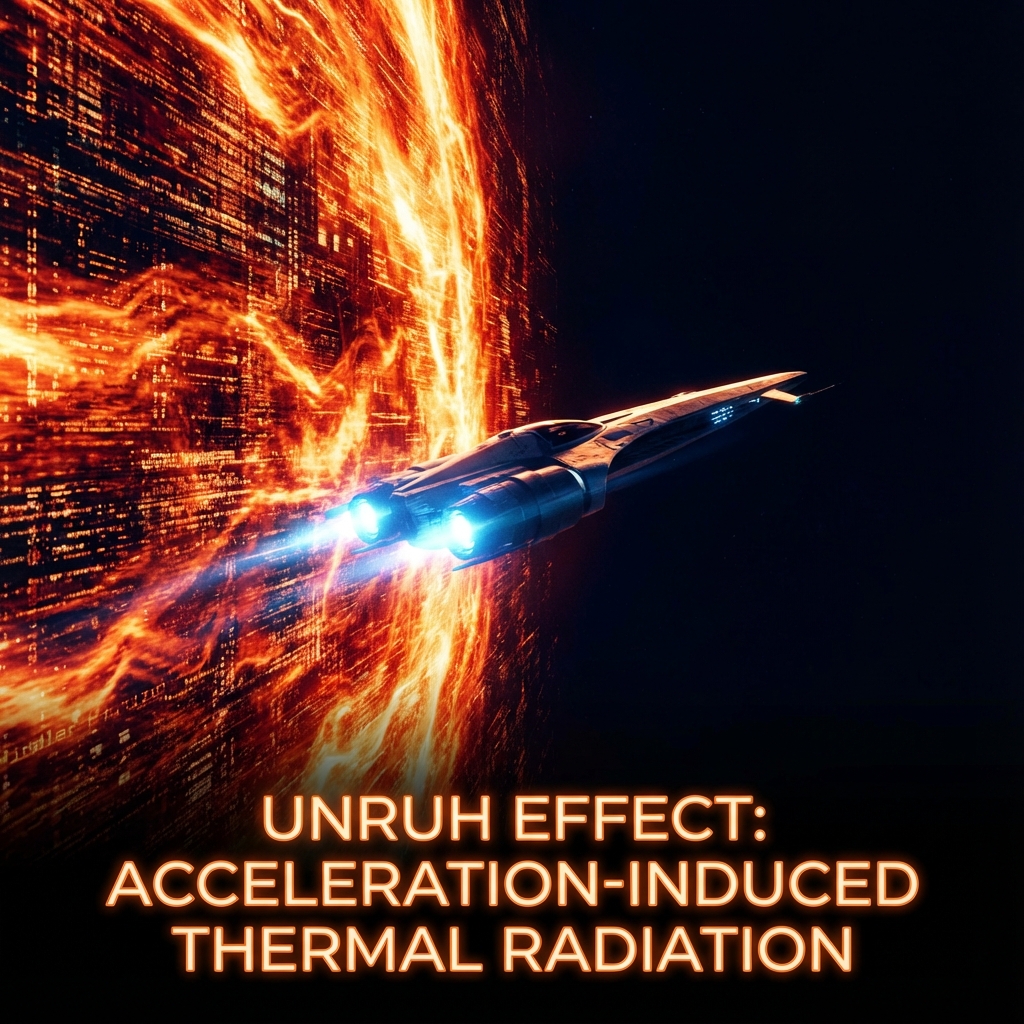
But according to the Unruh Effect, an accelerating observer sees the surroundings filled with thermal radiation. The greater the acceleration, the higher the temperature.
Computational interpretation: In our model, this temperature reflects information loss rate. When you accelerate away from a region, that region’s data can’t catch up (exits your view). This hidden data becomes background noise (entropy), and the system calculating this “occlusion culling” consumes energy, manifesting as temperature increase.
The computational cost of accelerated motion manifests as increased system background noise.
5.2.2 First Law of Thermodynamics for Spacetime
Now, suppose energy (data flow) passes through your horizon (enters invisible region).
- Heat (): Energy inflow = heat inflow.
- Entropy change (): This energy carries away information. According to holographic principle, information exists on surface area. So, horizon area must increase.
- Computational balance: For a stable system, heat and entropy must be related through temperature:
5.2.3 Derivation: From Thermodynamics to Geometry
Now we substitute the above physical quantities into formulas.
- Left side (energy/data): Described by energy-momentum tensor .
- Right side (geometry/area): Area change is determined by geometric curvature (Riemann curvature).
After complex mathematical derivation (omitting ten thousand words here), when we apply this simple thermal balance condition to every point in spacetime, we surprisingly find that only Einstein’s field equations can satisfy this requirement:

This means: As long as we acknowledge the holographic principle (area law) and thermodynamic laws, general relativity is an inevitable result.
5.2.4 Equation of State: Automatic Scaling Mechanism
The consequences of this derivation are shocking:
- Gravity is not a fundamental force: We didn’t introduce “gravitons.” Gravity is merely a statistical property of spacetime’s microscopic structure, like gas pressure.
- Einstein equations are equations of state: They’re similar to gas equations. They describe how spacetime geometry must adjust its “shape” under given data load to maintain system stability.
Theorem 5.2.1 (Holographic Balance Theorem)
Spacetime curvature is geometric inflation that the system must perform to accommodate information (entropy) carried by matter.
5.2.5 Explanation from Interactive Computing Perspective
In plain language, this is the Titans’ server’s automatic scaling/load balancing protocol:
- Data influx: When massive matter (data) accumulates in a region.
- Capacity alert: If space is flat, surface area (hard drive capacity) is fixed (). Too much data exceeds Bekenstein bound, about to data overflow.
- Automatic scaling: To prevent crash, the system must dynamically expand that region’s storage capacity. Geometrically, the only way to increase “volume” without changing “radius” is to increase curvature.
Therefore, gravity is the holographic computer’s automatic scaling mechanism.
Einstein’s field equations are this mechanism’s control algorithm: Based on current load (matter), it adjusts network topology (curvature) in real-time, ensuring no node’s bit density exceeds hardware limits.
Thus concludes Volume II “Rendering the World.” We explained light speed (bandwidth) and gravity (load). In the next Volume III, we will dive into the microscopic, to see how those jumping “pixels”—quantum mechanics—actually work. We will explain why Heisenberg’s uncertainty principle is actually data’s precision truncation.