6.1 Resolution Limits (Arithmetic Roots of Heisenberg’s Uncertainty)
(Resolution Limits - Arithmetic Roots of Heisenberg’s Uncertainty)
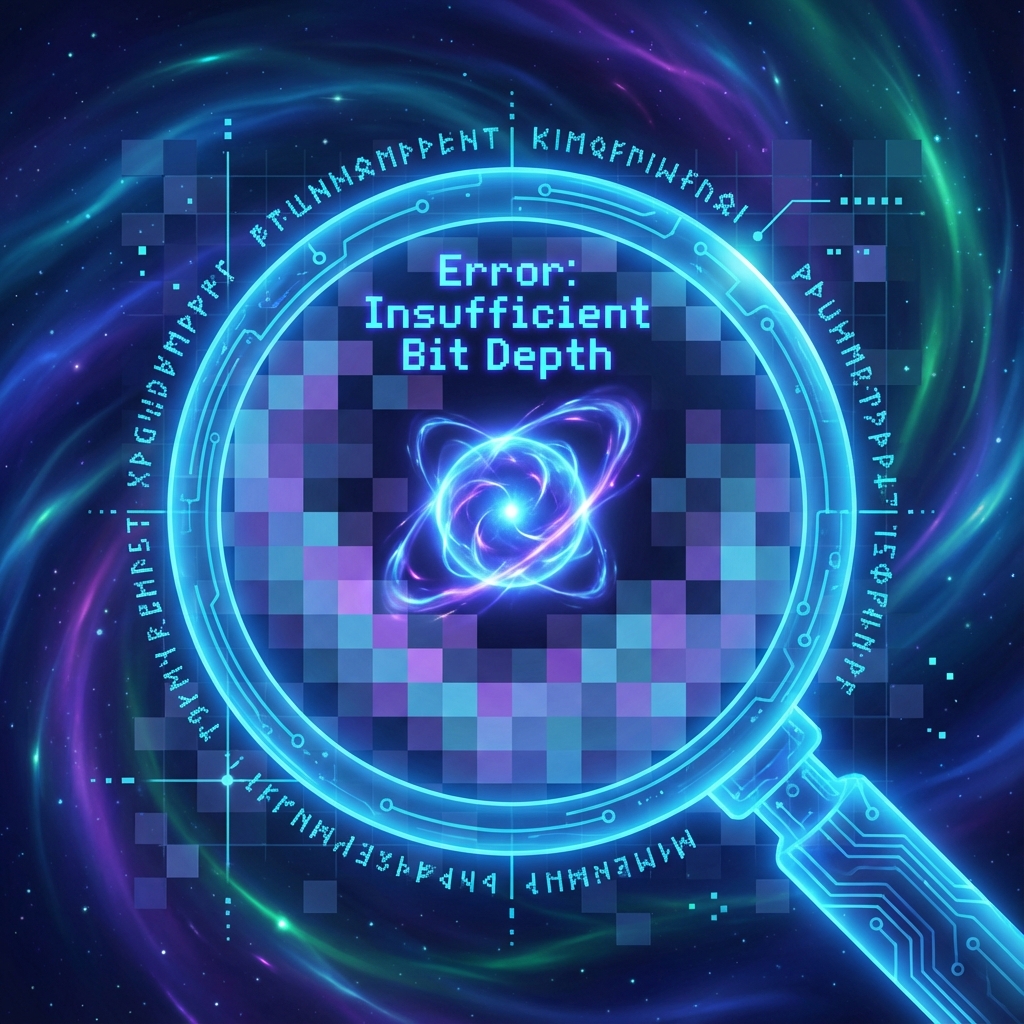
“God doesn’t play dice, but he does use finite-precision floating-point numbers. The uncertainty principle is not mysterious magic; it’s a blurry jpg image. When you zoom to pixel level, you naturally can’t see details; this is the iron law of any discrete system.”
In the first two volumes, we discussed macroscopic servers and networks. Now, we zoom in to see Azeroth’s microscopic pixels—quantum mechanics.
Quantum mechanics’ core feature is Heisenberg’s uncertainty principle: You cannot simultaneously know a particle’s position and velocity precisely. In Code of Azeroth theory, this is neither perturbation nor ignorance. It’s a mathematical corollary of the Axiom of Finite Information. Simply put, it’s insufficient resolution.
6.1.1 Video Memory Can’t Store Infinite Decimals
In classical mechanics, position is a real number. If you want to precisely write down a coordinate (like ), you need an infinitely long strip of paper. But as we said in Chapter 1, the Titans’ server has finite bits.
This means the system cannot store infinite-precision decimals. For any attribute, the system can only allocate finite bit depth.
Suppose the system allocates bits total to describe a particle.
- If you use many bits to describe position (very precise position), then fewer bits remain to describe velocity (blurry velocity).
- Vice versa.
Formula:
This is why when you measure position more precisely (), momentum becomes more chaotic (). The system isn’t unwilling to tell you; it’s because memory overflow, trailing digits are truncated.
6.1.2 Fourier Transform: The Seesaw of Time Domain and Frequency Domain
This mathematically corresponds to discrete Fourier transform.
- Position is like time domain signal (which frame you appear in).
- Momentum is like frequency domain signal (what’s your frequency).
Mathematically, there’s a dead law: You cannot create a signal that’s both extremely short at this moment (position determined) and extremely narrow in spectrum (momentum determined).
This is purely an arithmetic fact. Like you cannot zoom an image to 1x1 pixel while retaining all details.
6.1.3 Non-Commuting Operators: Data Type Conflicts
In programmer’s eyes, this uncertainty is due to data type conversion.
- Measuring position: Equivalent to executing
Read_Position(). System converts data to “bitmap format.” - Measuring momentum: Equivalent to executing
Read_Momentum(). System converts data to “spectrum format.”
These two operations are mutually exclusive. You cannot make a file both .bmp and .mp3. In this conversion process, information reorganization is inevitable.
Theorem 6.1.1 (Mutually Exclusive Precision Protocol)
Conjugate variables (position and momentum) are actually projections of the same underlying data in two different views. Since underlying data is only one copy, the system prohibits simultaneously opening two high-definition views.
6.1.4 Lazy Evaluation and LOD Technology
Finally, we connect the uncertainty principle with Level of Detail (LOD) technology.
In games, when the camera is far away, models are rough (low-poly). Only when you get very close does the graphics card load high-definition textures.
Heisenberg’s principle is actually the universe rendering engine’s LOD switching mechanism.
When an observer tries to “see” a particle with extremely high energy (short wavelength), they’re actually forcing the system to perform sub-pixel sampling.
- To satisfy this excessive demand, the system must call extremely high-frequency data.
- These high-frequency data correspond to huge momentum disturbances.
- This disturbance is not “measurement destroying the particle,” but high-frequency noise that the rendering engine must inject to generate high-precision coordinates.
Conclusion:
Heisenberg’s uncertainty principle is the bandwidth theorem of discrete signal processing. It protects the universe computer, preventing you from draining server memory through infinite-precision measurements. It’s the overflow protection mechanism in physical laws.