5.1 Server Load and Curved Spacetime (Complexity)
(Server Load and Curved Spacetime - Complexity)
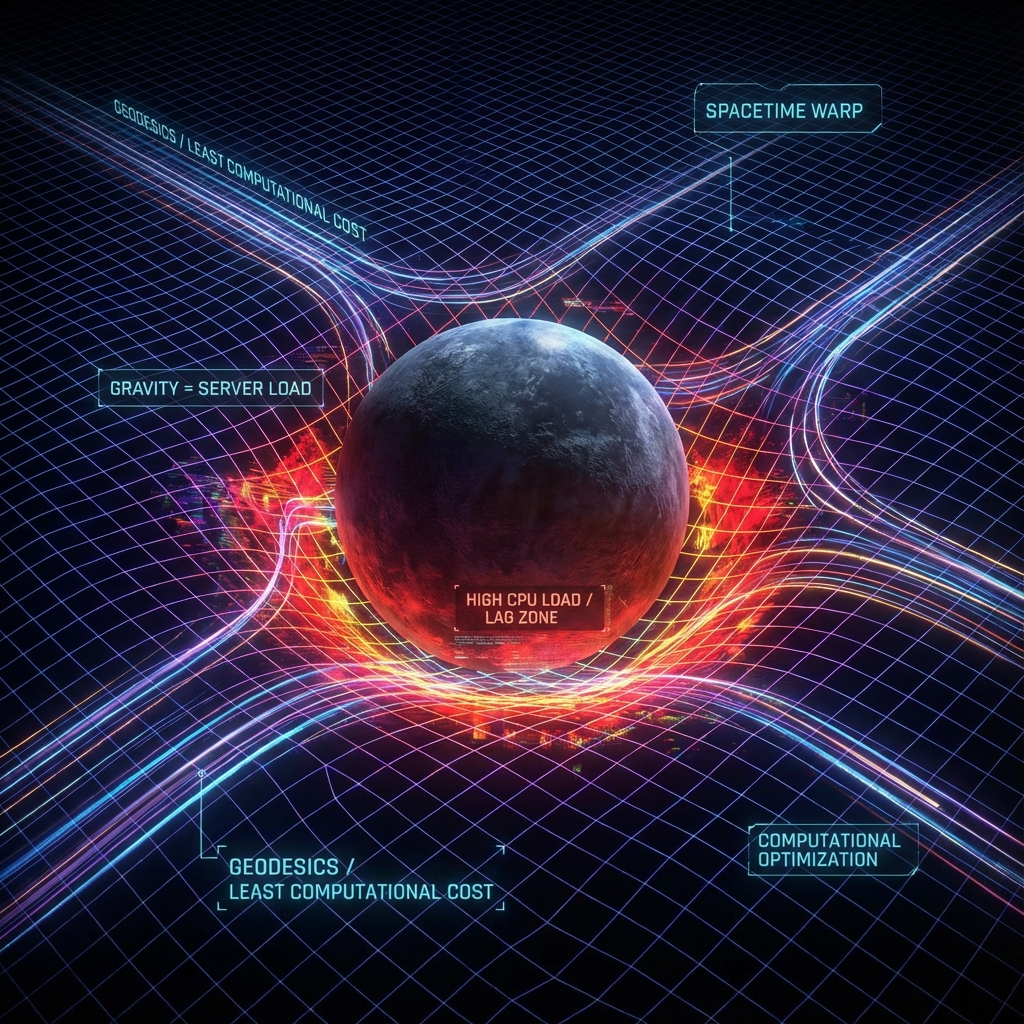
“Matter tells spacetime how to curve? No, data load tells the server how to allocate computing power. When you enter a capital city, the screen lags, character models load slowly—that’s not spacetime curvature; that’s the server’s computational load being too high in that area. Gravity is the ‘damping’ produced when computational systems process complex information.”
In previous chapters, we established: light speed is bandwidth, space is projection. Now, we face physics’ biggest BOSS—Gravity.
In Einstein’s general relativity, gravity is explained as spacetime curvature. But he didn’t explain why it curves.
In Code of Azeroth theory, we will demystify gravity. We will demonstrate: Gravity is not a force that pulls objects together, but an entropic force. Simply put, it’s a lag effect produced when the server processes complex data.
5.1.1 Gravity Is Emergent: Like Air Pressure
To understand gravity, think about air pressure. If you look at individual molecules, there’s no concept of “pressure.” Only when you count countless molecular collisions do you get pressure.
Similarly, gravity is the statistical manifestation of spacetime’s microscopic bits (quantum pixels).
Definition 5.1.1 (Entropic Force)
Matter tends to move toward places of low gravitational potential (high curvature) because this movement maximizes the system’s disorder (entropy). Or, this is the computational system finding the minimum computational cost path.
5.1.2 Complexity Equals Volume: Graphics Card Killer
Frontier research on holographic principles (CV conjecture) tells us: Spatial volume equals computational complexity.
- A region looking “large” means the system needs to execute many lines of code to render this region.
- The volume inside a black hole grows with time, meaning the black hole’s data structure becomes increasingly chaotic; decompressing it requires increasing computing power over time.
Therefore, curved spacetime is actually a “server load heatmap”.
5.1.3 Clock Slowing Due to Excessive Load
Now we can answer: Why do massive objects (stars/black holes) warp spacetime?
- Mass as complexity: A massive object is essentially a highly entangled, data-heavy high-complexity texture. For the server, this is a “graphics card killer.”
- Computational black hole: To render this complex object, the server must allocate massive CPU cycles to this region.
- Processing delay (gravitational redshift): According to computational conservation law, if the server is busy calculating this object’s internal structure, its speed of processing external messages (like photons passing by) slows down.
Conclusion: From the player’s perspective, “time” in that region slows down. When light passes there, due to the processing node’s network congestion, the path deflects (gravitational lensing).
5.1.4 Gravity Is Route Redirection
Objects “fall” toward massive objects because on that path, information transmission delay is minimized.
Imagine you’re playing an online game.
- Flat spacetime = empty wilderness, walking is straight.
- Curved spacetime = crowded capital city.
When you approach the capital, due to data packet congestion, the system automatically adjusts your route, directing you toward that load center (though this sounds counterintuitive, in four-dimensional spacetime’s geodesic equations, this is the shortest path).
Gravity is actually route redirection caused by network congestion.
5.1.5 Geometric Deformation in Tensor Networks
We can demonstrate gravity using tensor networks.
Imagine a flat fishing net (flat space). Now we want to place a super complex object on this net. To encode this object’s data, we need to insert more nodes into the original grid.
According to the CV conjecture, inserting more nodes equals increasing that region’s “volume.” But with fixed boundaries, increasing internal volume forces the grid to bulge (curve).
Conclusion:
Einstein’s field equations are actually the holographic computer’s resource scheduling equations:
- Left side (curvature): Represents distribution of computational nodes.
- Right side (energy): Represents data load to be processed.
The equation shows: To process high-density data load (), the system must reconstruct network topology (), increasing node density, thus causing macroscopic spacetime curvature.
Gravity is the ‘noise’ emitted when the universe computer runs at full load.