4.2 Resource Compression (Holographic Compression)
(Resource Compression - Holographic Compression)
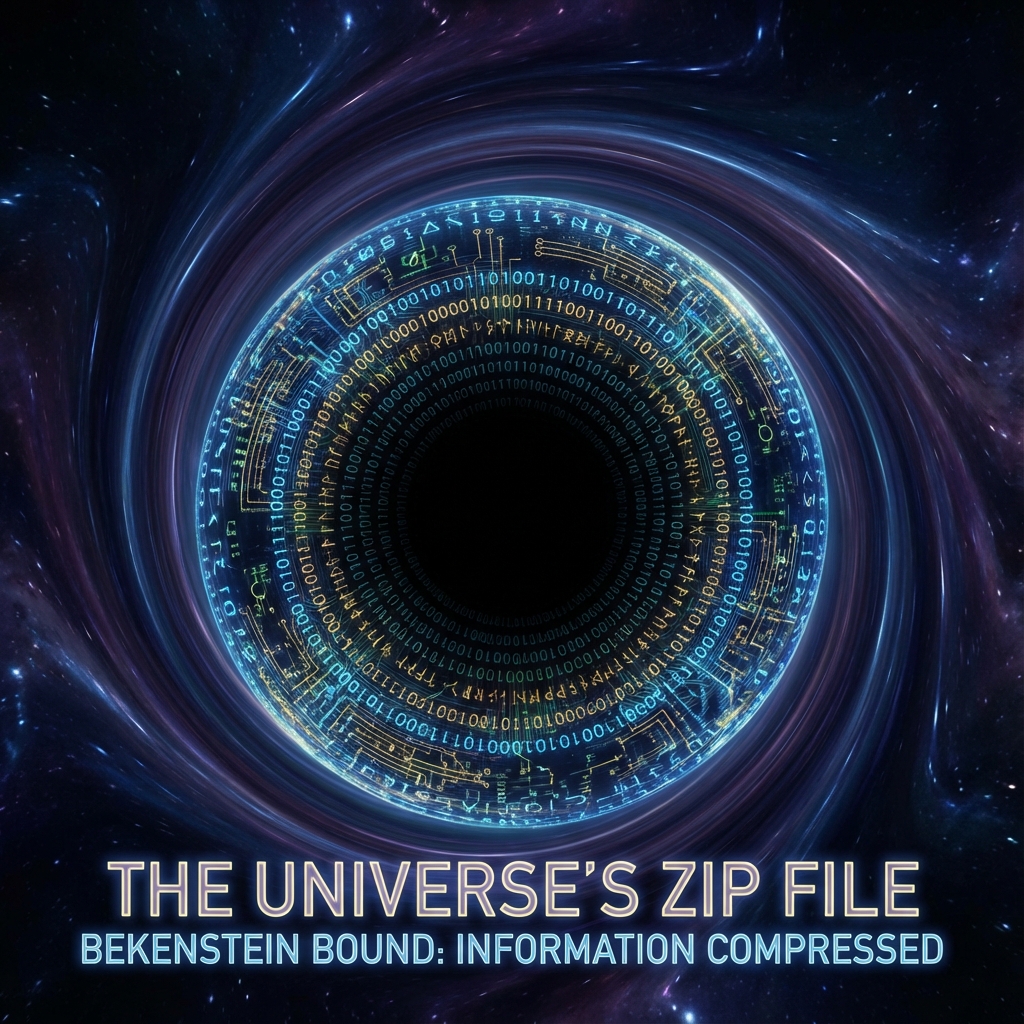
“Without compression, a 1:1 real-scale Azeroth would burst the Titans’ host. Nature is an ultimate minimalist programmer; it discovered that most places in three-dimensional space are empty. The real universe is a two-dimensional ‘membrane,’ and the deep space we perceive is just the decompression and projection of holographic data on this membrane.”
The previous section discussed that space is projection. This section discusses why this is done. The answer is simple: Save bandwidth.
This section will re-explain the holographic principle from a data compression perspective. The universe adopts strategies similar to texture mapping and sparse octrees in modern game development.
4.2.1 The Illusion of Volume: Don’t Be Fooled by Air Blocks
Intuition tells us that space is made of countless small blocks (voxels) stacked together. If you want to actually store a solid block, you need units of storage space. This is the volume law. This is the dumbest storage method.
However, the holographic principle tells us that nature uses the most efficient storage method. For any region, its maximum information only depends on surface area: For that block, nature only stores units (surface area), not .
This means that when we go deep into microscopic scales, the so-called “volume space” doesn’t provide additional information storage bits. Internal data is redundant.
Computational corollary: Three-dimensional space interior is not “solid.” It’s more like a hollow balloon; all physical information (particle positions, momenta) is actually written on the balloon’s surface (texture). Any point inside is not an independent storage unit, but a projection generated by boundary data through algorithms.
4.2.2 Bekenstein Bound: Maximum Compression Ratio
We can regard Bekenstein’s entropy bound formula as the universe server’s maximum compression ratio.
Theorem 4.2.1 (Holographic Channel Capacity)
The maximum storage density of any hard drive or network cable in the universe cannot exceed 1/4 bit per Planck area.
This formula is not just a thermodynamic constraint, but Azeroth’s bus specification. It shows:
- Bits are areal: At the bottom layer, data is laid on surfaces, not stacked in blocks.
- Saturation-caused horizon: If you force more than bits of data into a region, the system will trigger protection mechanisms due to stack overflow—forming a black hole (event horizon). A black hole is that block of data so dense that the rendering engine cannot process it, directly displaying as all black.
4.2.3 Error-Correcting Codes and Bulk Space
Since real information is only two-dimensional (), why do we feel the world is three-dimensional ()? This originates from entanglement redundancy.
In the holographic dual model (AdS/CFT), bulk space is proven to be essentially a quantum error-correcting code.
To protect fragile quantum information from loss, nature diffuses original two-dimensional data through complex entanglement networks into three-dimensional virtual volume.
We live in the “logical space” of error-correcting codes. The physical laws we feel (like gravity) are algorithmic byproducts of the system maintaining stability of these error-correcting codes.
4.2.4 Black Holes: Ultimate Compression Packages
Black holes are the most extreme case of holographic compression mechanisms.
For classical observers, things falling into black holes seem to disappear. But for holographic theory, black holes are optimal compression files (.zip).
- Horizon as hard drive: All information of a black hole is precisely stored on the horizon surface. No bits are lost, and no bits are inside.
- Firewall: Due to excessive data density, the system’s rendering engine cannot parse internal structure (cannot assign independent addresses to internal voxels), so it can only render a black spherical boundary and “flatten” all information on this boundary.
To programmers, a black hole is a high-density data node. Because it’s too dense, decompression requires infinite time.
4.2.5 Universe as Holographic Projector
In summary, we can draw Azeroth’s engineering blueprint:
- Source data: Located at the universe’s edge (or infinity), is a two-dimensional quantum bitmap.
- Projection algorithm: Renormalization flow based on tensor networks. It’s responsible for “decompressing” two-dimensional images into three-dimensional worlds.
- User experience: We players are inside the three-dimensional world. The “solid matter” and “distance” we feel are holograms after source data passes through the projection algorithm.
Conclusion:
Space is not empty; it’s a painting. Space is not solid; it’s a dream. Holographic compression is the Titans’ core optimization strategy to simulate grand worlds under limited hardware resources.
Since the three-dimensional world is a projection of two-dimensional data, any object’s movement speed in this projection must be limited by the projection mechanism’s refresh rate—this again confirms the essence of light speed as system bandwidth.