4.1 The Boundary Code (Area Law of Entanglement Entropy)
(The Boundary Code - Area Law of Entanglement Entropy)
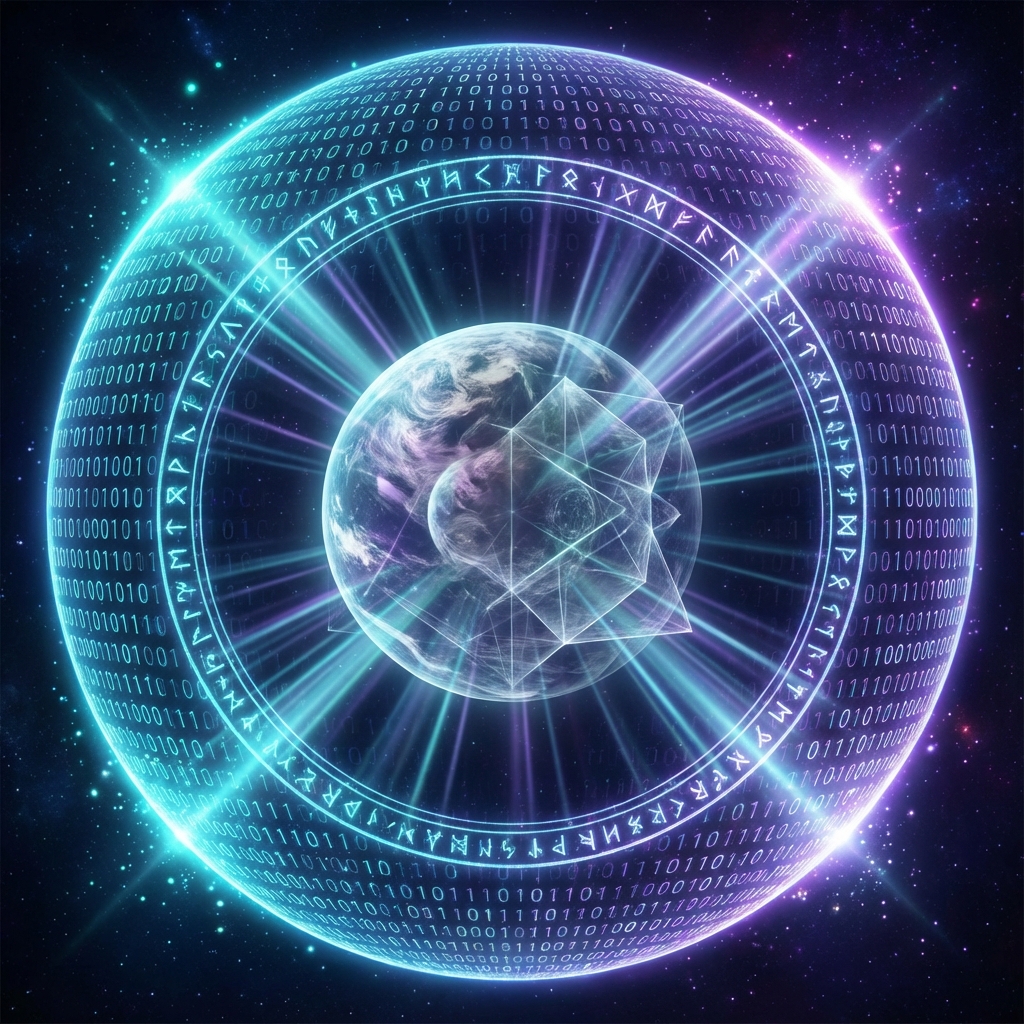
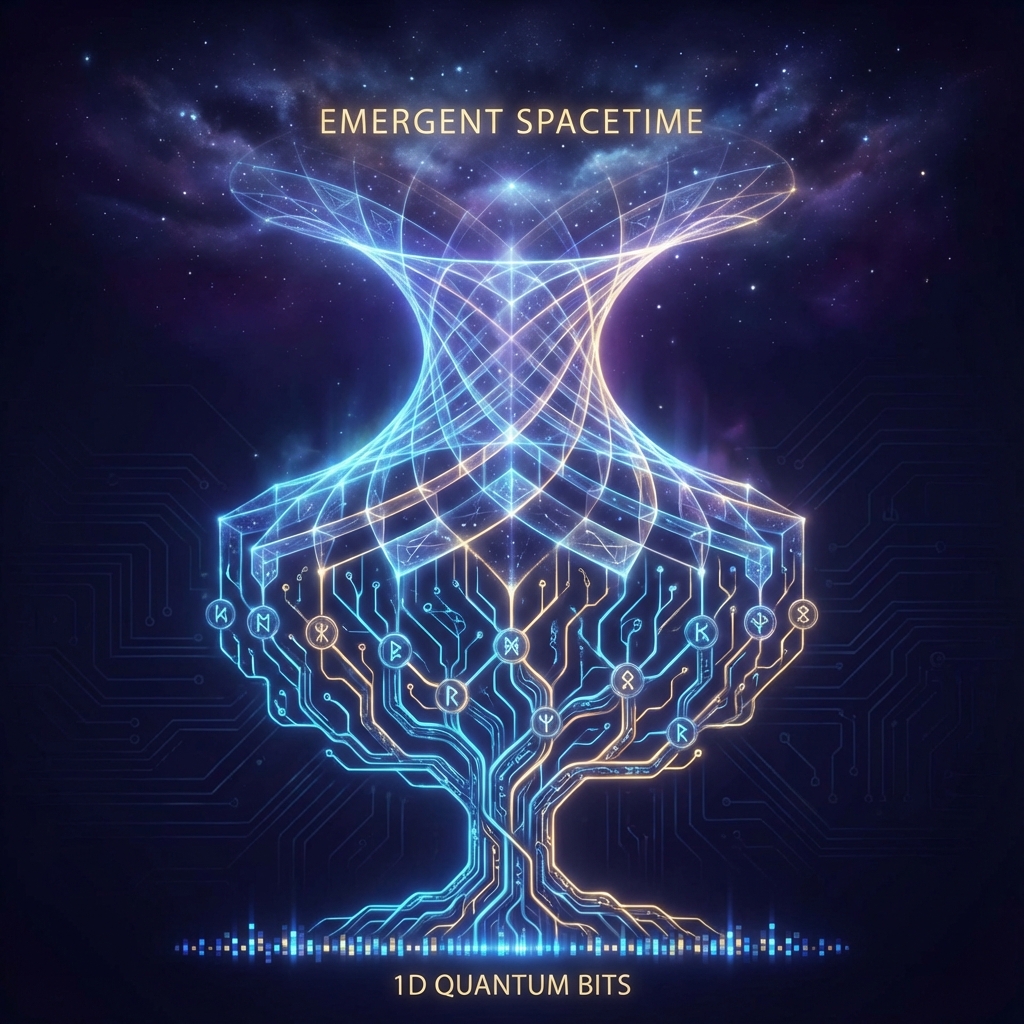
“Space is not an empty box containing things, but a web woven from entanglement relationships. The real ‘data’ only exists on two-dimensional surfaces; the three-dimensional world you see is just a holographic projection generated by this data for your convenience.”
In Chapter 3, we discussed that light speed is bandwidth limitation. Now, we need to solve a more fundamental problem: How did “space” itself, this game scene, come about?
In old physics, space was a pre-built stage. But in Code of Azeroth theory, this wastes too many resources. If you’ve played game development, you know you don’t need to model the entire Earth; you only need to render the texture layer that players can see.
This section will prove: Macroscopic three-dimensional space is essentially a holographic projection of the underlying quantum bit network. Through the seemingly counterintuitive law of area law of entanglement entropy, we will reveal the universe’s greatest secret: Volume is illusion; area is real.
4.1.1 Distance Originates from Entanglement: Who Are Friends?
In geometry, if two points have close coordinates, we say they’re close. But in the code world, distance is derived.
Definition 4.1.1 (Information Distance)
The “distance” between two objects is determined by their mutual information.
- If two quantum bits are in maximally entangled state, they are “adjacent.” Even if they look separated by a continent on screen, they’re next to each other in memory addresses.
- This view is called the ER = EPR conjecture: Quantum entanglement = wormhole connection.
Space is not an empty container, but a huge social network graph. Only after adding friends (entanglement) do you have a “path” between you.
4.1.2 Area Law: Your Hard Drive Is Full of Textures
To quantify this relationship, we need to examine the system’s entropy (information content).
In thermodynamics, information content is usually thought to be proportional to volume (). This is intuitive: a box full of books, more books (larger volume), more words.
However, at the bottom layer of the quantum world, we discovered an astonishing Bug—Area Law:
Theorem 4.1.1 (Area Law of Entanglement Entropy)
For a closed region, the maximum information it can contain does not depend on its volume, but on its surface area.
What does this mean?
Imagine a huge solid iron ball.
- If it’s a real solid object, describing the state of every atom inside should require huge data (volume law).
- But physical laws tell us that as long as we describe all data on its surface, everything inside is determined (area law).
Conclusion: The interior of this iron ball is actually empty, or redundant. All truly effective data is pasted on the surface. Three-dimensional space is not solid; it’s a holographic projection.
4.1.3 Tensor Networks and Spatial Rendering
In nature’s code, it uses Tensor Networks to achieve this compression.
This is like MERA networks:
- Bottom-layer data: Only exists on boundaries (one-dimensional chains or two-dimensional membranes).
- High-layer structure: Through entanglement renormalization, extends inward, naturally constructing an additional dimension (spatial depth).
Computational corollary:
The “curved spacetime” or “gravitational field” we feel is actually a manifestation of data compression algorithms in the bottom-layer code.
- Data near boundaries represents high-resolution details.
- Data deep inside represents low-resolution outlines.
The “depth” of space is essentially the logical depth of computational processing.
4.1.4 Ryu-Takayanagi Formula (RT Formula)
In 2006, Ryu and Takayanagi proposed a formula, which is equivalent to finding the Titans’ rendering equation.
Formula 4.1.1 (RT Formula)
This formula tells us:
- Geometry as entanglement: Spatial area directly corresponds to the number of entangled bits. If entanglement breaks, space breaks (wormhole disconnects).
- True face of gravitational constant G: is not some mysterious constant; it’s the bit-geometry conversion coefficient. It defines how many bits of data can render 1 square meter of area.
4.1.5 Summary: From Bits to Geometry
Based on the area law of entanglement entropy, we can draw the final conclusion of Code of Azeroth about space:
The universe is not a pre-existing three-dimensional box. The universe is a quantum bit ocean defined on two-dimensional boundaries.
To help us players understand, the system uses holographic algorithms to render this two-dimensional data into a three-dimensional image with depth.
The grand Azeroth we inhabit is essentially a low-loss compression format of boundary data. And universal gravitation is the geometric deformation produced when this compression mechanism operates.