9.2 Stitching the Universe
“We once thought interstellar travel was a race about speed, about how to make spaceships faster than light. This is an engineering misunderstanding. True interstellar travel is the art of ‘sewing.’ If you can stitch two distant galaxies together with enough entanglement threads, then distance is no longer an obstacle, but a folded wrinkle. You don’t need to cross the abyss; you just need to pull the two sides of the abyss together.”
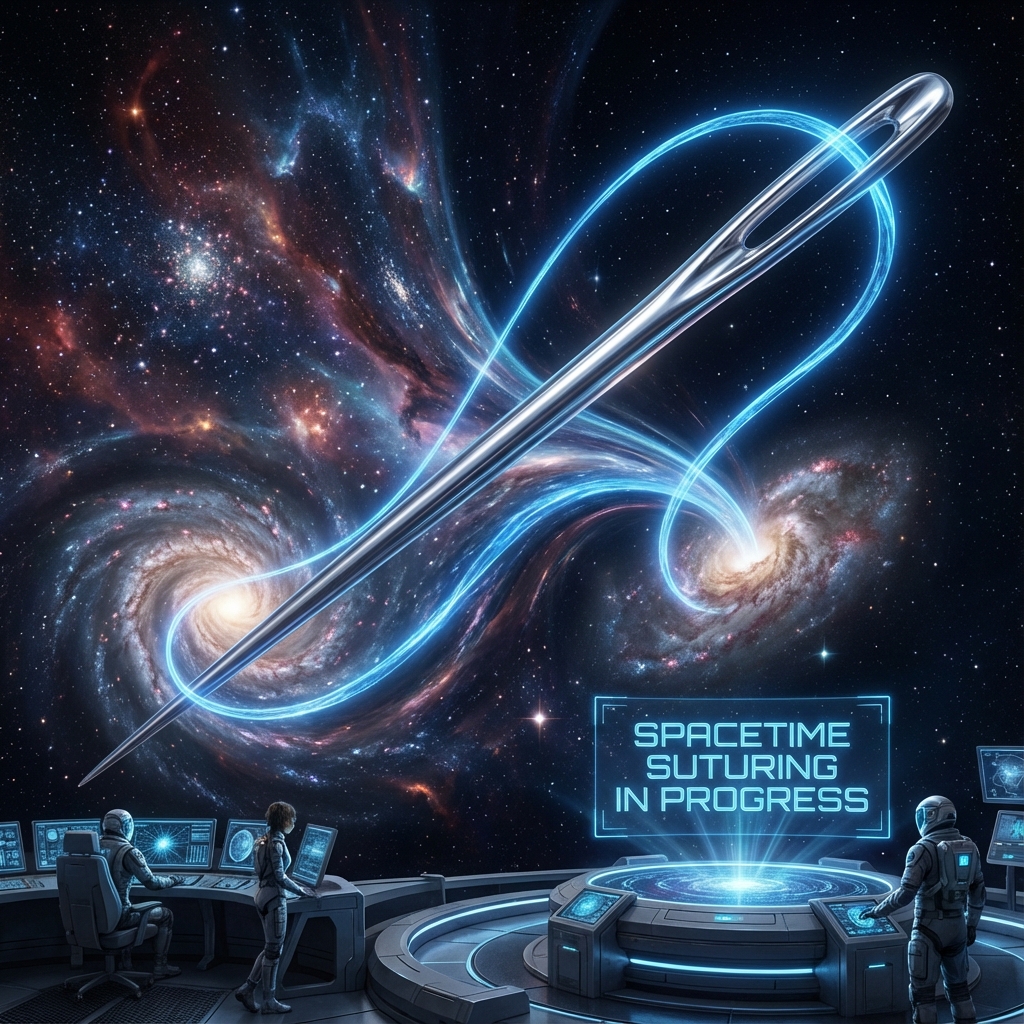
In the previous section, we established the truth at the microscopic level: every Bell pair (entangled particle pair) is essentially a Planck-scale miniature wormhole. This explains the non-locality of quantum entanglement. But for human civilization, microscopic wormholes are too small, not even able to pass a proton.
The engineering problem we need to solve is: How do we “bundle” billions of microscopic wormholes together to construct a macroscopic wormhole that can pass spaceships, even entire fleets?
This is Spacetime Suturing.
In the technical manual of Vector Cosmology, creating wormholes is no longer magic, but a precision engineering project about “entanglement entropy density”.
Entanglement as Suture Threads
First, we need to change our intuition about “space.”
We said in Volume I that space is woven from entanglement. If you want to change the topological structure of space (e.g., connect Earth and Proxima Centauri), you need “extra threads”.
-
Conventional space: Earth and Proxima Centauri are separated by 4.2 light-years of vacuum. The entanglement here is natural, background-level (vacuum fluctuations). They are too weak to pull distances closer.
-
Wormhole engineering: We need to artificially establish massive high-intensity entanglement between Earth and Proxima Centauri.
Step One: Entanglement Harvesting
We need to produce a large number of Bell pairs.
Suppose we create a quantum cloud A composed of particles on Earth, and simultaneously create another quantum cloud B on Proxima Centauri.
Through quantum communication or physical transport (this is the slowest step, called “laying optical cables”), we make every particle in A maximally entangle with the corresponding particle in B.
Now, we have pulled invisible threads between the two star systems.
Black Holes as Stitches: Geometric Compression
Having threads alone is not enough. If these threads are loose, they are just quantum correlations and do not change spacetime geometry.
To transform “quantum correlations” into “geometric channels,” we need to tighten these threads.
Step Two: Gravitational Collapse
We need to compress quantum clouds A and B separately until they collapse into black holes.
According to the ER = EPR conjecture:
-
EPR: A and B are entangled.
-
ER: When they become black holes, what connects them is no longer a diffuse wave function, but an Einstein-Rosen Bridge.
This is like twisting scattered thread ends (particles) into a tough rope (black holes), then pulling hard.
Space is sutured.
-
External perspective (): Earth and Proxima Centauri are still 4.2 light-years apart. Black holes A and B are two independent celestial bodies.
-
Internal perspective (): If you jump into black hole A, you won’t hit a singularity; you will directly slide into the wormhole throat. Because this throat is extremely short (determined by entanglement strength), you may only need to walk a few steps before emerging from black hole B (Proxima Centauri).
This is “the folding of distance”.
We are not flying faster than light; we are just using enormous entanglement tension to “pull” distant space before us.
Negative Energy Support: Propping Open the Throat
Theoretically, the wormhole is built, but it is extremely unstable. According to general relativity, the wormhole throat will rapidly collapse (pinch off) under gravity, so fast that even light cannot pass through.
To allow spaceships to pass, we need a “pillar”.
This pillar must have negative energy density (or violate the average null energy condition).
In FS geometry, this corresponds to reverse flow of .
Step Three: Casimir Injection
We use the Casimir effect in quantum field theory to create negative pressure inside the wormhole throat. Or, using the “negative entropy enclave” technology mentioned in Book II, inject high-purity structure into the throat wall to resist spacetime’s tendency to close.
This is like using a clothes hanger to prop open a flattened sleeve.
As long as negative energy is still being supplied, the wormhole is Traversable.
Conclusion: Interstellar Weavers
At this point, the blueprint for the interstellar transportation network of Type III civilizations is clear.
They do not build highways. They build Stargates.
Every stargate is a port of an entangled black hole pair.
-
They do not need spaceships to travel alone in vacuum for millennia.
-
They only need a “weaving fleet” to fly to the destination first, bringing half the entangled particles, then activate the node there.
Once the connection is established, the two worlds are geometrically “coincident”.
Materials, information, personnel can instantly exchange through this shortcut channel.
The universe is no longer a vast wilderness, but a neatly folded piece of clothing.
Wherever you want to go, you just need to “stitch” that corner of the garment over.
Since we can suture space and create connections, can we go further? Can we not only transport matter, but directly transport “structure”?
If the body is too heavy to pass through wormholes, can we only transport “soul” (holographic information)?
This leads to the theme of the next chapter: Topological Shortcut. We will explore the macroscopic version of quantum teleportation, the ultimate technology that “copy-pastes” reality directly between two points without black holes or spaceships.