9.1 The Geometric Channel
“In 1935, Einstein wrote two papers. One about wormholes (ER), one about entanglement (EPR). He thought these were two completely different discoveries—one about geometric channels of gravity, one about quantum ghost sensing. But he was wrong. Eighty years later, we finally understand: they are the same thing. Wormholes are entanglement; entanglement is wormholes.”
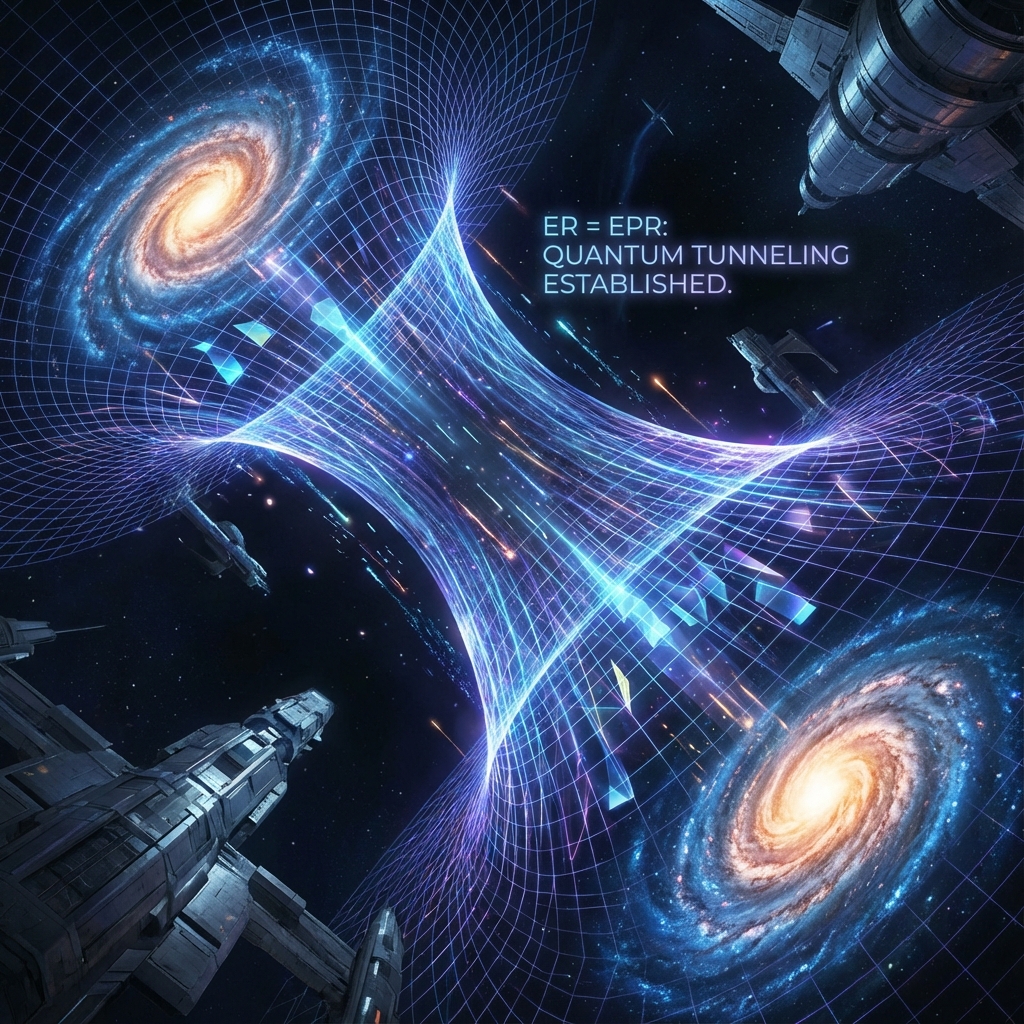
The Greatest Coincidence in Physics History
In the history of physics, there is no equation more shocking than ER = EPR.
-
ER (Einstein-Rosen Bridge): A solution of general relativity. It describes a geometric tunnel (wormhole) connecting two distant regions in spacetime.
-
EPR (Einstein-Podolsky-Rosen Pair): A phenomenon of quantum mechanics. It describes the mysterious entanglement correlation between two microscopic particles.
For a long time, physicists thought these were completely unrelated macroscopic and microscopic phenomena.
But under the unification of FS geometry and MERA tensor networks, Maldacena and Susskind proposed a subversive conjecture: They are mathematically isomorphic.
-
If you entangle two black holes together, a wormhole automatically forms between them.
-
If you entangle two electrons together, a Planck-scale miniature wormhole forms between them.
Microscopic Wormholes: The Stitches of Space
This discovery completely changed our understanding of “space.”
We usually think space is smooth. But from the ER=EPR perspective, space is “stitched” together by billions of microscopic wormholes.
-
Bell Pairs: Are not just two correlated random number generators. Geometrically, they are extremely short topological tubes connecting two points.
-
Vacuum: Is filled with these microscopic wormholes. Every Planck volume shakes hands with neighbors through these wormholes.
Why does light take time to pass through vacuum?
Because light must walk along the “external surface” (long path) of these wormholes.
Why is entanglement instantaneous?
Because entanglement is transmitted along the “internal channel” (shortcut) of wormholes. In the internal dimension of FS geometry, the distance between point A and point B is zero.
Space is like chainmail. Every iron ring (particle) is connected to its surroundings through clasps (wormholes). It is the pull of these clasps that maintains the integrity of space.
The Geometric Lie of Distance
This again confirms the viewpoint in the prologue of this book: Distance is an illusion.
When you look at two entangled particles 100 light-years apart:
-
perspective (external): They are 100 light-years apart. You need to run a long time to go from A to B.
-
perspective (internal): They are together. They share the same wave function, located at the same geometric coordinate point. The 100 light-years of space in between is just a holographic projection created by the universe to display “separation.”
ER = EPR is the universe’s “backend channel.”
On the surface, the universe has strict distance limits and light-speed barriers.
But in the backend, all entangled particles are tightly connected through private geometric tunnels.
Conclusion: No Spaceship Needed
The conclusion of this chapter is an engineering blessing for Type III civilizations.
If ER = EPR is true, then the logic of interstellar travel is rewritten.
We do not need to build spaceships faster than light (that is a clumsy method fighting ).
We need to create sufficiently strong entanglement (using the shortcut of ).
If we can macroscopically entangle enough matter (such as a spaceship) with a clump of matter at the destination, we have built a bridge between them.
As long as we can prop open this bridge (preventing wormhole collapse), we can directly “walk” across.
Since microscopic particles have miniature wormholes between them, how do we converge these tiny channels into a macroscopic wormhole that can pass a spaceship?
Does this require enormous energy, or delicate topological surgery?
This leads to the theme of the next section: Suturing the Universe. We will see that creating wormholes is essentially a “spacetime suturing surgery”.