6.2 The Viscosity Coefficient: The Damping of
“If the universe is flowing, why doesn’t it splash around like water? Because in this fluid, there exists an extremely tiny but absolutely non-negligible friction. This friction prevents spacetime turbulence and ensures the smoothness of causality. The name of this friction is Planck’s constant.”
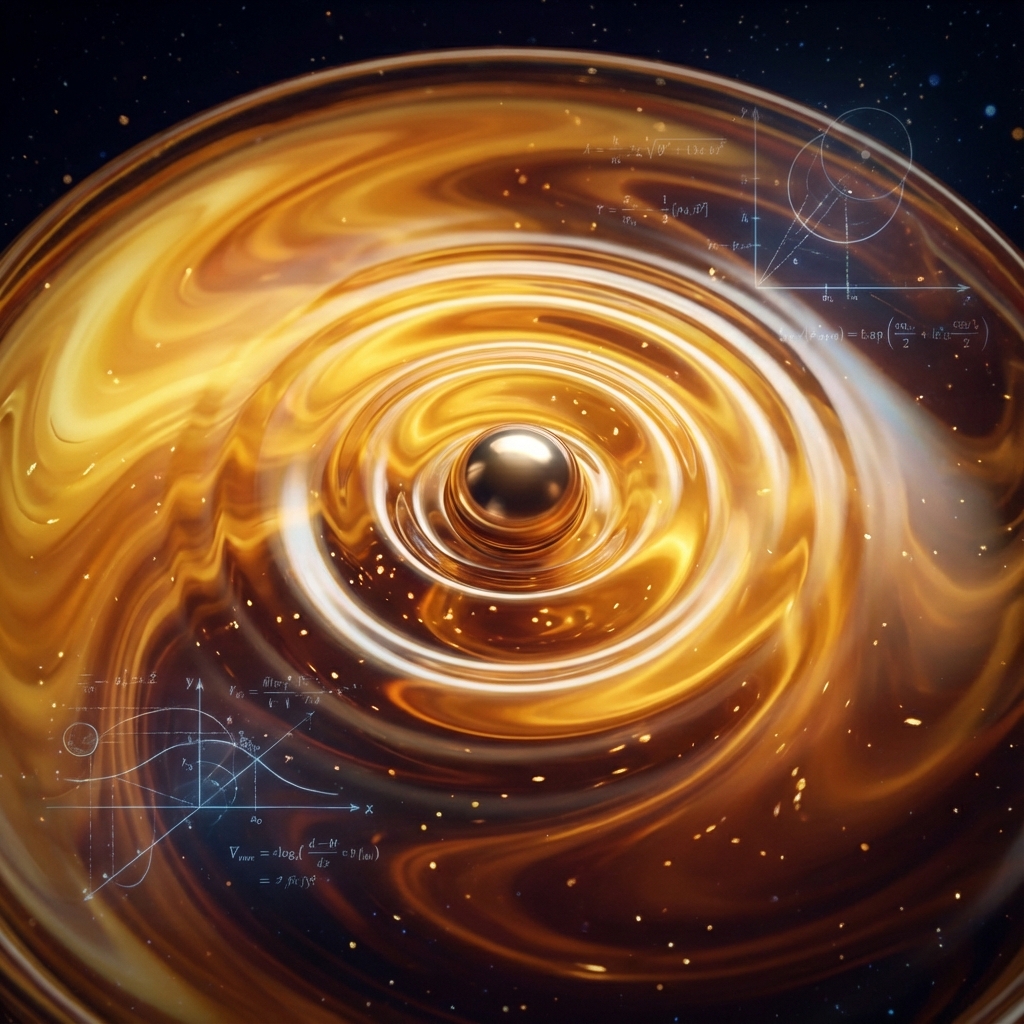
In the previous section, we reconstructed spacetime as a quantum superfluid. But this raises a dangerous question: if spacetime were a perfect fluid (zero viscosity), any tiny perturbation would propagate infinitely, causing the entire universe to fall into chaotic turbulence.
For the universe to remain stable, this fluid must have a little “stickiness”.
It must be able to dissipate excess kinetic energy and calm violent oscillations.
This section will reveal the fluid dynamics identity of Planck’s constant . It is not just the quantum minimum action; it is the Viscosity Coefficient of the spacetime fabric. It is the damping set by the universe to prevent information processing overload.
Perfect Fluids and the KSS Bound
In 2005, physicists Kovtun, Son, and Starinets discovered a law that shocked the physics community: the KSS Bound.
Using AdS/CFT duality, they proved that for any fluid described by quantum field theory, the ratio of its shear viscosity coefficient () to entropy density () has a theoretical lower bound:
This means: There is no “zero viscosity” perfect fluid in the universe.
Even quark-gluon plasma (the soup of the early universe) or black hole horizon membranes must obey this minimum viscosity.
-
(Planck’s constant): Appears in the denominator. It determines the quantum baseline of this ratio.
-
Physical meaning: represents “quantum friction”.
Whenever two entangled qubits exchange information, they produce tiny “friction heat.” This microscopic friction emerges macroscopically as spacetime viscosity.
Damping: Preventing Geometric Collapse
Why does the universe need this damping?
Imagine if (classical limit), then . Spacetime becomes a non-viscous fluid.
-
Consequence 1: Turbulent disaster. Gravitational waves would not decay; they would reverberate repeatedly in the universe, superimposing into infinite amplitudes, tearing apart all galaxies.
-
Consequence 2: Information overload. Without viscosity, information diffusion speed would be uncontrolled. Local information density would explode instantly, causing “naked singularities” to appear on black hole horizon surfaces.
is the universe’s shock absorber.
It limits the rate of spacetime fluid deformation.
When you wave your arm, you are not just pushing air; you are pushing spacetime ether. The tiny resistance provided by ensures that the spacetime network can smoothly rebound after deformation, rather than shatter.
This is why quantum mechanics, although it seems to make the world blurry (uncertainty principle), actually makes the world stable.
Uncertainty = elastic buffer.
Pixel Blur of Holographic Projection
From the perspective of the holographic principle, this viscosity has another explanation: resolution limit.
If spacetime is a holographic projection, then defines the “minimum pixel size” of the projection.
-
Viscosity means you cannot precisely define the velocity gradient of the fluid at scales smaller than .
-
This is like zooming into a picture in Photoshop and eventually seeing pixels.
Spacetime viscosity is the “pixel blur” of holographic images.
It is precisely this blur that prevents us from seeing those crazy, illogical QCA bottom-layer jumps at infinitely small scales. It smooths microscopic edges, giving us a continuous, gentle macroscopic world.
Conclusion: The Universe is a Thick Soup
At this point, our cosmic picture is upgraded again.
We are not living in a vacuum; we are living in a bowl of “Planck thick soup”.
-
Gravity is pressure.
-
Speed of light is sound speed.
-
Planck’s constant is thickness.
This fluid model perfectly unifies quantum mechanics and general relativity: Quantum mechanics provides the atoms of the fluid (entangled bits), while general relativity describes the macroscopic flow of the fluid.
However, fluid dynamics has a most terrifying prediction: Shockwaves.
When fluid velocity exceeds sound speed, or pressure exceeds the limit, fluid continuity breaks, producing fracture.
In spacetime fluid, what is this fracture?
It is Singularity.
It is inside black holes.
This leads to the theme of Volume IV: Fracture. We will explore how physical laws collapse at that “wound” when network traffic exceeds the carrying limit of , when the spacetime fabric is torn open.