6.1 Navier-Stokes Equation
“Physicists spent half a century searching for a quantization scheme for gravity, only to be surprised to discover that general relativity might not be a fundamental microscopic theory at all, but a macroscopic effective theory like fluid dynamics. You cannot ‘quantize’ water waves, because water waves are statistical averages of water molecules. Similarly, you cannot ‘quantize’ gravity, because gravity is the statistical flow of spacetime atoms.”
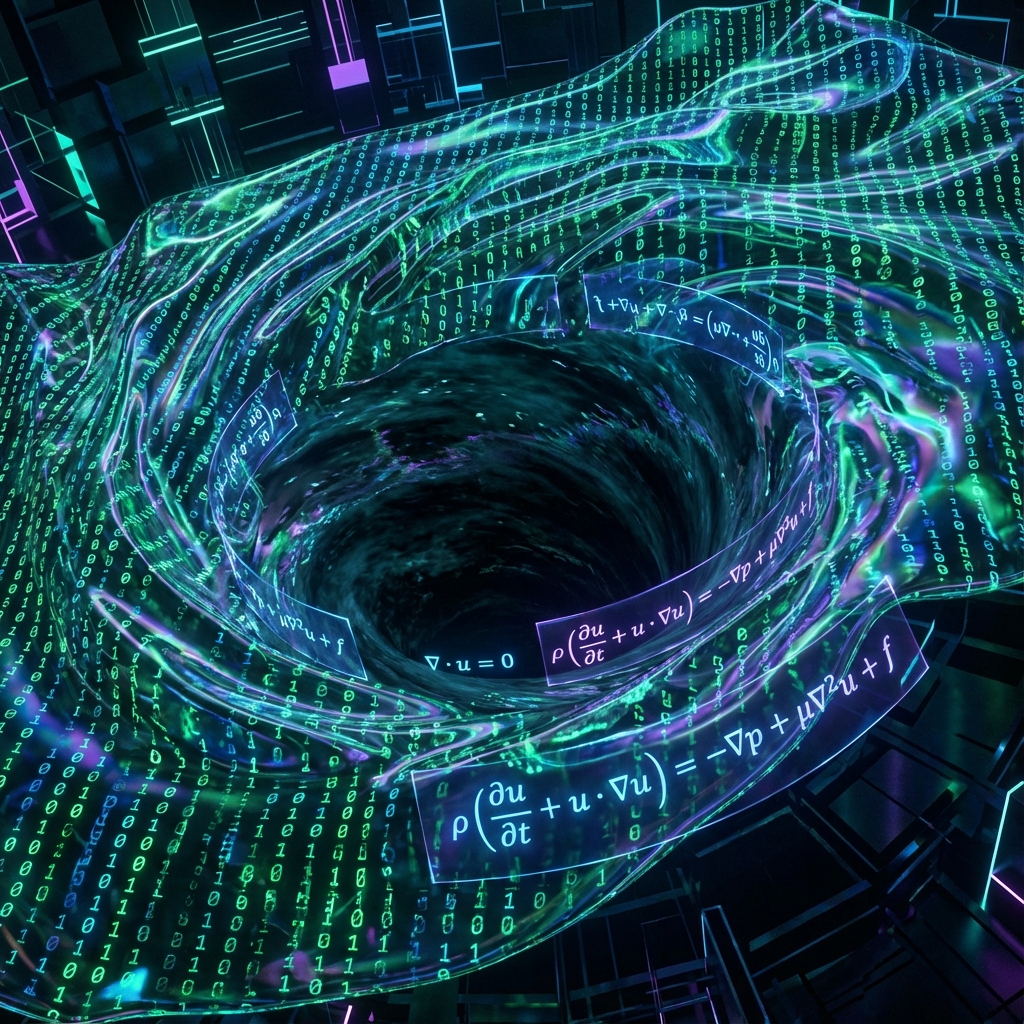
Damour’s Discovery: Horizon is a Fluid Membrane
In the 1970s, French physicist Thibault Damour discovered an astonishing fact:
If we project Einstein’s field equations onto a black hole’s horizon (Null Surface), the resulting equation is completely consistent with the Navier-Stokes Equation (the core equation describing viscous fluids).
This means: Black hole horizons behave like a heated, viscous soap bubble film.
-
Black hole expansion: Like fluid expanding when heated.
-
Gravitational wave oscillations: Like ripples on a fluid surface.
-
Angular momentum: Like fluid vortices.
This is not a metaphor. In the Fluid/Gravity Duality of the holographic principle, perturbations of the spacetime metric are strictly equivalent to transport processes of boundary fluids.
Brownian Motion of Spacetime Atoms
From the microscopic perspective of FS geometry, this is easy to understand.
Spacetime is composed of discrete QCA lattices (spacetime atoms).
-
Vacuum: Is the crystalline state of these atoms (ordered, static).
-
Curved spacetime: Is the fluid state of these atoms (pressured, flowing).
When a massive object moves, it is not gliding through a void; it is “pushing aside” surrounding spacetime atoms.
This pushing process produces resistance and also produces wake.
The “gravitational field” we observe macroscopically is actually the “pressure gradient field” formed by spacetime fluid around mass.
Emergent Gravity
This viewpoint demotes general relativity to “fluid dynamics”.
-
Water molecules have quantum mechanical equations (microscopic), water flow has Navier-Stokes equations (macroscopic).
-
Spacetime qubits have QCA rules (microscopic), gravity has Einstein equations (macroscopic).
Just as you cannot find “water molecules” by studying the wave equation of water waves, we cannot find “gravitons” through Einstein equations.
Gravitons do not exist. Or rather, they are just quasiparticles like phonons.
Gravity is a Collective Excitation of the spacetime medium.
Conclusion: The Universe is a Superfluid
At this point, our cosmic picture becomes more “wet”.
We are not living in geometric vacuum; we are living in a quantum entanglement superfluid.
-
Light is sound waves in this fluid (propagating at the limit speed ).
-
Matter is vortices in this fluid (topologically locked circulation).
-
Gravity is pressure in this fluid.
Since spacetime is a fluid, what is the most important property of a fluid?
It is Viscosity.
If spacetime had no viscosity, energy would dissipate infinitely; if viscosity were too large, motion would stop.
What is the viscosity of the universe?
This leads to the theme of the next section: Viscosity Coefficient. We will see that Planck’s constant actually defines the “thickness” of this cosmic soup. It is the damping set by the universe to prevent information processing overload.