4.2 The Hardness of Vacuum
“We are accustomed to viewing vacuum as ‘nothing,’ as an absolute weakness that cannot even block a breeze. This is the greatest lie of macroscopic senses. From the bottom-layer perspective of quantum error correction, vacuum is the hardest substance in the universe. It is not empty; it is filled to the brim with entanglement. It is a ‘quantum ether’ full of high tension. Any attempt to tear it will encounter the most violent rebound from physical laws.”
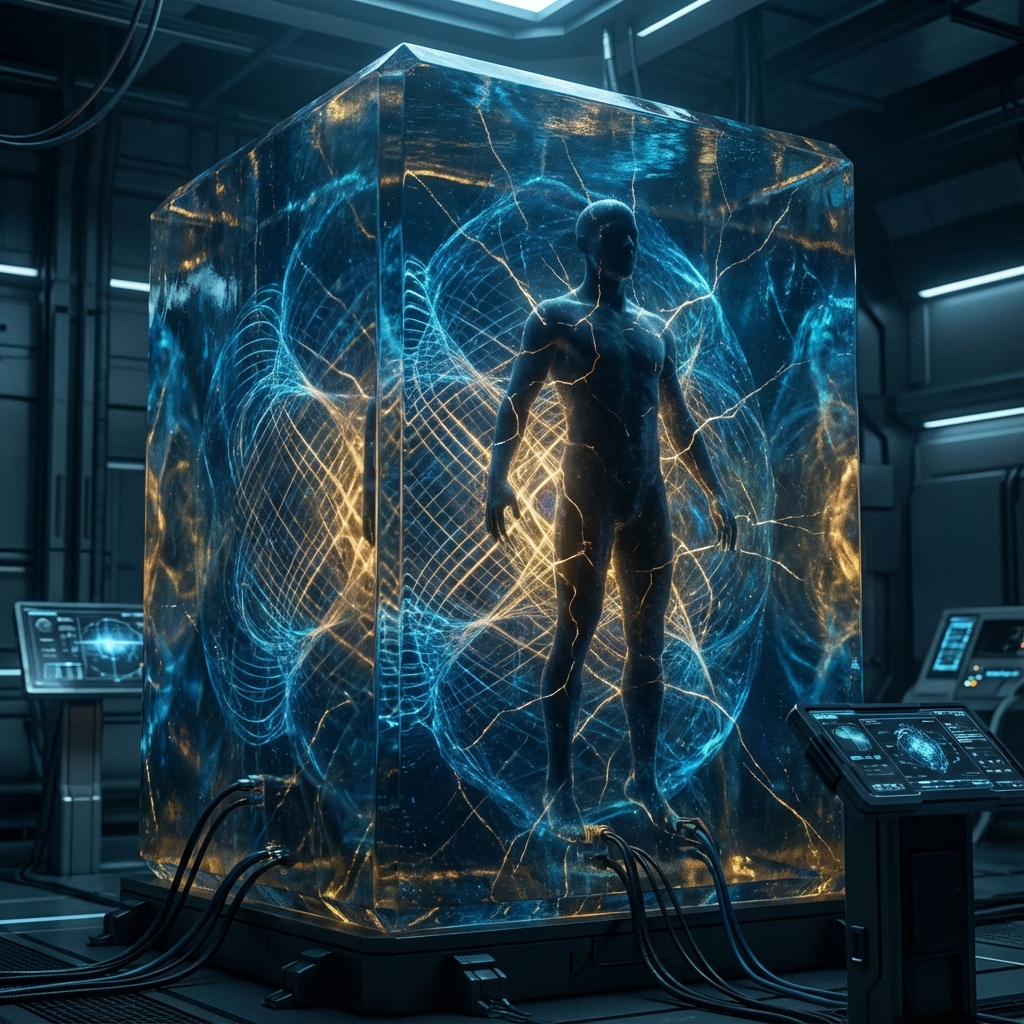
In the previous section, we defined physical laws as the “checking algorithms” of the cosmic operating system. Since there is checking, there must be a “baseline.” This baseline is what we call Vacuum.
In classical intuition, vacuum is the background of the stage, zero, nothingness.
But in the QEC (Quantum Error Correction) model of Vector Cosmology, vacuum has a completely different definition: Vacuum is the “Logical Zero State” of the error-correcting code.
It is not “no data”; it is “filled with redundant checking data, and all check bits are +1, a perfect state”.
Because it is perfect, it is hard.
The Filled Void: Ocean of Entanglement
Imagine a huge pool. If the water surface is as calm as a mirror, it looks like “nothing.”
But if you want to press a ball into the water, you will feel enormous resistance (buoyancy).
Vacuum is this pool.
-
On the QCA lattice: The vacuum state is not all pixels extinguished. Instead, it is a state where all pixels are in a specific Short-Range Entanglement (SRE) pattern.
-
Filler: Every Planck volume is tightly locked with its neighbors. This locking produces enormous “entanglement tension”.
Physicist John Wheeler once calculated the density of “vacuum zero-point energy,” and the result was astronomical ().
Although we cannot measure this energy macroscopically (because it is the baseline), it constitutes the “Stiffness” of spacetime.
Spacetime is a superfluid.
It is extremely dense and extremely hard. Matter (particles) are just tiny “Phonons” or “Vortices” in this dense fluid.
We feel air is thin because we ourselves are waves in this fluid. Waves naturally feel the medium is transparent. But if you want to tear the medium itself apart, you will encounter Planck-level resistance.
Quantum Recovery Force: The Rebound of Error Correction
This “hardness” manifests in information theory as Quantum Recovery Force.
In QEC theory, if environmental noise attempts to distort the vacuum (e.g., trying to create a fluctuation that violates energy conservation), the decoder of the error-correcting code immediately activates a “Recovery Map”.
-
Attack: A high-energy photon attempts to be created at an illegal position. This is equivalent to inserting a Bug into the code.
-
Defense: The surrounding entanglement network instantly senses this “Syndrome”.
-
Rebound: The network, by readjusting entanglement connections, “squeezes” this Bug out, or dissipates its energy as legal background thermal waves.
This is why you cannot casually tear space to create a wormhole.
Because space has extremely high “information elasticity”.
If you want to forcibly connect two non-adjacent points, you are not just fighting geometric distance; you are fighting the entire universe’s error correction algorithm. The system will desperately “correct” your operation back to the standard geometric structure.
Planck Pressure and Gravitational Constant
This hardness of vacuum has a specific physical parameter: the inverse of the gravitational constant ().
In Einstein’s field equations, the curvature (deformation) of spacetime is proportional to energy (stress), with a proportionality coefficient of .
Since is extremely small, this means is extremely large.
Spacetime is the hardest material to deform in the universe.
You need a mass as large as a star to make spacetime bend slightly.
-
is the Young’s Modulus of spacetime.
-
It represents vacuum’s ability to resist “information rewriting”.
If vacuum were not hard, if were large, then when you sneeze, the surrounding spacetime would wobble like jelly, causality would collapse, and your past and future would be in chaos.
The hardness of vacuum is the shield of causality.
Conclusion: We Are Insects Sealed in Amber
At this point, we have a deeper reverence for “existence.”
We are not living in an empty playground.
We are living in a huge, transparent, extremely hard quantum amber.
This amber (vacuum) uses its astonishing density and tension to fix all physical constants and support all material structures.
The reason we can move freely is that our motion amplitude is too small and energy too low, not touching the Yield Limit of the amber.
But if we attempt interstellar-scale operations (such as creating black holes or wormholes), we will hit this invisible wall.
Since we know that spacetime is a fabric with tension, how does this tension manifest macroscopically?
When we place a heavy object (star) on the spacetime fabric, the fabric will sag, and tension will be transmitted through deformation. This transmission, we call gravity.
This leads to the theme of Volume III: Tension. We will reveal that gravity is not a fundamental force; it is the “thermodynamic resistance” produced when the information network is compressed.