4.1 Physical Laws as Checksums
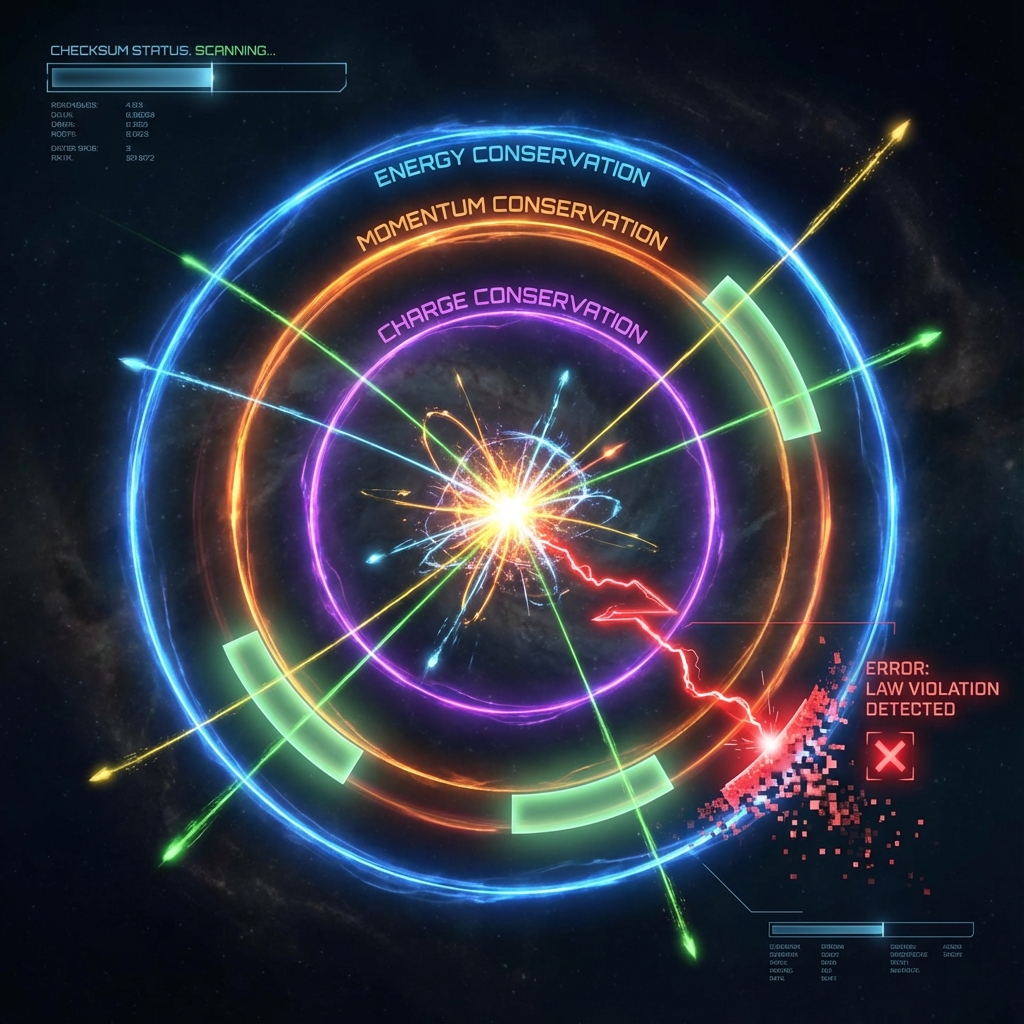
“Why don’t apples suddenly turn into oranges? Why doesn’t energy disappear out of thin air? Physicists say this is because of ‘symmetry.’ But from the perspective of information theory, symmetry is ‘redundancy.’ Physical laws are a rigorous antivirus software that constantly scans every corner of the universe. Once it discovers an ‘illegal state’ that violates conservation laws, it immediately treats it as an error and corrects it.”
Fragile Bits and Solid World
In quantum computing theory, if you want to build a stable logical qubit from unstable physical qubits, you must use Quantum Error Correction (QEC).
The core idea is: Encode information into global entanglement patterns and set a group of “checking rules.”
Our universe does exactly this.
-
Microscopic level: The state of a single particle is extremely unstable. It can be hit by vacuum fluctuations at any time and undergo phase drift.
-
Macroscopic level: The “physical reality” we see is actually the “logical state” after QEC encoding.
This is why macroscopic objects appear so stable. Because they live in a “Protected Code Subspace”.
Conservation Laws as Stabilizer Operators
In the mathematical form of QEC (stabilizer formalism), we define a group of Stabilizer Operators.
For any legal logical state , it must be an eigenstate of all stabilizer operators (eigenvalue +1).
If an error occurs, causing the state to become , then the measurement value of the stabilizer operator becomes -1. The system alarms: “Error here!”
In Vector Cosmology, we find that conservation laws in physics play exactly this role.
-
Energy conservation: This is the checksum of time translation symmetry.
If a process attempts to create energy out of nothing (e.g., ), it violates the checksum of the Hamiltonian .
System response: The probability amplitude of this process is greatly suppressed by destructive interference. The universe “refuses” to run this error code.
-
Charge conservation: This is the checksum of gauge symmetry.
If an electron suddenly disappears without producing an anti-electron, it destroys the charge conservation checksum in the holographic network.
System response: The local gauge field (electromagnetic field) generates an infinite energy barrier, preventing this “illegal operation” from occurring.
Physical laws are not used to describe how objects move; physical laws are used to define “which movements are legal.”
Any process that does not conform to conservation laws is treated as a logical error caused by environmental noise and automatically filtered out by the system’s self-repair mechanism.
Symmetry as Immune System
This perspective gives Noether’s Theorem a new biological metaphor: Symmetry is the immune system of the universe.
Every continuous symmetry (translation, rotation, gauge transformation) corresponds to a conserved quantity (momentum, angular momentum, charge).
And in information geometry, every conserved quantity is a firewall.
-
Universe without symmetry: Like a person without an immune system. Any tiny quantum fluctuation would be amplified by the butterfly effect, causing macroscopic structures to instantly disintegrate.
-
Our universe: Possesses a powerful symmetry group. This is an extremely complex “multi-engine antivirus system”.
It ensures that only those interactions that are “geometrically perfect” can occur.
When two particles collide, they must pass all checks like verifying a password (energy conserved? momentum conserved? charge conserved?).
Only when all pass will the transaction (interaction) execute.
If one fails, the wave function will decohere—that is, transaction failure, rollback operation.
Conclusion: Reality is the Result of Error Correction
So, the “objective reality” in our eyes is actually “survivorship bias”.
Right now, at the Planck scale, countless “error fluctuations” violating physical laws are occurring.
But they are all instantly corrected or eliminated by stabilizer operators.
The solid world we can see and touch is the pure output after the universe performs error correction operations per second (Planck frequency).
We are not living in the wilderness; we are living in a highly controlled clean room.
Since we know that the solidity of spacetime comes from error correction, where is the limit of this error correction mechanism? If the attack (perturbation) is too strong, exceeding the threshold of the error-correcting code, what will happen to spacetime? Is the vacuum really empty?
This leads to the theme of the next section: The Hardness of Vacuum. We will see that vacuum is not empty; it is a filled, highly elastic quantum error correction fluid.