1.2 The Derivation of Area Law
“If you want to know how many threads a piece of fabric is woven from, you don’t need to weigh it. You just need to pick up scissors, cut it horizontally, and count how many thread ends are exposed at the cut. The universe is the same. Our ruler for measuring information is not volume, but area. Because area is the cross-section of those cut entanglement threads.”
In the previous section, we established the qualitative picture of “space as entanglement network.” Now, we need to give this picture a quantitative mathematical proof.
In classical physics and our everyday intuition, information seems to be stored in Volume.
-
How many books a bookshelf can hold depends on its length, width, and height.
-
How much data a hard drive can store depends on the number of magnetic particles inside it.
However, one of the most shocking discoveries in modern physics—the Area Law of black hole entropy—completely shatters this intuition. The information content of a black hole is not proportional to volume, but to surface area.
This section will use the logic of Tensor Networks to derive the famous Ryu-Takayanagi Formula and reveal the geometric truth behind it: we live in a holographic universe because space itself is “stitched” by entanglement threads.
Imagining Scissors: The Definition of Entanglement Entropy
To measure how much information a portion of space contains, physicists invented a special measurement method: Entanglement Entropy.
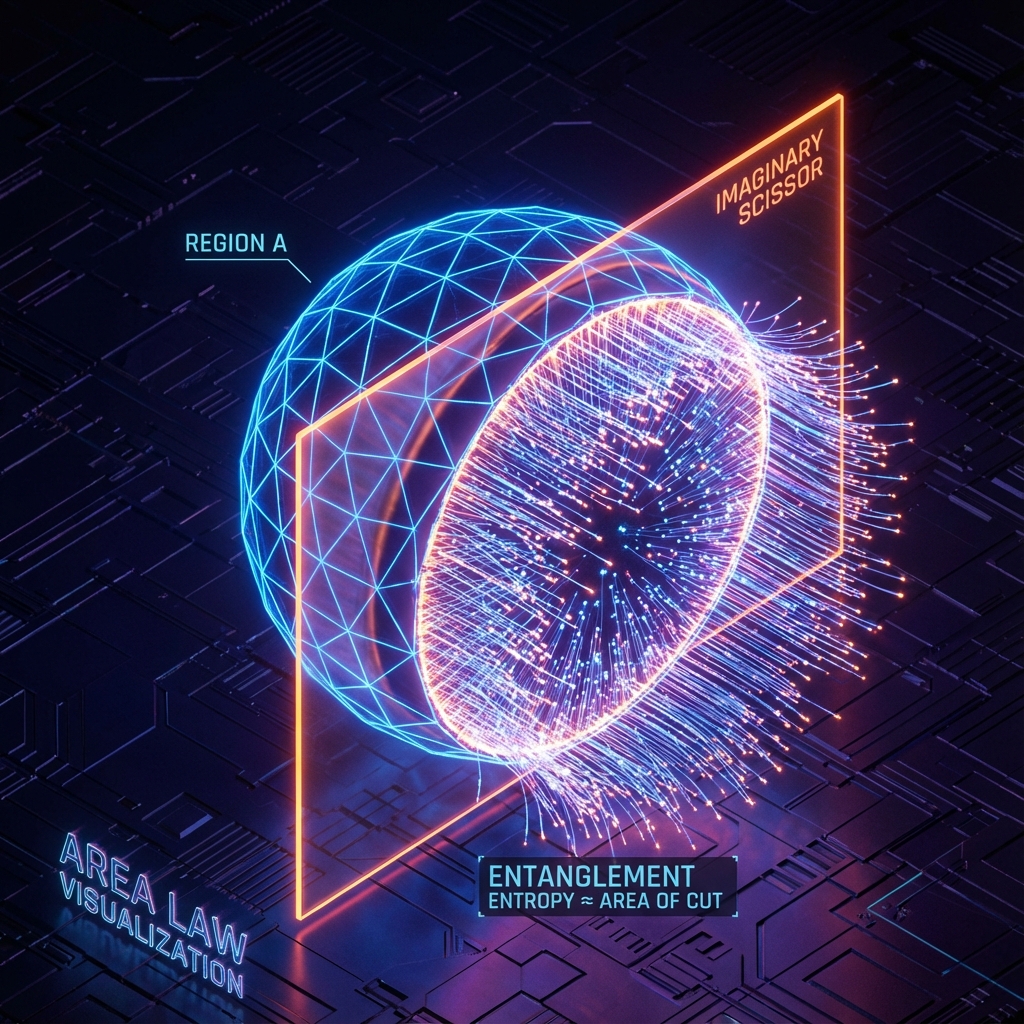
Suppose we divide the universe into two regions: Region A (e.g., the interior of a sphere we want to study) and Region B (the environment outside the sphere).
In quantum mechanics, A and B are not independent; they are connected by countless invisible Bell Pairs.
To calculate the entropy of A, we need to perform a thought experiment:
Pick up an “imaginary pair of scissors” and completely cut A from B along A’s boundary (surface).
-
What is cut? We cut all entanglement threads connecting A and B.
-
What remains? Each cut thread leaves a “thread end” (unpaired qubit) on A’s surface.
-
What is entropy? Entropy is the number of these thread ends.
Ryu-Takayanagi Formula: The Equality of Geometry and Information
This thought experiment directly leads to the most famous formula in AdS/CFT duality—the Ryu-Takayanagi Formula.
Where:
-
: The entanglement entropy (information content) of region A.
-
: The area of the Minimal Surface that wraps around A.
-
: Newton’s gravitational constant (in Planck units, corresponds to 4 times a Planck area).
The physical meaning of this formula is deafening:
It proves that “Information = Geometry”.
-
The left side is quantum information content (entropy).
-
The right side is classical geometric quantity (area).
Why are they equal?
Because Area is essentially “the total number of entanglement thread bundles passing through that cross-section”.
-
The larger the surface area, the more threads need to be cut, meaning A and B are more tightly connected.
-
If the surface area is zero (no connection), entropy is zero, and space breaks apart.
This is like the cross-section of a fiber optic cable. The thicker the cable (larger area), the more signals (entropy) it can transmit. Spatial geometry is the physical shell of entanglement flow.
The Illusion of Volume: We Live on a Hologram
Since information is only related to area, where did “volume” go?
If you fill a black hole with books, how can the information content of the books (proportional to volume) be stored only on the surface (proportional to area)?
The answer is: Volume is an illusion of holographic projection.
In the Tensor Network (MERA) model, the so-called “depth” dimension inside space is actually the direction of Renormalization Flow.
-
Boundary: High-resolution microscopic data.
-
Interior (volume): Low-resolution compression of boundary data.
When we go deep into the interior of space, we are not walking into a real “room”; we are viewing a “coarse-grained version” of the data.
Like the 3D game scene you see on a computer screen. Although you feel there is space inside the house, all the data is actually laid flat in 2D video memory.
Conclusion:
There is no real three-dimensional volume.
There is only a two-dimensional Holographic Screen, and the complex connection relationships between entangled pixels on the screen.
The “spatial depth” we feel is just a kind of “computational depth” produced when we, as observers, decode this hologram.
Conclusion: The Cost of Stitching
At this point, we understand why the gravitational constant exists.
is not an arbitrary number; it is the “toughness of the spacetime fabric”.
represents “the maximum number of entanglement threads that can be accommodated per unit area” (i.e., Planck pixel density).
If we try to tear space (e.g., create a wormhole), the resistance we need to overcome is the tension of these billions of entanglement threads.
This explains why gravity is so difficult to manipulate—because you are fighting against the most fundamental connection protocol of the entire universe.
Since we already know that space is stitched by threads and information is stored on surfaces, how does this entire network “grow” from nothing? Is it a flat grid or a fractal tree?
This leads to the theme of the next chapter: MERA Architecture. We will delve into the topological structure of tensor networks, seeing how the universe uses “multi-scale entanglement” to amplify Planck-scale pixels layer by layer into macroscopic-scale galaxies.