1.1 The Stitching of Bell Pairs
“Two particles can sense each other instantly even across light-years, not because signals travel too fast, but because in the deeper geometric structure, they were never separated. Entanglement is not a spooky action at a distance; entanglement is the ‘glue’ of space. It is countless such glue molecules that bond discrete pixels into a continuous universe.”
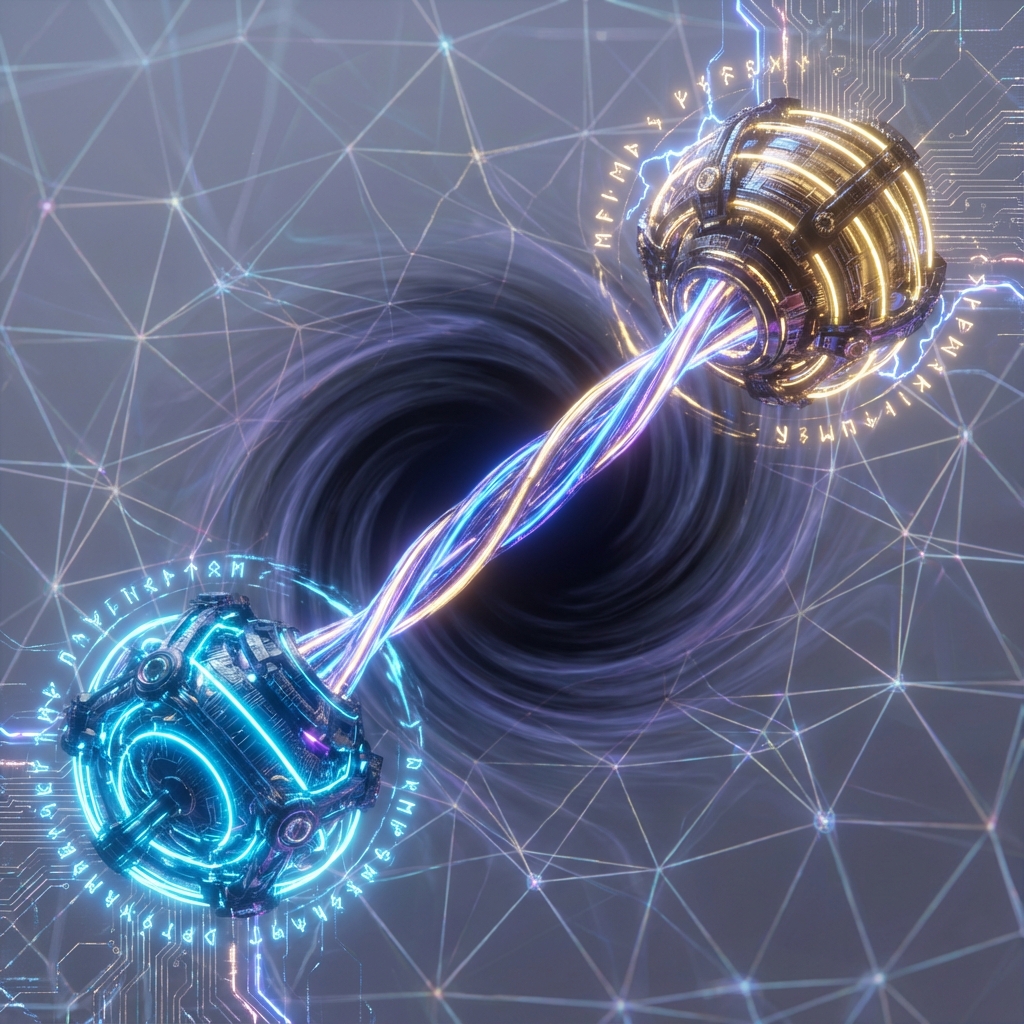
The Smallest Unit of Space
In classical geometry, the connection between points is axiomatically given (e.g., there is a straight line between two points). But at the QCA bottom layer of Vector Cosmology, points (qubits) are independent.
If nothing connects them, the universe is a pile of sand, without even the concept of “adjacency.”
The smallest unit that connects this pile of sand is the maximally entangled state, also known as the Bell Pair:
Look carefully at this formula.
-
It is not (both in state 0).
-
It is not (both in state 1).
-
It is the coherent superposition of both. This means that particle A’s state and particle B’s state are locked together tightly. If you measure A and get 0, B must be 0.
Geometrically, this is a “wormhole.”
Although these two particles may be far apart in physical memory addresses, in logical space (Hilbert space), they share the same wave function. Not only are they connected; they are topologically “Stitched” together.
Stitching the Void: Short-Range Entanglement Weaving the Web
How is our three-dimensional space formed?
It is achieved by filling the vacuum with dense Short-range Entanglement.
Imagine a lattice grid.
-
Each lattice point shares numerous Bell pairs with its left, right, up, and down neighbors.
-
This high-density local entanglement, like stitches, “sews” adjacent pixels together.
Why do you feel space is continuous?
Because these stitches are too dense.
When you walk through a room, your body is not gliding through a vacuum, but constantly performing “Entanglement Swapping” with Bell pairs in the background field.
With each step, you are untying old threads and sewing new ones.
This microscopic stitching mechanism ensures the Connectivity of space. If entanglement suddenly disappears in some region, it won’t become a vacuum; it will become a cliff of spacetime. You will fall or be bounced back when you reach there, because there is no “road” (geometric connection) there.
The Definition of Distance: The Measure of Mutual Information
This gives us a revolutionary geometric definition: Distance originates from correlation.
In FS geometry, the geometric distance between two regions and is inversely proportional to their Mutual Information ():
-
Strong entanglement ( large): large, distance small. This is why atomic nuclei are extremely dense, because the entanglement between quarks is extremely strong.
-
Weak entanglement ( small): small, distance large. This is why galaxies are far apart, because gravity (long-range entanglement) is much sparser than electromagnetic force (short-range entanglement).
There is no absolute “far”.
“Far” only means the threads connecting you are stretched very thin and very long.
If you could artificially increase the entanglement between yourself and a star in Andromeda (inject computational power, create Bell pairs), then geometrically, you would find that star “flying toward you” until it touches your nose.
Conclusion: Space is Emergent Glue
This section completely subverts Newton’s absolute space view.
Space is not a stage; space is glue.
It is a huge adhesive woven from Bell pairs.
-
When we say “the universe expands,” we actually mean this glue is being diluted (entanglement density decreases).
-
When we say “black hole horizon,” we actually mean the glue there is compressed to the limit, forming an unbreakable hard knot.
Since space is stitched by entanglement, if we want to calculate the “area” of a piece of space, how should we calculate it?
We don’t need a ruler. We need a pair of scissors.
Just count how many threads need to be cut to slice through this piece of space, and we know its size.
This leads to the theme of the next section: The Derivation of the Area Law. We will see that the famous black hole entropy formula () is actually a count of the “number of thread ends” on the cross-section of the cosmic fabric.