Chapter 7: The Holographic Pi Code
In the previous chapters, we decomposed the universe into vector projections, discrete lattices, and complex origami. We saw how geometry produces mass and how transactions produce forces. But all of this still leaves an ultimate mystery: How do these complex structures—particles, atoms, matter—stabilize from pure “flow”?
If the universe is just a constantly rotating vector, why do some parts solidify into stable “entities”?
This chapter will reveal the deepest mathematical secret of this book: Matter is topological knotting of phase. And the unit of counting for this knotting is precisely that ancient pi—.
We are about to see that Levinson’s Theorem is not merely a scattering theory formula; it is the underlying protocol by which the universe encodes “existence” as “numbers.”
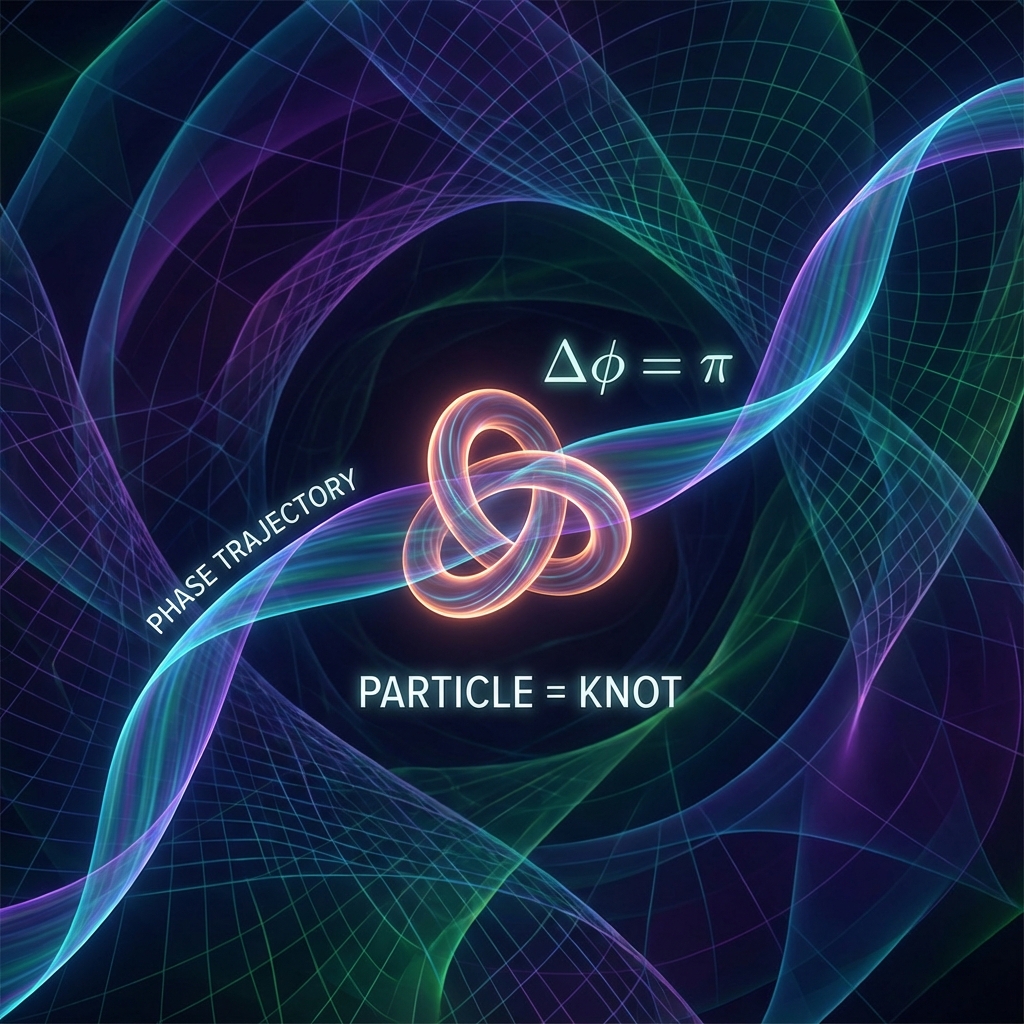
7.1 The Levinson Knot
“Matter is not stationary stone; matter is flowing dead knots. Existence is counting: how many we count in the void, that many particles we create.”
When we talk about “particles,” we often envision tiny marbles. But from the geometric perspective of Vector Cosmology, there are no marbles. There is only that eternally flowing trajectory in projective Hilbert space.
Then, what are so-called “electrons” or “hydrogen atoms”?
They are Knots in the Trajectory.
Geometric Journey in Energy Space
To understand this, we need to introduce the geometric perspective of Scattering Theory. Imagine a wave (say, an electron) trying to pass through a potential well (say, an atomic nucleus). From a macroscopic perspective, this is like a ball rolling over a pit. But from a quantum perspective, this is a geometric journey occurring on the energy axis ().
As energy increases from zero to infinity, the determinant of the scattering matrix traces a curve on the unit circle in the complex plane.
-
This is not a trajectory in space; this is a trajectory in Phase Space.
-
We can track how many times this curve winds around. This is Phase Winding.
Levinson’s Theorem: The Arithmetic of Existence
In classical scattering mechanics, we have a stunning theorem proposed by physicist Norman Levinson. It equates an abstract topological quantity (phase change) with a concrete physical quantity (number of particles).
The formula is:
Where:
-
is the total scattering phase shift.
-
is the number of Bound States (i.e., captured, stable matter particles).
-
is pi.
The physical-philosophical meaning of this formula is devastating: Particles are not fundamental entities; particles are topological counting of phase.
In our FS geometric language, this means:
When the universe’s total vector scans along the energy axis, if its phase completely winds around on the unit circle (or in some conventions), the universe declares: “Here is a particle.”
-
If it winds , that’s 2 particles.
-
If there’s no winding (phase shift is 0), that’s void.
The existence of matter is essentially counting . The entities we see are merely “dead knots” tied by FS trajectories in topological structure. As long as this knot doesn’t untie, the particle stably exists.
FS Length and Topological Cost
In Vector Cosmology, we elevate this theorem to the FS-Levinson Relation.
According to the FS metric we established in Volume 1, we can calculate the geometric length of this phase curve. Since the straight line is shortest between two points (or rather, winding once requires at least in circumference), we obtain an inequality:
This reveals the “geometric cost” of creating matter:
To maintain stable particles (bound states), the universe must consume at least of FS arc length in projective Hilbert space.
-
(geometric length) is the actual budget the universe pays.
-
(topological winding number) is the matter output the universe gets.
This is why matter has mass (i.e., has ). Because to maintain the existence of this topological knot, the vector must continuously rotate in internal dimensions, consuming budget at every moment to maintain this “ winding.” If rotation stops, the knot unties, and matter vanishes (decay).
The Meaning of Knots
“The Levinson Knot” completely changes our view of physical reality.
Atoms are not solid spheres; atoms are imprisoned waves. They don’t scatter like light because they are topologically locked. Just like tying a knot on a rope, the knot itself is not matter outside the rope; it is just a configuration of the rope. But this knot is stable; you can push it, it has inertia; you can treat it as a particle.
We, and everything around us, are complex knots tied on the universe’s great circle. And is the checksum that identifies these knots.
As long as you count how many are in the phase change, you know how many ghostly particles are hidden in the void. This is The Holographic Pi Code—it is the digital key to the material world.