Appendix D: QCA Realisation and Lieb-Robinson Bounds
In Volume II “The Microscopic Engine” of the main text, we proposed that the universe’s underlying architecture is not a continuous manifold but a discrete Quantum Cellular Automaton (QCA). This assumption not only solves the ultraviolet divergence problem but also provides a microscopic mechanical explanation for the speed of light limit.
This appendix will provide a rigorous mathematical definition of QCA and introduce Lieb-Robinson Bounds. This is a milestone theorem in mathematical physics that proves that even in non-relativistic quantum lattice systems, local interactions automatically give rise to a causal boundary like a “light cone.”
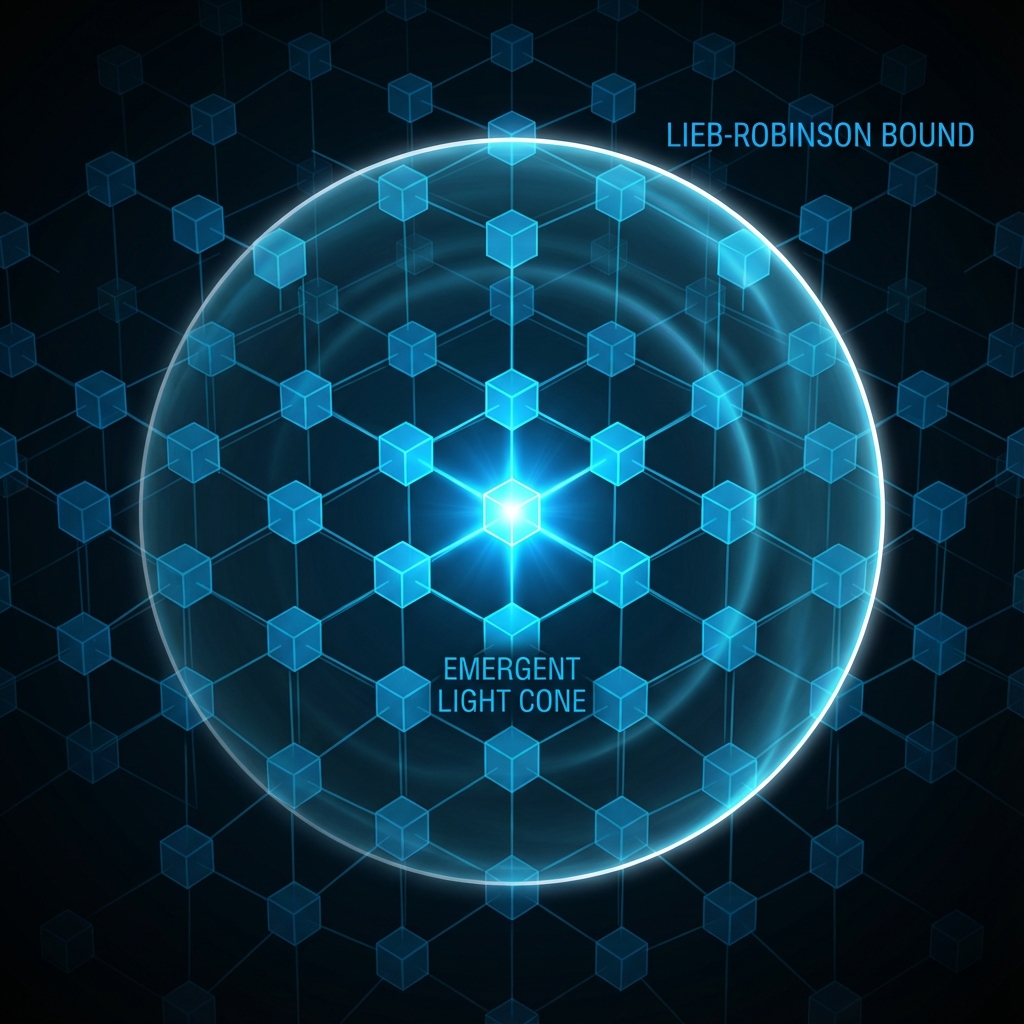
D.1 Mathematical Definition of Microscopic Lattice
Consider a -dimensional regular lattice (e.g., ). At each node of the lattice, a finite-dimensional Hilbert space is attached (e.g., a two-level qubit, ).
The universe’s total Hilbert space is the tensor product of all these local spaces:
The evolution of QCA is described by a global unitary operator . The discrete-time evolution equation is extremely simple:
where represents discrete time steps (Planck time beats).
D.2 Locality Axiom
The most fundamental physical axiom of QCA is Locality. This means information cannot instantly spread across the entire network.
Mathematically, if denotes the operator algebra supported on a finite region , then the unitary operator must satisfy:
Here denotes the -neighborhood of region (i.e., all points within distance lattice sites from ).
This axiom ensures that within one time update , information from any lattice site can propagate at most to neighbors at distance . This hardcodes causality at the microscopic level.
D.3 Lieb-Robinson Bounds: Emergent Light Cone
Although the locality of single-step updates is obvious, can this locality be maintained after steps of complex quantum entanglement evolution?
The Lieb-Robinson theorem gives an affirmative answer. It proves that in lattice systems with short-range interactions, the commutator of two originally distant observables decays exponentially with distance.
For any two local operators (located in region ) and (located in region ), after steps of evolution, their correlation satisfies the following inequality:
The physical meaning of this formula is extremely profound:
-
: The spatial distance between two points.
-
: The effective distance a signal can propagate in steps.
-
Exponential Decay: Outside the “light cone” expanding at speed , any causal correlation is exponentially suppressed to zero.
D.4 Microscopic Origin of Macroscopic Light Speed
The Lieb-Robinson velocity is the inherent maximum signal propagation speed of the lattice system. In the continuum limit, if we define the physical lattice spacing as and the time step as , then the maximum speed in macroscopic physics (speed of light ) is the physical incarnation of :
This proves the point we repeatedly emphasized in the main text: The causal structure of relativity is not a God-given background but a statistical result emerging from microscopic local interactions.
The in the FS capacity identity is actually bounded by this microscopic . The universe has a maximum speed because in the underlying QCA engine, information transfer is strictly limited by “neighbor access rules.” The speed of light is the macroscopic boundary of this microscopic rule.