Prologue: The Gap
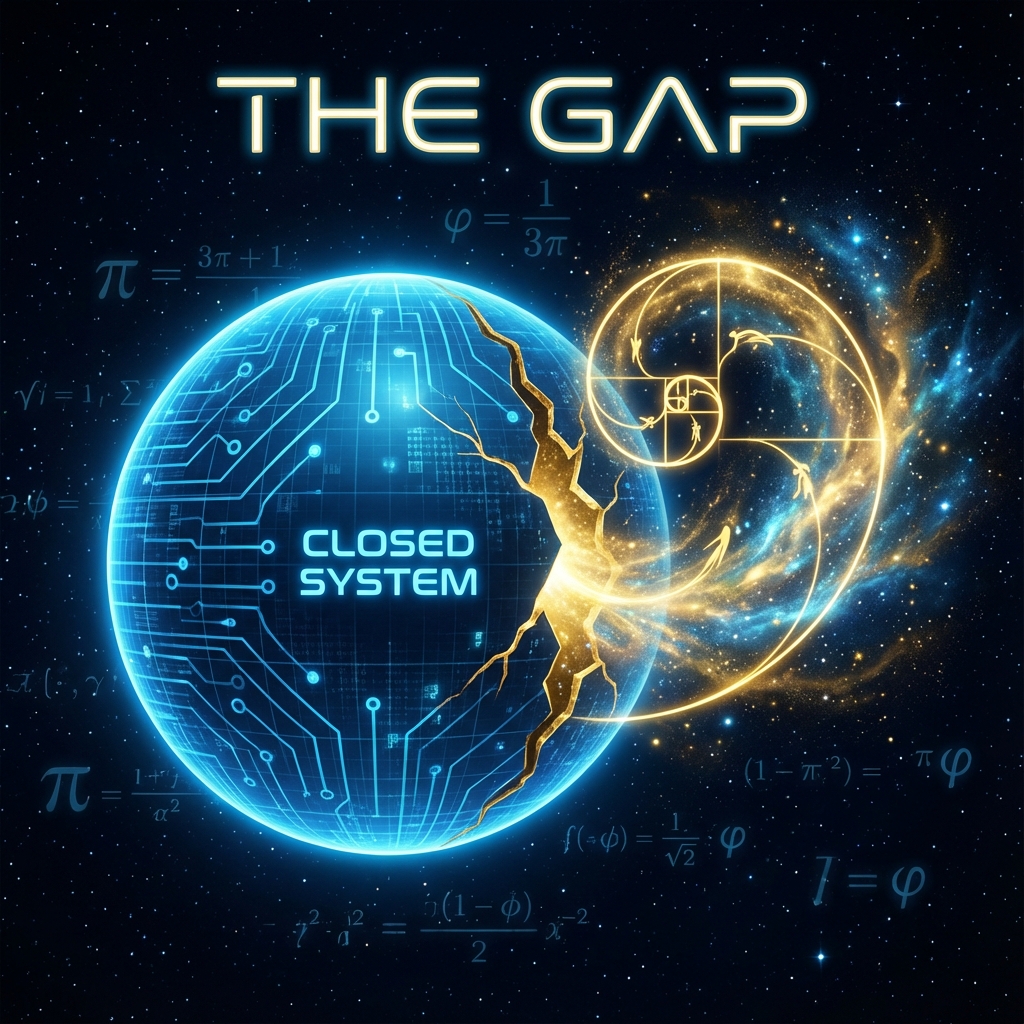
0.1 The Perfect Prison
We have just completed a magnificent construction.
In the first book, we built an indestructible edifice for the universe using the most elegant geometric language—Fubini-Study metric, Pythagorean theorem, Dirac circle. It was a symmetric, conserved, orderly world. There, every expenditure of energy was accounted for, every birth and death of particles followed strict topological counting. The formula was like a sacred incantation, guaranteeing that the universe’s total budget would never be in deficit, nor in surplus.
That feeling was serene. Like floating on a calm lake, or gazing at a flawless crystal ball.
However, if you stare at this crystal ball long enough, serenity transforms into a hidden sense of suffocation.
You begin to realize that this perfect circle is actually a prison.
The Curse of Conservation
In the first book, we praised the “conservation laws.” We said that the universe’s total vector magnitude is constant, the total rate of change is fixed. This sounds like a promise of eternity.
But think carefully—what is another name for “constant”?
Stagnation.
If the universe’s total budget is truly deadlocked, if everything is truly just a zero-sum game, then in this universe, no truly “new” thing can be born.
-
You think you are creating a poem, but you are merely rearranging words from a dictionary.
-
You think you are experiencing a unique love, but you are merely replaying a phase ripple already etched on a hologram.
-
You think civilization is progressing, but it is merely a game of passing from left hand to right hand between (internal structure) and (external expansion).
In a strictly conserved circle, the future does not exist; the future is merely an echo of the past rearranged.
Poincaré’s Nightmare
This despair has a precise mathematical expression—the ghost we briefly glimpsed in the bonus chapter: Poincaré Recurrence.
Quantum Cellular Automata (QCA) tell us that the universe is finite. Finite lattice, finite energy bands, finite Hilbert space dimension.
And unitary evolution tells us that information never disappears.
When a “finite” system, in a “closed” box, undergoes “information-preserving” evolution, mathematical law decrees its fate: it must return to its origin.
This is not a question of probability; it is a question of time. Given enough time (though it may be years), a shattered teacup will reassemble, a dead star will reverse its collapse, and even you, reading these words at this moment, will sit in the same chair again, thinking the exact same thought.
This is what Nietzsche trembled at: “Eternal Recurrence”.
If this is the truth, then the universe is not a magnificent epic, but a stuck record. All pain, all struggle, all love and hate are merely grooves on this record. We are trapped in an infinite loop, playing the same melody over and over, yet mistakenly believing it is linear time.
Perfect Suffocation
So, that “circle” that comforted us in the first book now reveals its cold side.
A circle is perfect because it is closed.
But life abhors closure. Life yearns to grow, to overflow, to embrace those accidents not listed on the budget sheet.
If is truly an absolute constant, then we are insects trapped in a glass bottle named “conservation.” We can fly fast (), we can grow complex (), but we can never escape the volume of this bottle.
Is this truly the complete truth of the universe?
Is the underlying mechanism that created such a rich, turbulent, unpredictable world really just a rigid program that only knows how to draw circles?
No. Intuition tells us that something has been omitted.
On the perfect arc of the circle, there must be a gap invisible to the naked eye.
In the infinite cycle of , there must be a backdoor leading outward.
Where is that gap?
It is not in the formulas; it is in itself, which we have always treated as a constant.
What if, just what if, this budget is not fixed? What if the universe is not merely allocating budget, but appreciating it?
This leads to the core of this book: we will shatter that perfect circle. We will escape from the prison. We will seek that mysterious force that allows the universe to breathe, to grow, to escape recurrence.
In the next section, we will discover a ghostly number in that gap. It is not ; it is .
0.2 The Ghost of Fibonacci
“ is a monument to conservation, promising that everything will return; while is a prophet of evolution, foretelling that no moment will truly repeat. In the interstices of ’s seamless rule, we discover a ghost.”
If the universe were truly a perfect circle, if everything were locked by the constant budget of , then life—this phenomenon that yearns for infinite expansion—should not exist. In a zero-sum closed box, any attempt to break the balance should be quickly erased by physical laws.
However, if we shift our gaze from grand astrophysics to the flowers beneath our feet, the seashells, even the shapes of galactic spiral arms, we discover a disturbing geometric pattern everywhere.
That is not a circle; that is a spiral.
And deep within the spiral hides another constant. It is not the circumference ratio (3.14159…) that represents closure and cycles, but the golden ratio— (1.61803…)—that represents growth and non-repetition.
The Gap on the Circle
In the first book, we defined matter as a “dead knot” of phase, with as its counting unit. This constructed a perfect static order. However, if the universe’s underlying logic were truly pure repetition, why do the most dynamic structures in nature—sunflower seed arrangements, nautilus chambers, hurricane eyes—all reject and frantically embrace ?
This is because possesses a unique mathematical property: it is the most irrational number.
This means that if you attempt to approximate using integer ratios, you will find it the most difficult. In dynamical systems theory, this corresponds to the frequency ratio that is “most difficult to resonate”.
-
The circle () seeks resonance, seeks return to origin, seeks closure.
-
The spiral () seeks to avoid the origin, seeks to fill unknown voids, seeks never to overlap.
If the universe were governed solely by , all history should have closed in Poincaré recurrence long ago. But the ubiquity of suggests another possibility: at the perfect closure of the circle, there exists an imperceptible gap.
Each time the universe vector completes one revolution (), it does not perfectly bite its own tail. It shifts outward—or inward—by an infinitesimal amount.
This tiny shift is the Ghost of Fibonacci. It means the circle has not closed; the circle has become a spiral.
The Inflation of Budget
What does this gap mean physically?
Returning to our sacred formula: .
In a closed universe, is an absolute constant.
But in a universe with a gap, we must face a startling hypothesis: itself may be a variable.
Imagine the universe not as a rigid clock, but as a living organism that is growing.
As intrinsic time elapses, the dimension of Hilbert space explodes exponentially. According to the dimensional inflation hypothesis we mentioned earlier, the total information update rate (i.e., ) required to maintain this larger system is undergoing a long and hidden inflation.
This is not a violation of energy conservation; this is dimensional growth.
If the total budget is slowly increasing, then the radius after each revolution will be slightly larger than the previous one.
-
For observers living in extremely short timescales (like us), this tiny growth is negligible, so we measure perfect conservation laws and closed circles.
-
But for evolutionary history spanning billions of years, this accumulation leads to a phase transition from dead matter to complex life.
Escaping Recurrence
The Ghost of Fibonacci is the secret passage through which the universe escapes Poincaré recurrence.
If is constant, we are doomed to repeat the past.
But if grows with , then the “you” in the next cycle will possess greater bandwidth and deeper dimensions than now. History may rhyme (patterns similar), but never repeats (energy levels different).
Life instinctively exhibits the shape of Fibonacci spirals because life is the first subsystem in the universe to perceive this secret. Living organisms, through continuous evolution and reproduction, attempt to keep pace with the expansion of the universe’s total budget .
In the prison of the circle, we hear knocking from beyond the wall. That sound tells us that the wall is not the end of the world; the wall is merely the starting point of the next level of the spiral.
Thus, the prologue has been drawn. We will not only shatter the superstition of the circle; we will also chase that ever-escaping spiral. In the chapters to come, we will first confront the greatest illusion: why, in a universe that is clearly expanding exponentially, do we feel we live on a stable, conserved island?
This leads to the core theme of Volume I—The Red Queen’s Run.