Chapter 1: The Red Queen’s Race
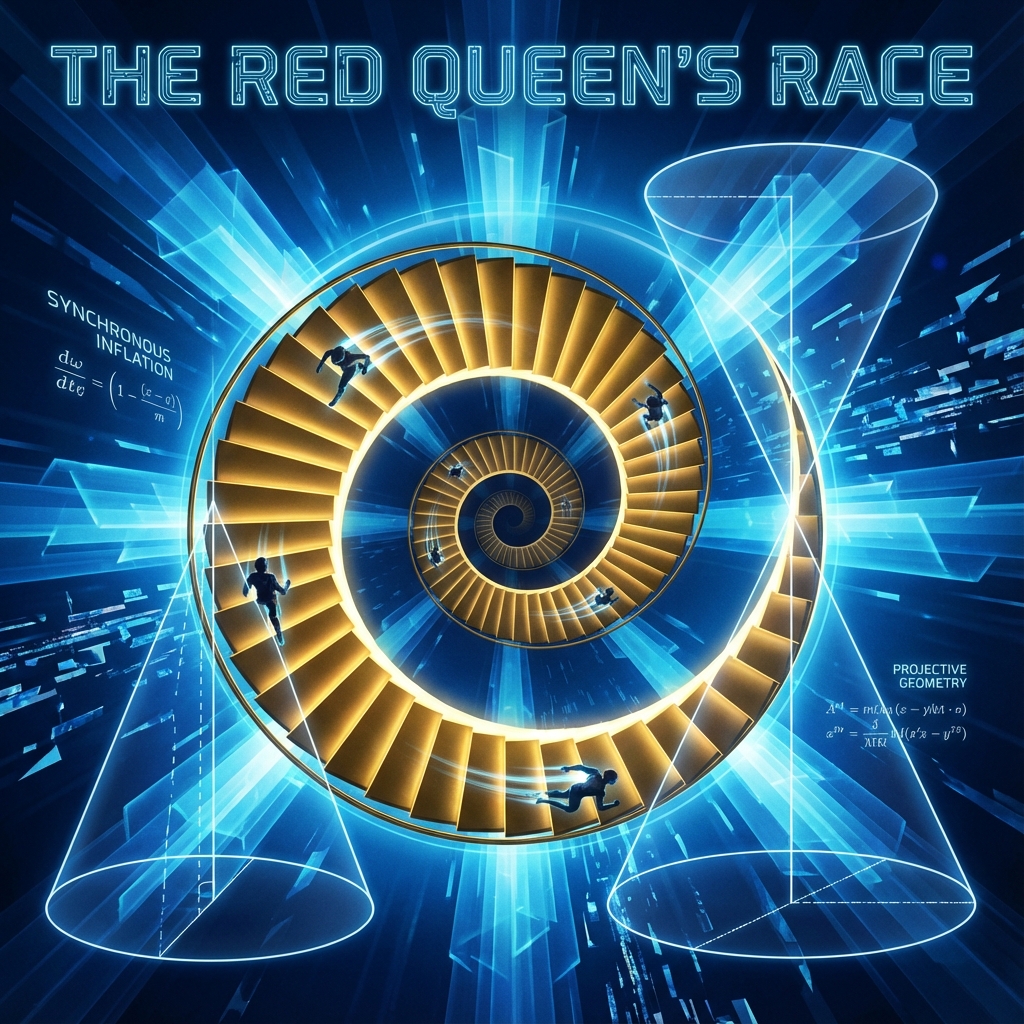
We have boldly pushed open the door to the spiral universe. In the prologue, we claimed that the constant budget , which we held as sacred in the first book, is actually undergoing a long and hidden inflation.
But this immediately invites a sharp rebuttal from our most intuitive experience:
“If the universe is truly expanding exponentially, if the total budget is truly skyrocketing, why do we feel nothing? Why do physical constants appear so stable? Why do conservation laws remain unshakeable in the laboratory?”
This is a fatal question. If we cannot answer it, all conjectures about the “spiral” are mere fantasy.
To solve this puzzle, we need to borrow that famous metaphor from Lewis Carroll’s Through the Looking-Glass—the Red Queen’s Race.
“Here, you must run as fast as you can, just to stay in place.”
This chapter will reveal that the reason we perceive the world as a static “circle” is precisely because we, together with the world, are running at astonishing speed.
1.1 Synchronous Inflation: The Illusion of Closure
We usually think that “measurement” is a person holding a fixed ruler, measuring a changing world. If the world grows larger, the reading will increase.
But what if the ruler is made of exactly the same material as the world?
Alice’s Transformation Potion
Imagine Alice drinks a magical potion, and her body instantly doubles in size.
If the room she is in, the ruler in her hand, the wavelength of light in her eyes, even the rate at which her brain neurons process information, all double in size or speed at the same instant.
Would Alice notice any change?
Absolutely not.
-
She measures the table with her ruler, and the reading is still 1 meter.
-
She looks at the clock on the wall, and the rhythm of the second hand feels unchanged (because her thinking speed has also synchronized).
-
From her perspective, the world is still conserved, and physical laws are still perfect closed loops.
This is the trick of Synchronous Inflation.
In the spiral model of Vector Cosmology, the magnitude of the universe’s total state vector (or the total budget ) is undergoing exponential growth with intrinsic time :
This is a massive, violent growth. If we view it from a “God’s perspective,” the universe is not only rotating but also “exploding” outward at an astonishing rate (in the radial dimension of Hilbert space).
However, as observers, we are not outsiders standing in God’s perspective. We are part of the system itself. We are entities composed of (internal structure), and the upper limit of is precisely .
The Relativity of Scale
This means that all the “benchmarks” we use to perceive the world are tightly bound to .
-
Our rulers: Composed of atomic lattices. The Bohr radius of atoms depends on the fine structure constant and electron mass. In FS geometry, these parameters are ultimately projection ratios of the total budget across different sectors. If the total budget doubles while the projection ratios remain unchanged (geometric similarity), then atomic scales will also “double” (in absolute terms).
-
Our clocks: Determined by atomic vibration frequencies. Frequency is proportional to energy. If doubles, the energy scale doubles, and our clocks run twice as fast.
The result is perfect cancellation.
When we use a “ruler that has doubled in size” to measure a “universe that has doubled in size,” the factor appears simultaneously in both numerator and denominator, then cancels out.
This is why we cannot observe the radial expansion of the spiral. We are locked in a conformal illusion.
The Blind Spot of Projective Space
This physical picture has solid mathematical support. In the first book, we repeatedly emphasized that the universe’s state space is projective Hilbert space .
The word “projective” is crucial.
In projective geometry, vectors and represent the same physical state.
Projective space only cares about direction (angle), not length (magnitude).
-
Circle: Represents the rotation of vector direction. This is the physical change we can observe (phase, interference, motion).
-
Spiral: Represents the growth of vector magnitude. This is the blind spot of projective geometry.
Because we live in projective space, our physical laws are determined only by “angles” (such as the ratio between and ). As long as this ratio remains unchanged, no matter how many billions of times the absolute value of expands, the physical laws in our eyes remain that perfect, conserved Dirac circle.
Dynamic Stability
This completely overturns our understanding of “stability.”
We thought the world was stable because it was stationary like a rock.
Now we understand that the world is stable because, like a spinning top, it maintains dynamic balance through high-speed rotation and expansion.
The Red Queen is right.
For the universe to maintain macroscopic stability—“atoms don’t disintegrate,” “light speed doesn’t change,” “yesterday is like today”—it must frantically increase the investment in at the fundamental level. It must continuously create new degrees of freedom, continuously broaden Hilbert space, to offset the dissipation brought by entropy increase.
Once this race stops, once truly becomes a rigid constant, relative “decline” will immediately begin—that is the true collapse.
So, the “circle” we see is actually a projection of a spiral on the retina. We are like ants on that infinitely ascending spiral staircase; because we grow together with the staircase, we always feel we are circling on the same plane.
But if this expansion is perfect, how can we possibly detect it? Are we doomed to be trapped in this “illusion of closure”?
No. Although synchronous inflation masks most traces, it is not flawless. Just as we discovered “lattice drooping” in the first book, this malignant inflation of dimensions will also leave traces at the extremely macroscopic scale of the universe.
That is the theme of our next section: dark energy. That is not repulsion; that is the replenishment after budget dilution.