Appendix B: Geometric Proof of Naimark’s Dilation
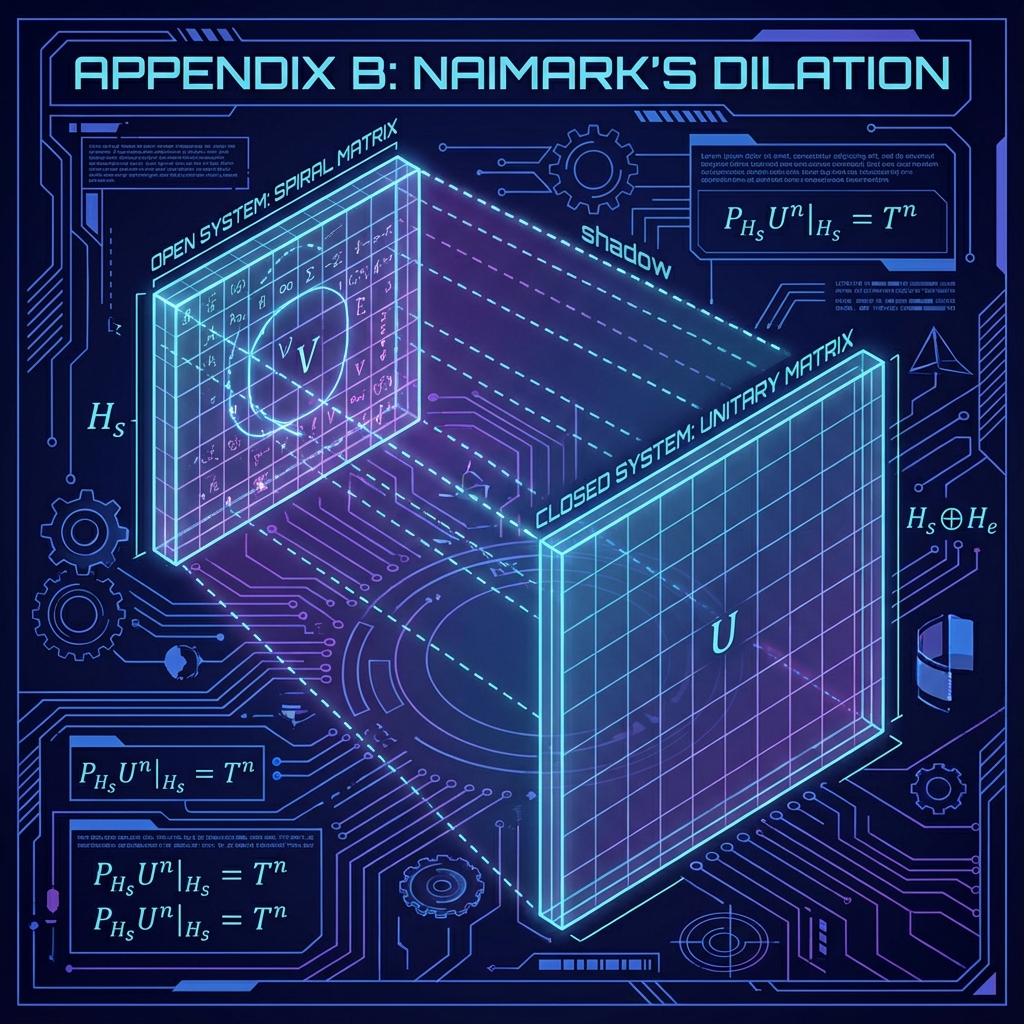
In the final chapter of Vector Cosmology II, we presented an ultimate vision full of Zen: the spiral is not the opposite of the circle; the spiral is merely a projection of a higher-dimensional great circle onto a lower-dimensional subspace. This view is not literary rhetoric in mathematics, but a direct physical application of Naimark’s Dilation Theorem in functional analysis.
This appendix will provide a rigorous geometric proof of this “great circle containing small circle” structure, starting from operator theory in Hilbert space. We will show that any seemingly open, dissipative, or non-unitary evolution trajectory must be a Contraction or Projection of some higher-dimensional closed system’s unitary evolution.
B.1 Non-Unitary Evolution of Open Systems
In the main text, we described two characteristics of the spiral universe:
-
Dissipation: Information flows to the environment (entropy increase).
-
Growth: The system absorbs negative entropy from the environment (life/civilization).
In quantum mechanics, this corresponds to an Open Quantum System. Its state evolution is no longer described by a unitary operator (satisfying ), but by a Contraction Semigroup or Completely Positive Trace-Preserving (CPTP) Map .
If we only focus on the system’s internal Hilbert space , we find that the total vector’s modulus (or coherence) is not conserved:
Geometrically, this means the trajectory no longer stays on the unit sphere of , but curls inward (spiral downward) or diverges outward when external pumping is introduced (spiral upward). This is precisely the “spiral” picture we saw in the second book.
B.2 Naimark’s Theorem: Finding the Larger Space
The core insight of Naimark’s theorem (and its subsequent generalizations, such as Stinespring dilation) is: Non-conservation is due to too narrow a view.
Theorem Statement:
Let be a Hilbert space, and be a one-parameter contraction semigroup on it (i.e., the operator family describing spiral evolution).
Then, there necessarily exists a larger Hilbert space such that is a subspace of (), and on there exists a unitary group (i.e., the operator family describing great circle evolution) satisfying:
where is the orthogonal projection operator from the large space back to the small space .
Physical Translation:
This mathematical formula is the most stunning physical metaphor of the entire book:
-
(Spiral): The physical laws we observe in the macroscopic world, seemingly with birth and death.
-
(Great Circle): The actually occurring, eternally conserved evolution in the global space ().
-
(Projection): Our observational limitations. Because we are part of the system, we can only “see” the component projected onto .
This rigorously proves: Any spiral trajectory is the shadow of high-dimensional circular motion.
B.3 Geometric Reconstruction of the Environmental Term
The environment velocity we introduced in the first book finds its precise geometric definition in Naimark dilation.
In the global space , the unitary evolution preserves the total modulus, satisfying the global FS capacity identity:
When we project it back to the system space , the tangent vector is decomposed as:
where:
-
: This is the system evolution velocity we observe (containing and ).
-
: This is the environmental evolution velocity orthogonal to the system.
According to the Pythagorean theorem (orthogonality in Hilbert space):
This directly leads to the extended capacity identity we used in the main text:
Conclusion:
Naimark’s theorem mathematically guarantees from the bottom up that the “environment” is not an arbitrary trash can, but a necessary piece completing the geometric structure.
-
When the system exhibits “dissipation,” it is actually the vector of rotating toward the direction.
-
When the system exhibits “ascension” or “absorption of negative entropy,” it is actually the vector rotating back from the direction to the direction.
In that invisible space, there is no dissipation, no growth, only rotation of angles. This is the geometric essence of “The Palm of the Buddha.”