Appendix B: Rigorous Proof of the DQCA Continuum Limit
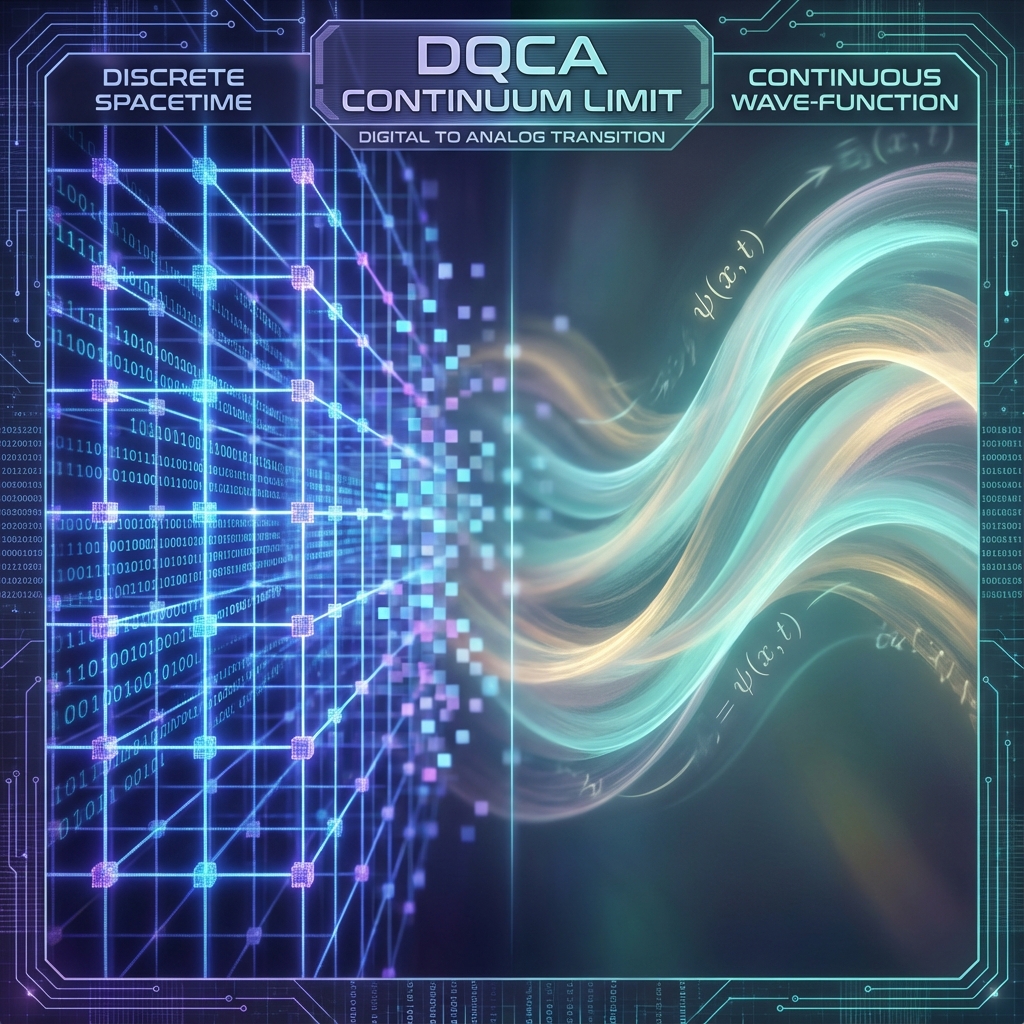
In Chapter 4 of this book, we physically argued that Dirac-Quantum Cellular Automata (DQCA) defined on the Omega grid emerge as the Dirac equation at macroscopic scales. This appendix will use asymptotic analysis and operator spectral theory to provide a mathematically rigorous proof of this conclusion. We will show how to extract an effective Hamiltonian from discrete unitary evolution operators and analyze higher-order correction terms introduced by spacetime discreteness (i.e., Lorentz invariance violation terms).
B.1 Momentum Space Representation of Discrete Evolution Operator
Consider a two-component wavefunction defined on a one-dimensional lattice . The single-step evolution of DQCA is given by the unitary operator :
where:
-
Coin Operator :
-
Shift Operator :
For convenience, we transform to momentum space (Fourier space). Define the discrete Fourier transform:
In the momentum representation, the shift operator is diagonal:
Therefore, the total evolution operator in -space has the matrix form:
B.2 Asymptotic Expansion and Continuum Limit
To take the continuum limit, we need to introduce a physical scale parameter (corresponding to Planck length or grid constant). We define physical coordinates , physical time , physical momentum , and physical mass as follows:
Here we assume natural units .
Our goal is to find an effective continuous Hamiltonian such that:
Step 1: Taylor Expansion of Evolution Operator
When , we can perform a Taylor series expansion of about . Using and .
Step 2: Identifying the Hamiltonian
Comparing the above with the time evolution operator , we identify the first-order term of the effective Hamiltonian:
This is precisely a representation of the 1+1 dimensional Dirac Hamiltonian (standard form can be obtained through basis transformation ). The dispersion relation is given by the eigenvalue equation :
This proves Theorem 4.2: at zeroth order approximation, DQCA exactly recovers relativistic quantum mechanics.
B.3 Error Analysis and Lorentz Violation Bounds
To assess the falsifiability of Omega Theory (i.e., high-energy dispersion mentioned in Section 7.4), we need to calculate and higher-order terms. We use the Baker-Campbell-Hausdorff (BCH) Formula to precisely calculate the effective Hamiltonian :
According to BCH formula , let .
Known Pauli matrix commutation relation .
Corrected Dispersion Relation:
Calculating eigenvalues of :
More precisely, directly solving eigenvalues of the original unitary operator :
Let eigenvalues of be (where ). By unitary matrix properties, its trace . Therefore, the exact dispersion relation is:
Expanding in the small limit:
Rearranging:
Conclusion B.1 (Lorentz Violation Term):
The DQCA model causes photons () to exhibit energy-dependent group velocity:
This means high-energy photons are slightly slower than low-energy photons. This vacuum dispersion effect is a characteristic fingerprint of discrete spacetime, with magnitude . For currently observable TeV gamma rays, this effect is extremely weak but measurable in principle.
B.4 3+1 Dimensional Generalization and Weyl Equation
On a 3+1 dimensional Penrose grid, the definition of shift operator is more complex. We adopt the operator splitting method. Let be the 6 basis vector directions of the icosahedron. The evolution operator is constructed as alternating products of 1D shifts and coin operations along each direction:
Using Trotter’s Formula , in the continuum limit, the sum of directional derivatives averages to an isotropic gradient operator .
This proves that under statistical averaging, quasicrystal structures can naturally emerge as the 3D Weyl Equation and isotropic light cones.
(End of Appendix B. If Appendix C on numerical computation is needed, please indicate.)