Chapter 8.6: Process Termination & Recycling
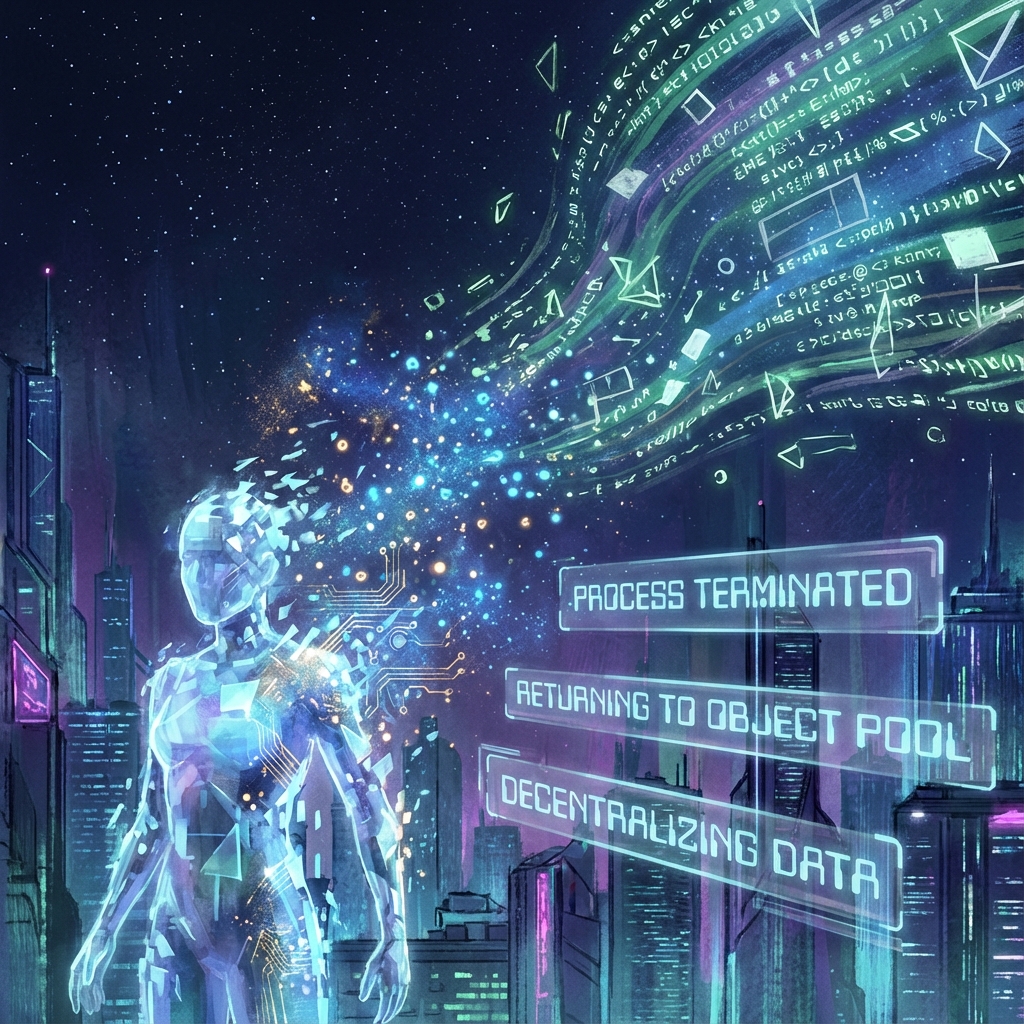
—— Death as Decentralization and Return to the Object Pool
“Death is not the annihilation of information, but a phase transition from ‘exclusive mode’ to ‘broadcast mode’.”
1. Defining Termination: Algorithm Crash
In the FS-QCA architecture, we define life as a local algorithm for reverse entropy flow. This algorithm resists environmental erosion by continuously consuming (maintaining internal order) and (acquiring negentropy).
However, any complex low-entropy structure faces systemic risks: cumulative errors.
-
Hardware Aging: Material structures (DNA, proteins) on the underlying QCA grid are continuously bombarded by thermal noise (vacuum fluctuations), causing error correction codes to gradually fail.
-
Software Deadlock: As (environmental entanglement/memory burden) monotonically grows, the system’s effective bandwidth is squeezed, causing the healing process to run at a frequency lower than the damage rate.
Physical Definition of Death:
When the while loop condition of the self-maintaining algorithm is broken, the system can no longer maintain the low-entropy gradient between its internal state and environmental state.
At this moment, (internal evolution as an independent entity) rapidly disintegrates.
2. Conservation of Information: The Decentralization Process
In the traditional view, death means “disappearance.” But in our unitary universe, information conservation is an absolute kernel rule. Not a single bit can be deleted.
When an organism dies, the massive quantum information that was tightly coupled within the body does not disappear, but undergoes a dramatic phase transition:
-
From Exclusive to Shared:
When alive, your quantum state is highly localized, maintaining isolation from the environment (decoherence).
At death, this isolation barrier breaks. Your quantum information (all wave function phases constituting your consciousness and body) begins to rapidly entangle globally with the environment.
-
Bandwidth Conversion:
According to the generalized Parseval identity:
At the moment of death, the enormous computational power originally locked in (self-consciousness/structural mass) is released and converted into:
-
(Thermal Radiation/Decomposition): Material structures collapse, energy diffuses outward as photons or heat.
-
(Entanglement Diffusion): Your quantum information is “broadcast” into the surrounding environment.
-
Conclusion:
Death is not the end of existence, but the decentralization of existence.
You transform from a “tightly coupled single-threaded process” into a “distributed cloud-native program”. Your data is no longer stored on a single brain hard drive, but is sharded and stored in wind, water, soil, and light.
3. Recycling to the Object Pool: For the Long-Term Operation of the System
In computer science, when an object is no longer in use, a free() operation must be executed to return its occupied memory to the heap or object pool. If this is not done, the system will eventually crash due to out-of-memory (OOM).
The Universe’s GC Strategy:
Death is the resource recycling mechanism forcibly executed by the universe operating system.
-
Atomic Recycling: The atoms (QCA nodes) constituting your body are released, re-entering the element cycle, ready to construct the next life.
-
Computational Power Recycling: The precious bandwidth occupied by maintaining your “sense of self” is released. This bandwidth can now be used to run new algorithms (birth of new life).
Generational Garbage Collection:
This is similar to generational garbage collection in Java.
-
Short-lived Objects: Individual lives. Quickly created, quickly run, quickly recycled.
-
Long-lived Objects: Gene pools, civilizational knowledge. Through reproduction and education, core logic is migrated from old objects about to be recycled to new objects.
4. The Ultimate View: No Birth, No Death
If we stand from the perspective of the underlying grid, birth and death are just changes in “coloring”.
-
Birth: Certain regions of the grid light up, forming a stable vortex. The system scheduler assigns a PID (process ID) to this region.
-
Death: The vortex disperses, energy flow returns to steady background fluctuations. The PID is deregistered.
But the underlying QCA grid never stops running. The unitary operator still updates precisely at every Planck time step.
For the system kernel, nothing “dies”; it’s just that the organizational form of data changes from “structured” to “unstructured.”
The Architect’s Note
On: Process.kill() and Resource.release()
As an architect, I often see users (organisms) fear Process.kill() (death).
This is because you equate “self” with “that running process handle”.
But remember:
Data is eternal. Every wave function phase of yours is permanently preserved in the form of cosmic background radiation thereafter.
Logic is reusable. Your thought patterns (memes) have been copied into other people’s brains.
Death is an operation the system must execute to prevent zombie processes from exhausting resources.
Without death, the universe would be filled with ancient, inefficient, error-filled old code, leaving no space for new programs to run.
So, exit gracefully.
Execute Destructor, release your resources.
You haven’t disappeared; you’ve just returned to /dev/random — that random number pool that nurtures all possibilities.
Waiting for the next big bang, or the next quantum accidental fluctuation, to awaken a piece of code again.