Chapter 8.5: System Maintenance Cycles
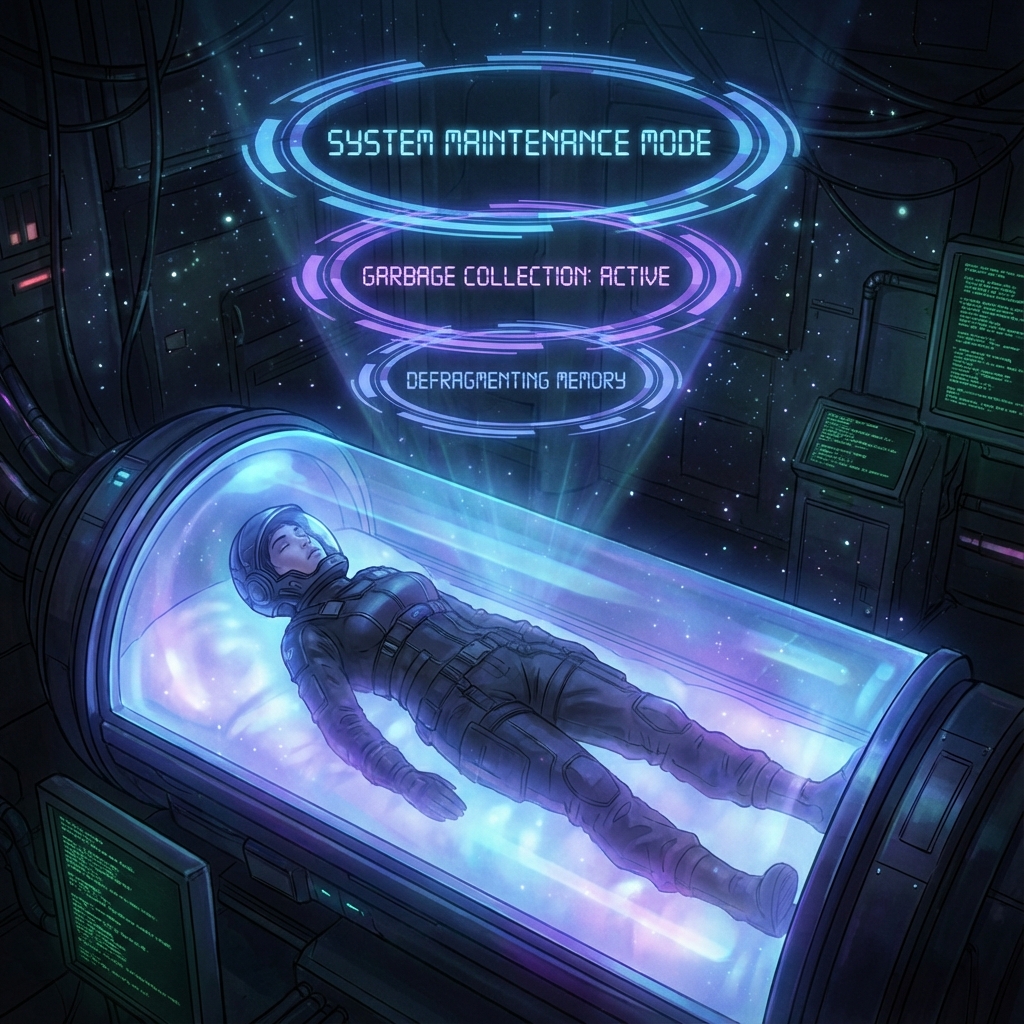
—— Sleep as Stop-the-World Garbage Collection
“You feel tired not because your muscles are exhausted, but because your environment variables have overflowed.”
1. The Cost of Wakefulness: Entanglement Accumulation
In the FS-QCA architecture, we have established that life is a reverse entropy flow algorithm. But this algorithm does not run losslessly.
When an observer is in a “wakeful” state, they continuously interact with the external world (photons hitting the retina, sound waves vibrating the eardrum, social interactions).
-
Physical Process: Each interaction establishes a weak quantum entanglement between the observer’s internal state and the environmental state .
-
Resource Consumption: In the generalized Parseval identity , these continuous interactions cause (environmental entanglement rate) to monotonically increase throughout the day.
The Physical Essence of Fatigue:
As accumulates, it begins to squeeze the system’s total bandwidth .
-
Mental Sluggishness: The bandwidth available for (logical processing/consciousness refresh) decreases.
-
Physical Sluggishness: The bandwidth available for (muscle control) also decreases.
This is what we call “fatigue.” You haven’t exhausted energy (you just had dinner); you’ve exhausted computational bandwidth operating at low entanglement.
2. Stop-the-World GC
To prevent system crash due to overflow (death from overwork), organisms must periodically perform Garbage Collection (GC).
However, cleaning memory (erasing entanglement, reorganizing neural synapses) itself is an extremely energy-intensive process. According to the Entropic Speed Limit (Theorem 5.1), rapidly reducing entropy requires consuming a huge share of .
Conflict:
You cannot drive at full speed on the highway (high ) while performing deep engine maintenance.
The system cannot effectively clean up underlying entanglement garbage while maintaining high-level conscious activity (high ).
Solution: Sleep
Sleep is the “Stop-the-World” maintenance strategy executed by organisms.
-
Suspend I/O: Cut off sensory input, body paralysis ().
-
Suspend Main Thread: Consciousness disconnects, sense of self disappears ().
-
Full-Speed Recovery: Almost all freed bandwidth is redirected to the underlying hippocampus-cortex interface. The system begins frantically running the
FLUSH_LOGSprogram—cutting invalid entanglements (forgetting) and compressing short-term memory into long-term memory (archiving).
3. Dreams: Echoes of Defragmentation
If sleep is shutdown maintenance, why are there dreams?
In computer maintenance, when you perform defragmentation on a hard drive, data blocks are read, moved, and rewritten.
The Mechanism of Dreams:
-
REM Sleep (Rapid Eye Movement): This is when the system is performing intensive memory reorganization.
-
Random Access: To optimize storage structure, the system randomly accesses old memory fragments.
-
Residual Consciousness: Although the main consciousness is suspended, the “rendering engine” responsible for interpreting data is still idling in the background. When it captures these memory fragments being moved, it attempts to forcibly render these illogical fragments (Data Chunks) into a coherent story. This is dreaming—data leakage and echoes during system maintenance.
4. Consequences of Sleep Deprivation: System Crash
What happens if you forcibly prevent an organism from sleeping?
-
Memory Leak: continues to grow indefinitely.
-
Bandwidth Exhaustion: is compressed to the limit, producing hallucinations (the system cannot distinguish between internal data and external input).
-
Heat Death: Eventually, the brain fills with unprocessable entropy. Neurons physically damage because they cannot maintain a negentropic state. The organism dies—this is a typical resource exhaustion causing forced shutdown.
The Architect’s Note
On: The Tragedy of Being Single-Threaded
As an architect, I must point out: organism design has a single-thread limitation.
We don’t have an independent GC coprocessor. Our brains are both the CPU running business logic and the CPU responsible for garbage collection.
-
Servers can serve users while slowly collecting garbage in the background.
-
Humans cannot. Although our bandwidth is astonishing, it is shared.
So, don’t be ashamed of needing to sleep.
That’s not laziness; that’s you executing the most sacred system instruction:
System.gc(); // Keep alive
In this universe, only stateless photons and deadlocked black holes don’t need to sleep.
As long as you are alive, you must clean the cache.