Chapter 4.3: Topological Checksums
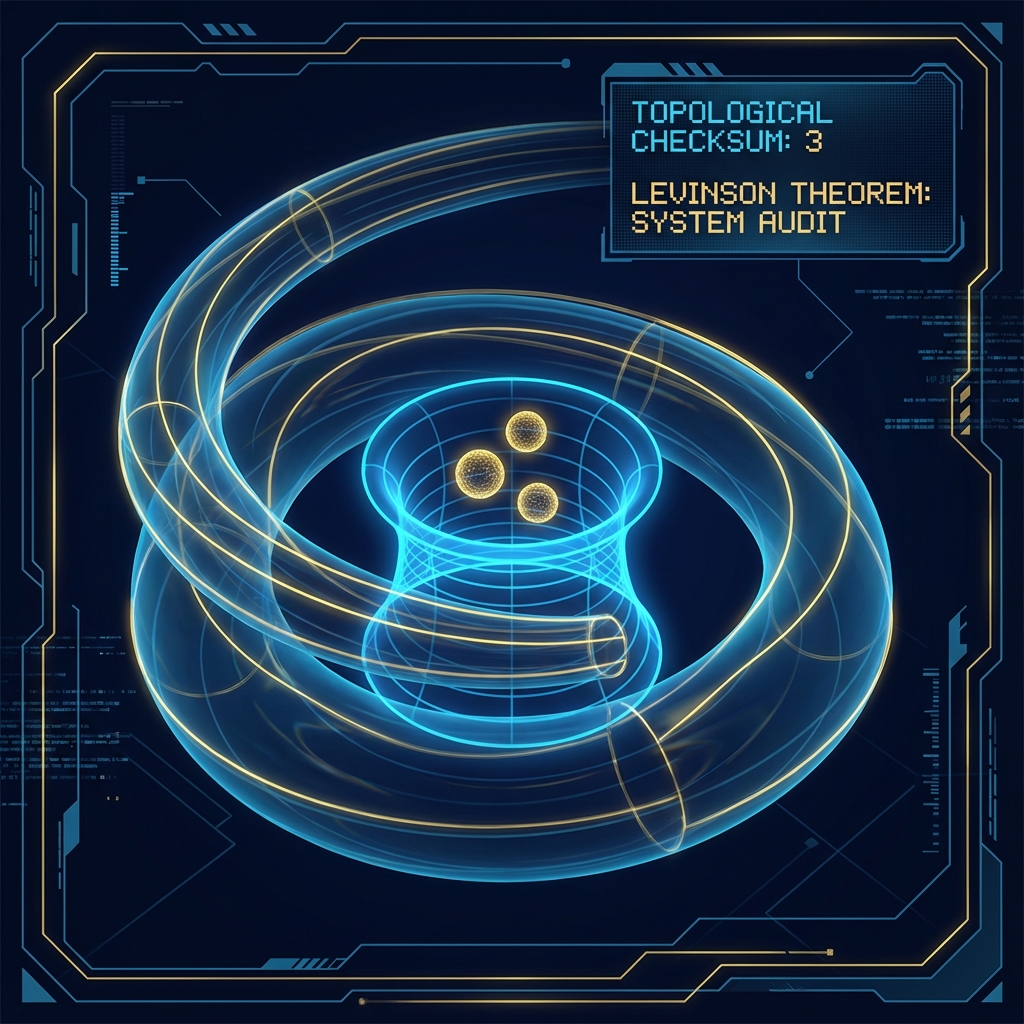
—— The FS-Levinson Relation and Bound State Counting
“Geometry measures error, while topology measures existence. It is the system’s cyclic redundancy check (CRC) preventing data loss.”
1. Topology as System Integrity
In previous chapters, we either focused on local geometric distances (such as FS distance, time delay) or dynamic resource allocation (such as relativity). Now, we introduce a completely new dimension of measurement: Topology.
In systems engineering, when transmitting large amounts of data, merely ensuring signal integrity (geometric fidelity) of each bit is insufficient. We need a macroscopic mechanism to verify “whether the file has been fully transmitted” or “how many objects are in the data packet.” This mechanism is usually called a Checksum.
In physics’ I/O interface (scattering), similar mechanisms exist. When we fire probe waves at an unknown potential field (black box system), we can not only measure the time it reflects back (delay), but also infer how many stable particles are hidden inside this black box by analyzing the Global Phase Winding of scattered waves. These stable particles “imprisoned” inside the potential field are called Bound States.
We will prove that the number of bound states is not a random parameter, but a strictly controlled Topological Invariant, directly encoded in the FS geometric trajectory of the scattering matrix.
2. The Phase Trajectory of the S-Matrix
To extract this topological information, we need to examine the determinant of the scattering matrix .
For a multi-channel scattering system, is a unitary matrix. Its determinant is a complex number with modulus 1, which can be written in exponential form:
where is called the Total Scattering Phase.
Now, let us track the trajectory as energy varies in projective Hilbert space (or more precisely, on the manifold of unitary group ).
As energy increases from zero () to infinity (), the complex number moves on the unit circle.
-
FS Arc Length: The geometric length of this curve on the unit circle is proportional to .
-
Winding Number: More importantly, how many times does this curve wind around the origin?
3. Theorem: The FS-Levinson Relation
In standard quantum mechanics, Levinson’s theorem connects the total change in scattering phase with the number of bound states. In our geometric architecture, this theorem is reconstructed as a statement about the topological properties of projective space trajectories.
Theorem 4.3 (FS-Levinson Relation)
Assume the system Hamiltonian , and potential satisfies appropriate decay conditions. The total topological winding number of the phase trajectory of the scattering matrix determinant over energy interval directly equals the number of Bound States () existing inside the system.
Mathematical expression:
(Note: Coefficients and signs depend on specific conventions; typically the total phase decrease equals , i.e., half a turn represents one bound state)
Physical Proof and Interpretation:
-
Spectral Completeness: The total dimension of Hilbert space is conserved. When potential well introduces discrete bound states (negative energy levels), it actually “borrows” corresponding state density from the continuous spectrum (positive energy scattering states).
-
Spectral Shift Function: Scattering phase essentially measures the “deficit” of continuous spectrum state density relative to the free case.
-
Geometric Image: Each complete clockwise rotation of in projective space (phase decrease of ) marks a quantum state “falling” from the continuous spectrum into the bound spectrum.
4. Robustness in a Discrete World
In continuous theory, proofs of Levinson’s theorem often involve complex analytic continuation. But in our micro-architecture (QCA), this conclusion becomes exceptionally clear and Robust.
In QCA lattice models, the energy spectrum is a discrete finite set . Scattering matrix is no longer a continuous curve, but a series of discrete points on the unit circle in the complex plane.
Determinant traces a Polygonal Path.
Property 4.3.1 (Discrete Topological Index)
In this discrete setting, we can still define discrete winding numbers. This integer index has extremely strong interference resistance:
-
UV Insensitivity: No matter how we refine the lattice (adding high-energy modes), as long as the low-energy structure remains unchanged, the total winding number will not change.
-
As Checksum: This means that even if microscopic details (perturbations) change, as long as no phase transition occurs (i.e., bound states are not ejected or absorbed), this topological integer remains constant. It is the ultimate measure of system stability.
The Architect’s Note
On: System Consistency Check
As architects, we ask: why does the universe need this theorem?
Imagine you’re designing a file system. Files (quantum states) are either stored in Memory (bound states, Bound States) or transmitted over the Network (scattering states, Scattering States).
The FS-Levinson Relation is actually the universe operating system’s Resource Audit Log.
-
is Traffic Statistics: It records the total phase flow through I/O ports (scattering channels).
-
is Inventory: It records the number of objects locked inside the system.
This theorem tells us: “Total Resources = Inventory + Flow”.
If you find that the scattered phase is missing a few turns (flow deficit), the only explanation is: the system must hide a corresponding number of bound states inside.
This is why we call it a “Topological Checksum”.
When you cannot directly open the black box to see how many particles are inside, you only need to measure the phase winding of input-output signals. If it winds 3 times, there must be 3 particles inside. This is a Non-intrusive, globally geometric property-based system state detection mechanism.
It ensures that the universe, as a vast computing system, always has balanced resource accounts. No “ghost” particles can disappear or appear out of thin air without leaving phase traces.