Chapter 4.2: Data Fidelity
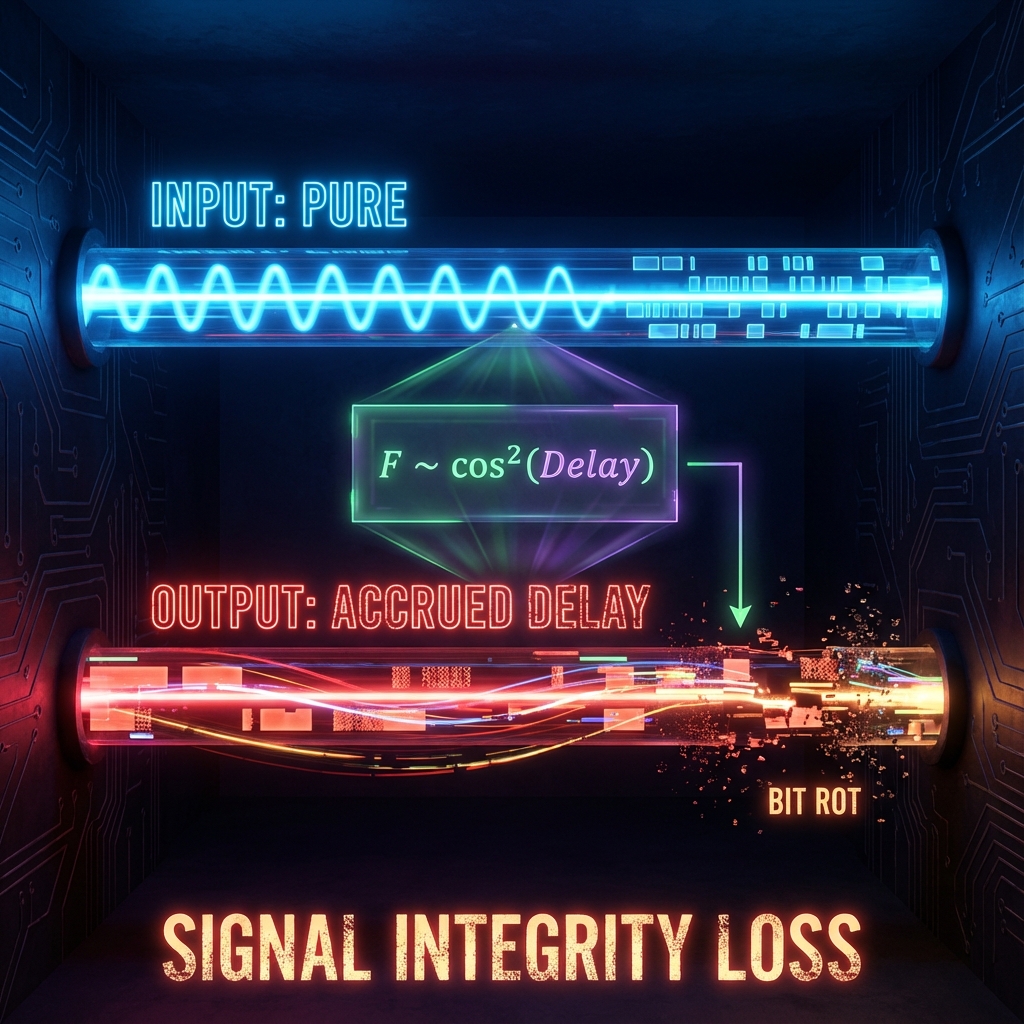
—— The Delay-Fidelity Trade-off Protocol
“Any response deviating from the reference clock, whether late or early, is a distortion of the original signal.”
1. Fidelity as Signal Integrity
In the previous chapter, we established FS geometry in energy space and discovered that Time Delay in scattering processes is essentially the distance the system state moves in projective space.
Now, we face a more practical engineering problem: when the universe server (scattering center) processes a data packet (wave packet), if the processing time is too long (large delay) or the processing logic is abnormal (negative delay), can the output data packet remain unchanged?
In quantum information and communication, we use Fidelity () to measure the similarity between two quantum states. For pure states and , fidelity is defined as the square of their overlap modulus:
Under the geometric architecture, fidelity has a direct trigonometric relationship with Fubini-Study distance :
This means that any nonzero geometric displacement (i.e., nonzero FS distance) necessarily leads to a decrease in fidelity ().
2. Narrow-Band Analysis: Geometric Evolution of Wave Packets
To obtain experimentally verifiable predictions, we examine the most common physical scenario: Narrow-Band Scattering.
Assume the input signal is a wave packet with spectral width , centered around frequency (energy) . The input state can be represented as a superposition of spectral function and energy eigenstates:
After processing by scattering matrix (i.e., “I/O operation”), the output state becomes:
In single-channel cases, the scattering matrix is merely a phase factor . If bandwidth is sufficiently narrow, we can expand the phase around using Taylor expansion:
where the first derivative is exactly half of the Wigner-Smith time delay (according to definition convention).
3. Prediction: The Delay-Fidelity Trade-off
Based on the above expansion and the geometric speed formula established in the previous chapter, we can derive a precise trade-off relationship.
Theorem 4.2 (Delay-Fidelity Trade-off)
For a narrow-band wave packet with bandwidth , if the scattering process produces Wigner-Smith time delay at the central energy, then the fidelity between input and output states approximately satisfies:
Or, in the small-angle approximation (when delay or bandwidth is small):
Physical Proof and Interpretation:
-
Geometric Distance Calculation: From Chapter 4.1 and related derivations, we know that the FS distance of narrow-band wave packets before and after scattering is proportional to the variance of the delay operator. For linear phase approximation, this transforms into:
(Note: The coefficient 2 depends on specific channel definitions; here we adopt the standard convention of single-channel phase ).
-
Trade-off Mechanism: This formula reveals a harsh uncertainty trade-off.
-
If you want high fidelity (), you must either let delay approach zero (), or let bandwidth approach zero (, i.e., monochromatic plane wave).
-
Once you have finite bandwidth (necessary for transmitting information) and encounter significant time delay, signal quality must decrease.
-
-
Experimental Prediction: This effect can be experimentally verified in mesoscopic conductors or photonic waveguides. By preparing light pulses with specific pulse widths and passing them through a resonant cavity (producing large delay), we can directly measure the visibility of interference fringes (i.e., fidelity) as a function of delay time, verifying the cosine-squared decay law.
4. The Truth About Negative Delay: Phase Prefetching
One of the most puzzling phenomena in scattering theory is Negative Wigner-Smith Delay. That is, the peak of the output wave packet seems to arrive earlier than a reference wave packet propagating at “vacuum light speed.” Does this imply retrocausality or time travel?
In the FS geometric architecture, the answer is no. We see the truth through the geometric distance formula .
-
Sign Independence: FS distance depends on the absolute value of delay. Whether positive delay (lag) or negative delay (advance), both manifest in projective space as state vector deviation from the original direction.
-
Fidelity Decay: The formula also applies to negative delay. This means that although “negative delay” sounds like a system performance improvement (early response), this “jump-start” also comes at the cost of sacrificing signal fidelity.
Physical Picture:
Negative delay is essentially a Phase Reshaping or Prefetching effect. The system utilizes the coherence of the wave packet’s front end, suppressing the tail through destructive interference while enhancing the front, causing the “center of mass” to shift forward. This operation requires computational power to reorganize the wave function structure, so it also produces displacement in projective space, damaging the “authenticity” of the original signal. At the microscopic QCA level, all evolution steps still strictly advance forward, with no retrocausal operations violating causality.
The Architect’s Note
On: Jitter and Packet Corruption
As architects, we regard “scattering” as a form of network transmission.
-
Ideal Transmission ():
Data packet enters the switch, is instantly forwarded, with no queuing. Output packet = Input packet. Fidelity .
-
Positive Delay ():
Data packet queues in the buffer. Although content doesn’t change, timing does. If this delay is consistent for all frequency components in the wave packet (no dispersion), this is simply
Sleep(). But usually, different frequency components have different delays (dispersion), like network jitter, causing waveform distortion when reassembling the packet. The larger the delay, the more severe the accumulated phase misalignment, and the higher the packet corruption rate (). -
Negative Delay ():
This corresponds to Speculative Execution or Prefetch in software.
The switch guesses content based on the packet header (Head) and constructs the output packet in advance.
-
Cost: This guessing often depends on specific packet structure (wave packet coherence). If prediction logic is too aggressive (negative delay too large), the output packet, although “faster,” may lose critical checksum information in the tail.
-
Conclusion: Whether procrastination (positive delay) or jump-start (negative delay), for systems pursuing bit-perfect consistency, both are forms of distortion.
The universe’s I/O interface has a strict QoS policy: Timing is Data. Destroy timing, and you destroy the data itself.
-