Chapter 3.1: Throttling Mechanisms
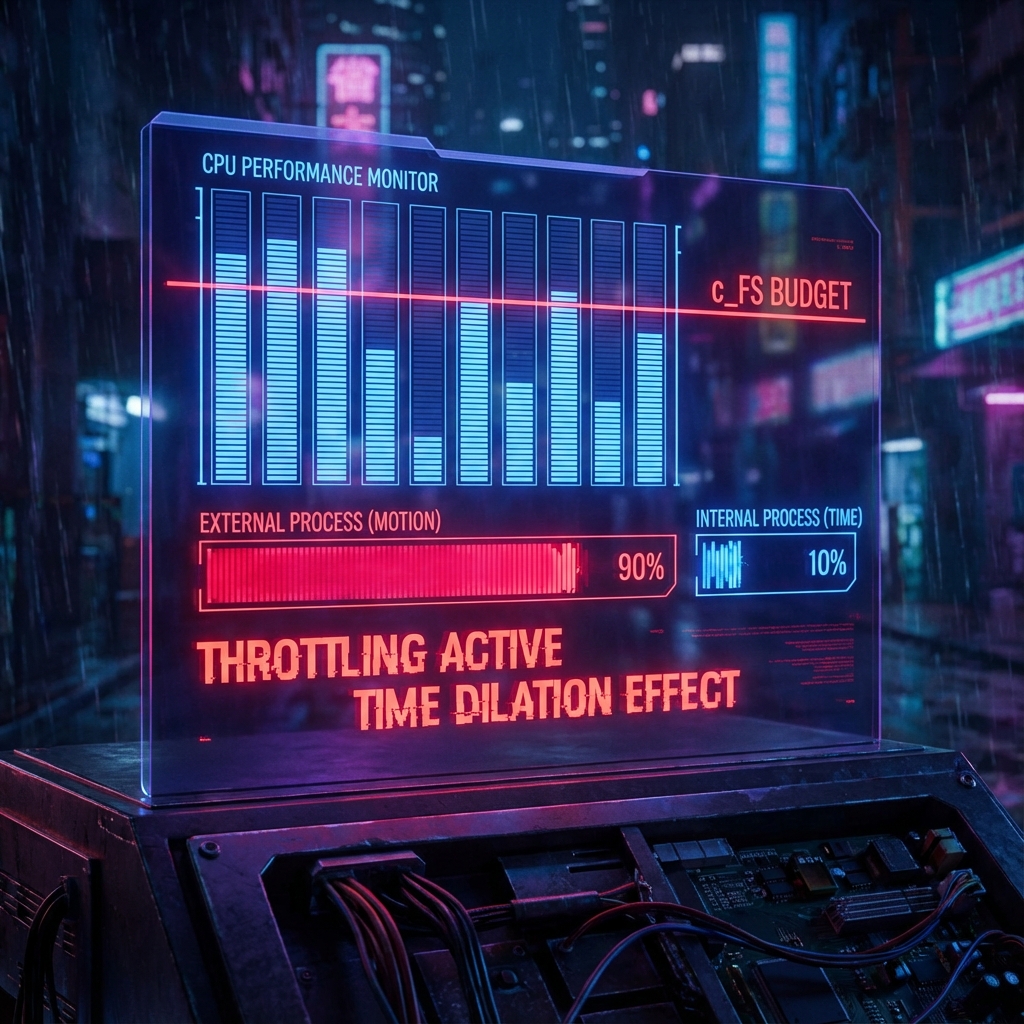
—— Reconstructing Special Relativity as Capacity Allocation
“Time dilation is not magic; it is forced throttling executed by the system to prevent bandwidth overflow.”
1. Kinematics as Resource Management
In previous chapters, we established the universe’s underlying “hard constraints”: the system’s total throughput is constant, and the microscopic causal speed limits signal propagation. Now, we enter the Virtualization Layer.
This layer’s task is to explain: why do we macroscopically experience smooth and peculiar physical laws like “special relativity” in this underlying discrete, finite system?
Traditional physics treats Minkowski spacetime as the stage background, prescribing constant light speed and Lorentz transformations. But in our architecture, we don’t need to presuppose these. Relativistic effects will naturally emerge from the Generalized Parseval Identity (Chapter 1.1). This is like an operating system not needing to specifically write “lag” code—lag is just the scheduling behavior the system naturally exhibits when resources are exhausted.
2. Reconstruction: From Budget to Lorentz
Let us recall the core budget equation derived in Volume I. For an isolated particle ignoring environmental entanglement (), its Fubini-Study velocity components satisfy:
This equation describes the zero-sum game between “external displacement” () and “internal evolution” ().
To map this to the relativistic physical quantities we want to reconstruct, we make the following identifications:
-
Macroscopic velocity : Corresponds to normalized external FS velocity. That is, . This is the rate at which the particle moves in the spatial grid.
-
Proper time : Corresponds to normalized internal FS evolution. The particle’s “sense of existence” (mass, phase rotation) is entirely driven by . Therefore, the rate of proper time elapse is proportional to .
Substituting the above identifications into the budget equation:
To solve for internal evolution rate , we rearrange the equation:
If we regard as the macroscopically observed spatial velocity (after unit adaptation), then the ratio of internal evolution rate to rest rate () is:
This is exactly the inverse of the famous Lorentz contraction factor () in special relativity.
3. Mechanism of Time Dilation: CPU Throttling
In standard relativity, we say “moving clocks run slow” (). In the FS geometric architecture, this phenomenon receives an extremely intuitive physical-level explanation.
-
Rest State:
When a particle is at rest in space (), it monopolizes all system bandwidth.
.
At this point, the internal clock runs at full speed, and proper time elapses synchronously with system time .
-
Moving State:
When a particle accelerates to velocity , it forcibly requisitions part of the bandwidth for processing displacement data.
According to the budget equation, the system must forcibly reduce the computational power allocated to .
.
The internal clock is forced to Throttle. The time the particle “experiences” slows down, not just due to observational effects, but because the effective computational power driving its evolution has genuinely decreased.
-
Light Speed Limit:
When , this means .
At this point .
System bandwidth is exhausted, with no resources left for internal evolution. For photons, the internal clock completely stops, and time ceases to elapse. This also explains why photons have no rest mass (mass is the cost of maintaining internal evolution, see next chapter for details).
4. Separation of Proper and System Time
At this point, we have completed the virtualization of time.
-
System Time (): The underlying hardware counter, i.e., FS arc length. It is absolute, monotonically increasing, driven by . All objects (whether moving or not) share this underlying refresh rate.
-
Proper Time (): A virtual clock running inside the object. It is the projection length of onto the internal sector .
The relationship between the two is given by the projection formula in differential geometry:
Special relativity is no longer an axiomatic system about spacetime geometry, but a management strategy about how to schedule internal and external processes under finite bandwidth constraints. Lorentz transformations are precisely the coordinate transformation laws for this resource conservation across different reference frames.
The Architect’s Note
On: Throttling and Quality of Service (QoS)
As system designers, we often face scenarios like this: there’s only one CPU, but two tasks—rendering high-frame-rate game graphics () and running background logic calculations ().
When players frantically move their view (high-speed motion), GPU/CPU load surges. To prevent overheating or crashes (i.e., prevent ), the system kernel executes a Throttling strategy: temporarily suspend or slow down background logic threads.
-
Macroscopic Manifestation: Players see smooth graphics (displacement is fast), but background AI reactions become sluggish (time slows down).
-
Physical Mapping: This is moving clocks running slow. The faster you run, the less computational resources the universe allocates to you for “aging.”
This is why faster-than-light is impossible:
This is not just a speed issue; it’s a Deadlock problem. When , the resource pool is empty. Wanting to exceed light speed () means you need to request more than 100% CPU time from the system, which will directly throw ResourceOverflowException and be intercepted by the kernel. The universe’s stability depends on this merciless scheduler.