Chapter 2.2: Latency & Cutoffs
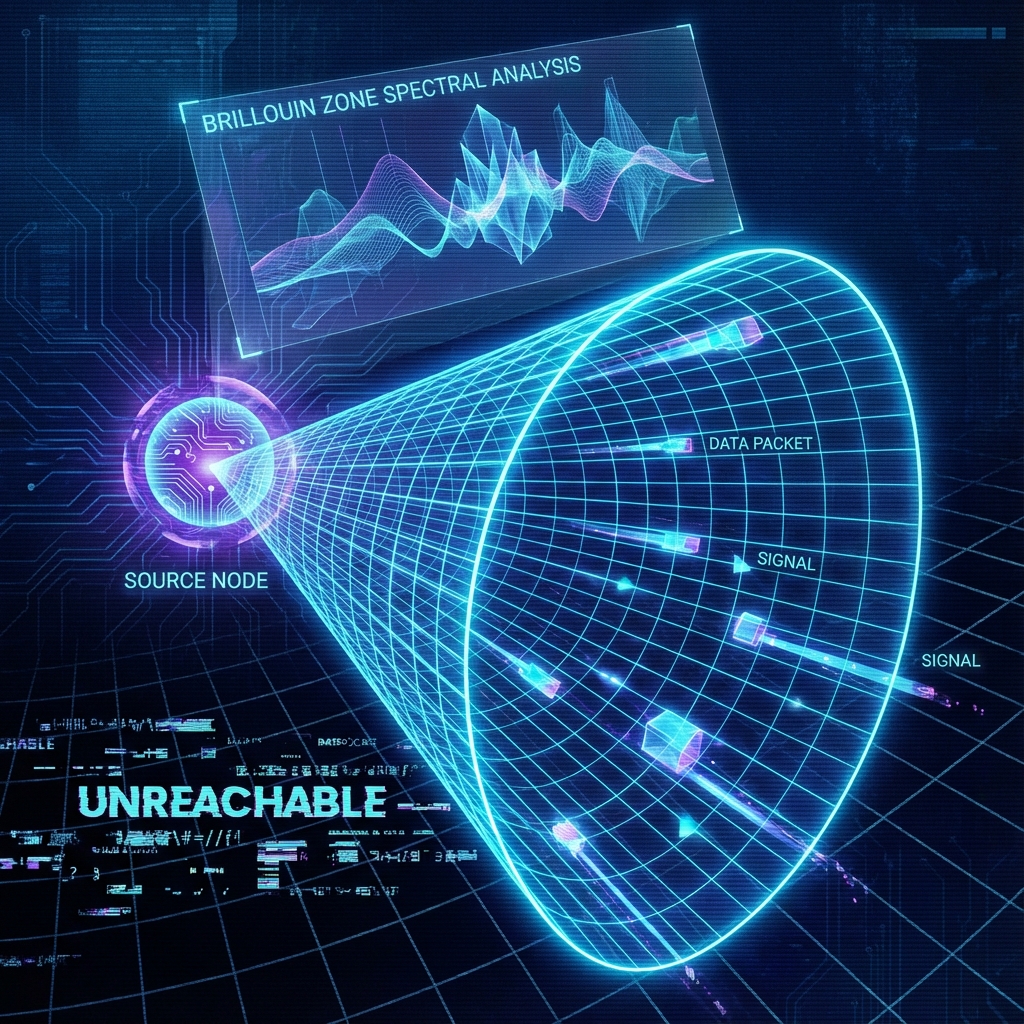
—— Signal Integrity and Natural Regularization
“Causality is not a philosophical iron law; it is the physical latency of local network propagation.”
1. Signal Integrity: From Locality to Light Cones
In the previous chapter, we defined the universe’s underlying hardware as a discrete Quantum Cellular Automaton (QCA). Since each cell (processor) can only directly exchange data with its neighboring cells, an inevitable corollary follows: Information cannot instantaneously span the entire network.
In the old conception of continuous spacetime, the speed of light is often regarded as a sacred geometric preset, hardcoded into the Minkowski metric. But from our micro-architecture perspective, there is no preset “speed of light,” nor any preset “light cone.” What we have is only Local Interactions and the maximum signal propagation speed that emerges from them.
This signal delay limit determined by the underlying topological structure is called Lieb-Robinson Bounds in mathematical physics. It is the first cornerstone for constructing the universe’s causal structure.
2. Theorem: The Lieb-Robinson Bound
To quantify signal propagation, we need to examine how a local perturbation diffuses through the lattice network.
Setup:
Consider a quantum system defined on lattice . Let and be two finite regions on the lattice, and and be observable operators supported on and respectively (i.e., only acts on quantum states in region , only acts on region ).
At time , since and are spatially separated, these two operators commute (). This means measurements at do not interfere with states at .
As discrete time evolves, operator becomes in the Heisenberg picture. At this point, the support region of gradually expands.
Theorem 2.2 (Lieb-Robinson Inequality)
There exist positive constants and a finite speed such that for any , the norm of the commutator satisfies the following upper bound:
where denotes the shortest distance between the two regions on the lattice.
Physical Proof and Interpretation:
The left side of this inequality measures whether operations on region at time can be detected by observers in region (i.e., whether the two operations no longer commute).
The right side tells us:
-
Exponential Suppression: As long as distance is greater than , the commutator value decays exponentially with distance.
-
Effective Light Cone: We can define a linear region . Outside this region (spacelike region), signal strength is effectively zero (or exponentially tiny).
-
Speed Limit: is called the Lieb-Robinson Speed. It is determined by the strength and range of microscopic interactions. In the continuous limit, this directly corresponds to the speed of light in special relativity.
Conclusion: Causality is not an axiom, but a statistical necessity of local interaction networks.
3. Natural Regularization: Brillouin Zone and Finite Bandwidth
Modern physics, especially quantum field theory, has long been plagued by “Infinities”.
When we try to calculate interactions between two particles at extremely short distances, or calculate the zero-point energy of vacuum, integrals often diverge. This is called Resource Overflow or Infinite Recursion Error in software engineering.
The root cause of this divergence lies in the continuity assumption: if unrestricted, wavelengths can be infinitely short (frequencies infinitely high), meaning the system has infinite degrees of freedom. But in the FS-QCA Architecture, this assumption is completely broken by the underlying discrete structure.
Mechanism A: Compactification of Momentum Space (Brillouin Zone)
Since space is a discrete lattice (spacing ), according to Fourier transform principles, the system’s momentum space is no longer unbounded , but a topologically compact Brillouin Zone, typically torus .
Momentum is restricted to the range:
This means no wavelengths shorter than exist. All momentum integrals are naturally replaced by finite integrals .
Mechanism B: Energy Cap
Since time evolution is discrete and driven by unitary operator , the system’s energy spectrum (quasi-energy) is also confined to a finite bandwidth. No physical states with infinite energy exist.
Conclusion:
QCA provides physics with a Natural Ultraviolet Regulator.
We do not need to artificially introduce a cutoff and then let it tend to infinity. The underlying grid size itself is a physical hard cutoff. This completely eliminates the “ultraviolet divergence” problem that has plagued theoretical physics for half a century, and makes calculations of divergent quantities like black hole entropy finite and meaningful. All topological indices and geometric phases are well-defined and stable in this discrete spectrum.
The Architect’s Note
On: Network Latency and Crash Protection
As system architects, we must handle two core risks when designing the universe kernel: signal conflicts and system crashes.
1. is the Universe’s Ping Value
The existence of Lieb-Robinson speed tells us that instantaneous network-wide broadcast (Action at a Distance) is physically impossible.
If node A undergoes a state update, node B must wait for data packets to hop through intermediate nodes (Hop-by-Hop).
-
This is why we see “light cones” macroscopically—they are merely the inevitable latency of data synchronization.
-
Faster-than-light communication is forbidden because it violates the underlying routing protocol. If you try to send information faster than , your data packets will be lost before reaching the destination or become unreadable due to excessively low signal-to-noise ratio (exponential decay).
2. Prevention of Blue Screen of Death (BSOD)
Traditional quantum field theory allows infinitely short wavelengths (infinitely high frequencies), which is equivalent to allowing code to request infinite memory or execute infinitely deep recursion. This inevitably leads to system crashes (calculation results diverge to infinity).
Our architecture fixes this serious bug through Pixelation.
-
The universe sets a minimum resolution (lattice spacing).
-
When you try to probe scales smaller than this, you won’t see deeper truth; you’ll only see Aliasing Effects—like the pixels you see when zooming into a low-resolution image on a screen.
“Infinity” not only does not exist physically, it is also logically illegal. A stable universe system must be finite to be computable. All so-called “singularities” or “divergences” are merely mathematical artifacts produced when we use incorrect continuous approximation models (extrapolated beyond the Brillouin zone). On the underlying grid, everything is finite and smooth.