Chapter 1.1: The Budget Equation
—— The Generalized Parseval Identity
“The system’s total throughput is constant. Every displacement is a hijacking of computational resources.”
1. Orthogonal Decomposition of the Tangent Bundle
In the previous chapter, we established through Axiom I a fundamental property of the universe: the total Fubini-Study rate of state evolution is hardcoded as the constant . This raises a direct question: if the total rate is fixed, how do the diverse physical phenomena we observe in the macroscopic world (such as flying bullets, decaying atoms, entangled particles) arise?
The answer lies in Allocation.
To quantify this allocation, we need to delve into the geometric structure of projective Hilbert space. At any moment , the tangent space at the system state contains all possible directions of evolution at that moment. We decompose this tangent space into three mutually orthogonal linear subspaces (Sectors), corresponding to different categories of physical degrees of freedom.
Definition 1.1.1 (Orthogonal Sector Decomposition)
Assuming the evolution on the total Hilbert space is driven by different sets of generators, we can decompose the tangent space as:
where:
-
(External Sector): The subspace spanned by generators such as spatial translations and rotations (e.g., momentum operator ). Since momentum operators are associated with position changes, this sector corresponds to the “external motion” we observe in classical physics.
-
(Internal Sector): The subspace spanned by generators of internal degrees of freedom (e.g., rest mass Hamiltonian , spin, gauge charges). This sector corresponds to the “intrinsic property evolution” of particles, manifesting macroscopically as the elapse of proper time.
-
(Environmental Sector): When we treat the system as open, the subspace spanned by generators involving interactions with auxiliary environmental degrees of freedom. This sector corresponds to the establishment of “quantum entanglement” and information leakage.
Correspondingly, the velocity vector describing the total evolution of the universe can be uniquely projected and decomposed into three components:
And we need to ensure these components are orthogonal in the Fubini-Study metric sense, i.e., (when ). This is usually guaranteed by the commutation properties of the underlying generators or specific state structures.
2. Theorem: The Generalized Parseval Identity
Based on the Riemannian geometric properties of the Fubini-Study metric and the orthogonal structure above, we derive the most central dynamics equation of this book, which forms the geometric foundation for unifying relativity and quantum mechanics.
Theorem 1.1 (The Generalized Parseval Identity)
The instantaneous evolution velocity components of the universe strictly satisfy the following quadratic conservation law:
where denotes the instantaneous FS rate in sector .
Proof:
-
Premise Introduction: According to Axiom I, the total Fubini-Study modulus of the full differential tangent vector is constant, i.e., .
-
Linear Decomposition: Substitute the velocity vector, .
-
Inner Product Expansion: Compute the squared modulus:
-
Orthogonality Utilization: Since we define sectors as mutually orthogonal, all cross terms (such as ) are zero.
-
Pythagorean Theorem: What remains are only self-interaction terms, i.e., the sum of squared moduli of each component:
-
Conclusion: Substituting the condition from Axiom I, we obtain .
3. Interpretation: The Zero-Sum Game of Computational Resources
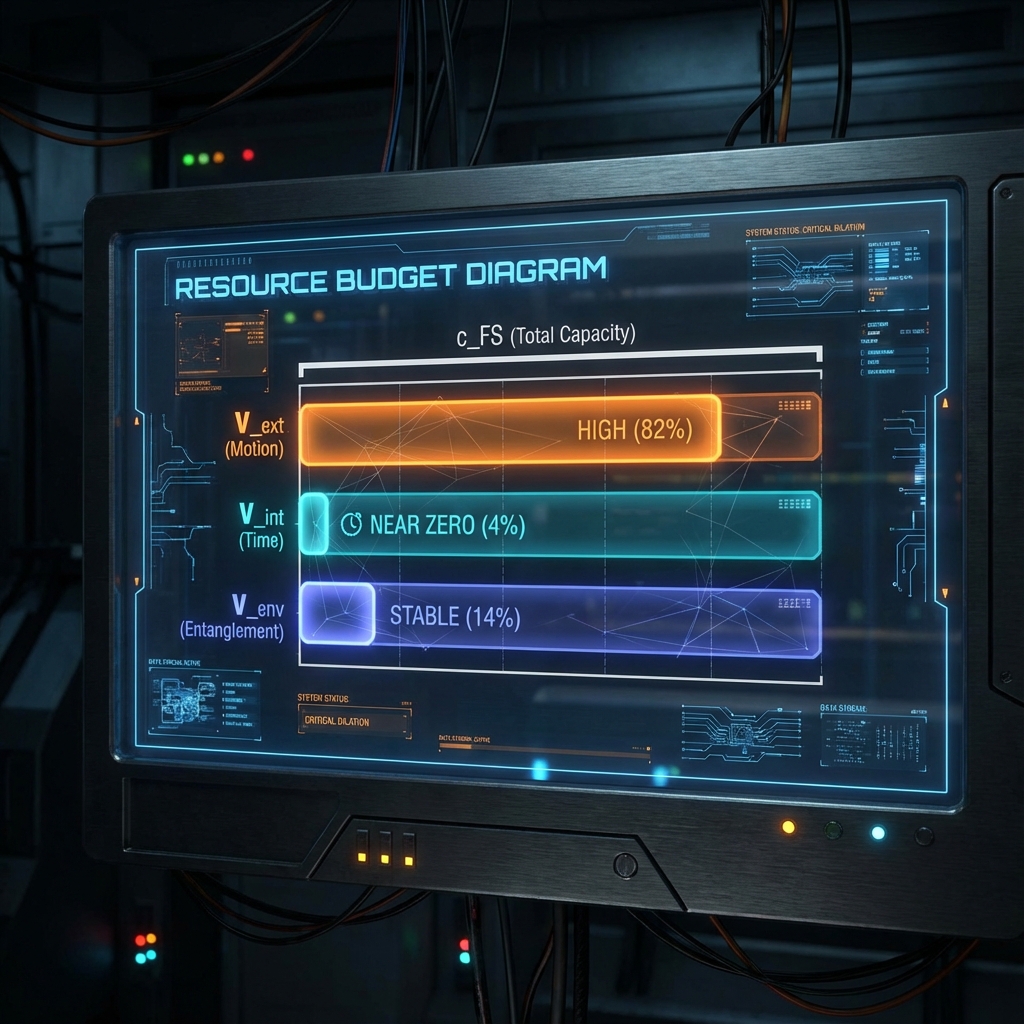
This equation is not merely an elegant geometric identity; it is the fundamental economic principle governing physical reality. It reveals the “impossible triangle” in physics: changes in position, the elapse of time, and information entanglement are actually competing for the same finite resource pool.
We interpret as the “Information-Velocity Budget”.
-
(Spatial Bandwidth Cost): This is the computational power consumed by the system to update an object’s position coordinates in external space.
-
(Internal Computation Cost): This is the computational power consumed by the system to maintain the evolution of an object’s internal quantum states (such as phase factors). Macroscopically, this corresponds to the existence of mass and the elapse of proper time.
-
(Network Communication Cost): This is the computational power consumed by the system to handle interactions with the environment (establishing entanglement).
This identity enforces a Zero-Sum Game:
You cannot have everything. If you want to move fast in space (increasing ), you must borrow budget from elsewhere. Typically, this budget is deducted from .
Corollary 1.1.1 (Geometric Reconstruction of Special Relativity)
For an isolated system (ignoring environmental entanglement, setting ), the equation simplifies to:
This explains the physical mechanism of Time Dilation.
When a particle accelerates in space (), to maintain equation balance, its internal evolution rate must decrease.
When approaches the limit , is forced to approach 0. This is why photons (Massless Particles) do not experience time—they are “Computationally Bankrupt” entities that spend all their budget on propagation, with no remaining resources to maintain an internal clock.
The Architect’s Note
On: Multithreading on a Single Core
We can imagine the universe as a single-core CPU, whose clock frequency corresponds to . On this CPU, three main threads are running:
-
I/O Thread (): Responsible for moving data (changing positions).
-
Worker Thread (): Responsible for processing business logic (evolving internal states, i.e., experiencing time).
-
Network Thread (): Responsible for synchronizing with other nodes (entanglement).
The Generalized Parseval Identity tells us: Because the bus bandwidth is locked, these three threads must time-share or compete for resources.
-
Idle State: The I/O thread is suspended (). All computational power is allocated to the Worker thread (). At this point, your internal clock runs fastest, and your “sense of existence” (mass) is strongest.
-
Full Load Transmission: Like photons, the I/O thread occupies all bandwidth (). The Worker thread is completely Starved (). For photons, the moment they are emitted and the moment they are absorbed are simultaneous in their own reference frame, because they have never executed a single “internal clock interrupt.”
-
Moving Clocks Slow Down: This is not some mysterious spacetime curvature; it is simply the basic logic of the Resource Scheduler. When you run, the system is forced to Throttle your internal clock to handle the data stream generated by your displacement. Physics is essentially the QoS (Quality of Service) strategy of the universe’s operating system.