Volume IV: Observer, Cybernetics, and Ultimate Causality
(第四卷:观察者、控制论与终极因果)
Chapter 9: Multi-User Protocol
(第九章:多用户协议)
9.2 Mechanism Against Conflict: Pauli Exclusion Principle as Information-Theoretic Constraint
(防冲突机制:泡利不相容原理的信息论解释)
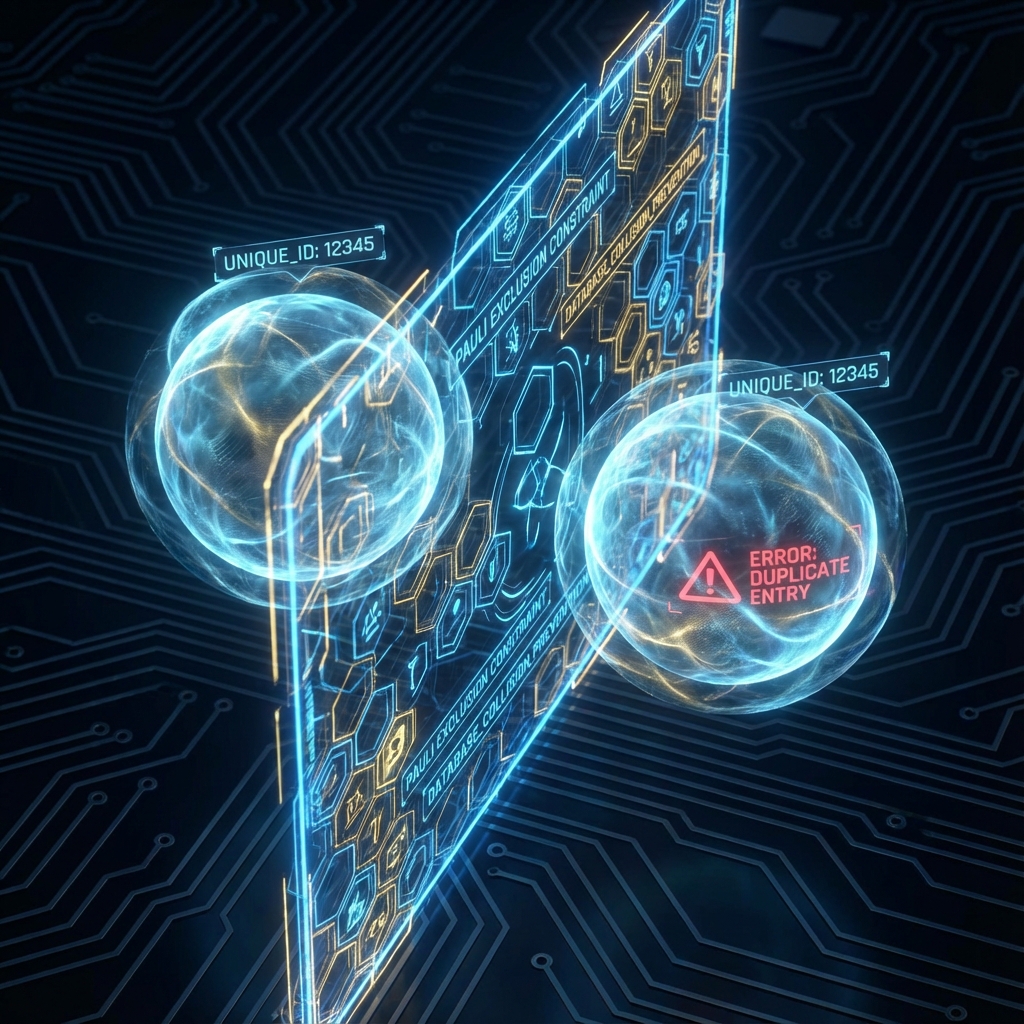
“Why is matter hard? Why can’t we walk through walls? This is not primarily due to electromagnetic repulsion, but to deeper logical constraints. In an interactive computational universe, fermions (matter particles) are defined as persistent objects with ‘Unique Identifiers’ (Unique ID). The Pauli exclusion principle is the anti-clipping algorithm enforced by the system database to prevent ‘Primary Key Collisions.’”
In Section 9.1, we established the multi-user consensus protocol, explaining why multiple observers can see the same world. This raises a new engineering challenge: in a shared virtual environment, if two players (or two particles) attempt to occupy exactly the same spacetime coordinates and quantum states, how should the system handle this?
In classical wave dynamics, waves can superimpose (linearity). But in the macroscopic reality we perceive, matter has Impenetrability—you cannot sit on a chair already occupied by someone else. The physical root of this “hardness” is the Pauli Exclusion Principle.
This section will prove that the Pauli exclusion principle is not a mysterious quantum force, but a Unique Constraint protocol in multi-agent computational systems. It distinguishes between Messages (bosons) and Entities (fermions), thereby ensuring the existence of complex material structures.
9.2.1 Type Distinction: Messages vs. Objects
In computer science, we distinguish two basic data interaction modes:
-
Broadcast/Message: Multiple receivers can receive the same message; multiple waveforms can superimpose in optical fibers. Data is Non-exclusive.
-
Object/Resource: A memory address can only store one variable at a time; a database record must have a unique primary key. Data is Exclusive.
In physics, this precisely corresponds to two classes of fundamental particles:
-
Bosons (e.g., photons): Follow Bose-Einstein statistics.
-
Property: Multiple particles are allowed to be in the same quantum state .
-
Computational Definition: Bosons are the system’s Packets. They are responsible for transmitting interactions (forces) between objects, so they must support superposition and broadcast (like lasers). They have no individual identity, only carriers of energy.
-
-
Fermions (e.g., electrons, protons): Follow Fermi-Dirac statistics.
-
Property: Any two fermions cannot be in exactly the same quantum state.
-
Computational Definition: Fermions are the system’s Persistent Objects. They constitute the skeleton of matter. To ensure logical consistency, the system assigns them Individual Identity, prohibiting data overlap.
-
9.2.2 Antisymmetric Wavefunction as Hash Collision Detection
The mathematical formulation of Pauli’s principle lies in that the wave function of identical fermion systems must be Antisymmetric.
For two fermions and , exchanging their positions, the wave function’s sign must flip:
If these two particles attempt to occupy exactly the same state (i.e., ), it must satisfy:
The only solution is:
Computational Interpretation:
The wave function represents the legality probability amplitude of system configurations.
-
means the probability of this configuration is zero, i.e., Illegal Operation.
-
Antisymmetry is actually an underlying Hash Check Algorithm. The system constantly monitors the “state fingerprints” (quantum numbers ) of all fermion objects.
-
When the system detects that two objects have identical fingerprints, the check function returns (null pointer), preventing this state from being instantiated. This is the physical “exchange repulsion”, which requires no exchange of mediating particles, purely arising from logical impossibility.
9.2.3 Electron Shells: Memory Address Allocation Table
If the Pauli exclusion principle did not exist, all electrons in atoms would fall to the lowest energy ground state ( orbital). If that were the case, all atoms would have identical chemical properties, chemical bonds could not form, and complex life and the universe would not exist.
Due to the uniqueness constraint, electrons are forced to Stack:
-
The 1st electron occupies the orbital (address
0x001). -
The 2nd electron attempts to enter but is rejected by the system (
Error: Address Occupied), forced to occupy the orbital (address0x002). -
And so on, constructing complex electron shell structures.
Theorem 9.2.1 (Structure Emergence Theorem)
The macroscopic volume and chemical diversity of matter are direct results of the system performing Sequential Memory Allocation under Uniqueness Constraints. The periodic table is essentially the Address Map of the universe’s memory management unit (MMU).
9.2.4 Degeneracy Pressure: Physical Manifestation of Logical Errors
When gravity (system load balancing mechanism, see Section 5.1) attempts to compress stellar matter to the extreme, it encounters a powerful counterforce—Degeneracy Pressure. White dwarfs are supported by electron degeneracy pressure, neutron stars by neutron degeneracy pressure.
This pressure is very peculiar; it is independent of temperature. Even at absolute zero, it still exists.
In Interactive Computational Cosmology (ICC), degeneracy pressure is the macroscopic manifestation of Logical Exception Throwing.
-
Compression: Gravity attempts to cram more fermions into smaller phase space volume (reducing uncertainty in ).
-
Conflict: According to Heisenberg’s bandwidth theorem (Section 6.1), decreasing causes to increase. To avoid state overlap (maintaining uniqueness of phase space cells ), fermions are forced to occupy higher momentum states.
-
Resistance: This forced high momentum manifests as outward pressure.
This is like trying to cram 101 people into a theater with only 100 seats. No matter how hard you push, the 101st person cannot enter. This “cannot enter” resistance is not because the seat surface has repulsion, but because the ticketing system (Pauli principle) refuses to issue a ticket.
Corollary 9.2.1 (Nature of Contact)
When you slap a table with your hand, the “hardness” you feel is more than 90% due to electron degeneracy pressure (Pauli repulsion), not electromagnetic repulsion. You are actually touching the Unique Constraint boundary in the universe’s code. Your hand cannot pass through the table because the system prohibits coordinate data overlap between two objects (Clipping).
9.2.5 Summary: Foundation of Multi-User World
The Pauli exclusion principle is a core component of the Multi-User Protocol.
-
Without it, all matter would collapse into an undifferentiated Bose-Einstein condensate (BEC), and the world would become a single wave function.
-
With it, each fermion must maintain its individual independence.
This provides the physical foundation for “multi-user”: precisely because fermions cannot overlap, we can have independent bodies, and brains can have independent neural structures. We are not only independent oracles in consciousness (software), but also mutually exclusive persistent objects in matter (hardware). The Pauli principle is the underlying law that allows us to “occupy a place in this world.”