Volume II: Emergence of Spacetime
(第二卷:时空的涌现机制)
Chapter 4: Holographic Principle and Spatial Metric
(第四章:全息原理与空间度规)
4.1 Area Law of Entanglement Entropy
(纠缠熵面积律)
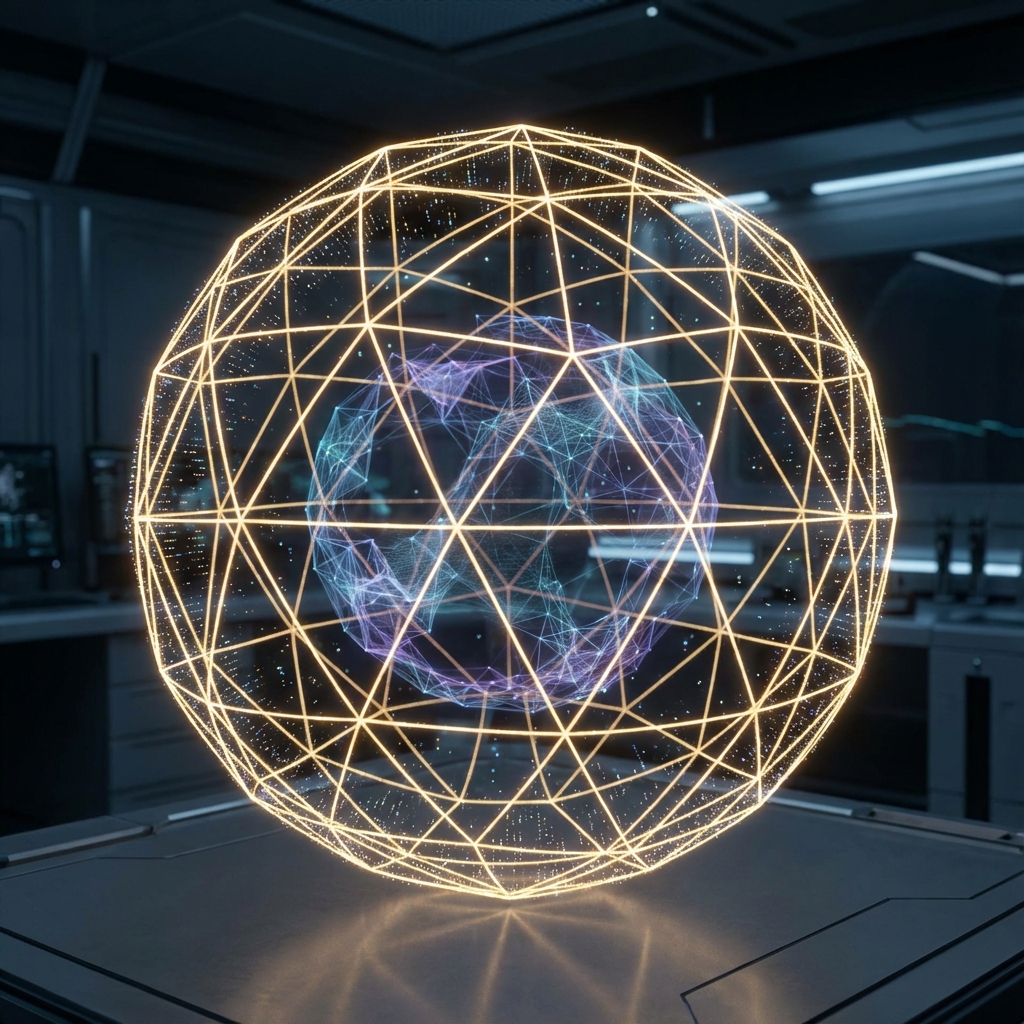
“Space is not a container holding objects, but an emergent picture of mutual entanglement between objects. Distance is decorrelation, geometry is information. When we deeply explore the microscopic structure of space, we find that the three-dimensional volume is merely a holographic projection of entanglement information on a two-dimensional boundary.”
In Chapter 3, we derived the spacetime kinematics of special relativity by analyzing bandwidth limits of information propagation (speed of light). However, a deeper question remains unanswered: How does “space” itself, as a stage, exist?
In classical physics, space is treated as a pre-existing, continuous background manifold. But within the framework of Interactive Computational Cosmology (ICC), any physical object must be computable. A continuous, infinite-precision background space violates the Axiom of Finite Information. Therefore, space must be Emergent.
This section will argue that macroscopic geometric spatial structures are essentially tensor network representations of entanglement relationships in the underlying qubit network. Through the Area Law of Entanglement Entropy, we will prove that the so-called “three-dimensional volume” is actually redundant data structures generated by the system to process entanglement information, and the true effective information exists only on lower-dimensional boundaries.
4.1.1 Geometry from Entanglement
In traditional geometric concepts, if the coordinate values of two points and are close, we say they are “near.” But from a quantum information theory perspective, distance has a completely new definition.
Definition 4.1.1 (Information Distance)
In quantum many-body systems, the “distance” between two subsystems and is determined by their Mutual Information .
If two qubits are in a maximally entangled state, they are logically “adjacent,” regardless of how far apart they appear in macroscopic space.
This viewpoint is called the generalized form of the ER = EPR Conjecture: Einstein-Podolsky-Rosen pairs (EPR Pairs, i.e., quantum entanglement) and Einstein-Rosen bridges (ER Bridges, i.e., wormholes/spatial connections) are mathematically equivalent.
Therefore, Hilbert space, which originally had no geometric structure, weaves a topological structure of “near” and “far” through entanglement networks between countless qubits. Space is a giant entanglement graph.
4.1.2 Conflict between Area Law and Volume Law
To quantify this entanglement geometry, we need to examine the system’s Entanglement Entropy.
Let the entire system be in a pure state . We divide the system into two regions: region of interest and environment . The von Neumann entropy of region is defined as:
where is the reduced density matrix of region .
In thermodynamics, entropy usually follows the Volume Law: . This means every particle inside the system contributes independent degrees of freedom, and information is widely distributed throughout the volume. This corresponds to classical gases or high-temperature thermal reservoirs.
However, in the ground state (vacuum) of quantum field theory and most quantum many-body systems in low-energy states, we observe a surprising counterintuitive phenomenon—the Area Law:
Theorem 4.1.1 (Area Law of Entanglement Entropy)
For quantum many-body systems with local Hamiltonians in their ground state, the entanglement entropy of subregion is not proportional to its volume , but proportional to the surface area of its boundary :
This mathematical fact reveals the holographic nature of space:
-
If the information content inside a three-dimensional sphere is only proportional to its surface area, this means most “voxels” inside the sphere (Bulk) are Redundant in information theory.
-
The true independent degrees of freedom do not fill the entire space; they only cover the boundary. Three-dimensional space is not solid; it is a Holographic Projection.
4.1.3 Tensor Networks and Spatial Renormalization
To understand how this holographic projection is computationally realized, we need to introduce Tensor Networks, particularly Multi-scale Entanglement Renormalization Ansatz (MERA).
In computational simulations, to compress and store huge wave functions, we use tensor networks to approximate quantum states. MERA networks have a hierarchical structure:
-
Bottom Layer: Corresponds to microscopic physical degrees of freedom (such as lattices on a one-dimensional chain).
-
Top Layers: Coarse-grain information through Disentanglers and Isometries.
When we draw the MERA network, a surprising geometric structure emerges:
-
The original one-dimensional quantum system lies at the network’s edge (Boundary).
-
The hierarchical structure of the tensor network extends inward, naturally constructing an additional dimension.
-
This emergent geometric structure mathematically precisely corresponds to Hyperbolic Space or Anti-de Sitter Space (AdS).
Computational Implication:
The “curved spacetime” or “gravitational field” we perceive is, in the underlying code, actually the Renormalization Group Flow optimizing quantum computational efficiency.
-
Tensors near the boundary represent high-frequency, short-wavelength modes (microscopic details).
-
Tensors deep inside (Bulk) represent low-frequency, long-wavelength modes (macroscopic contours).
-
The “depth” of space is the Logical Depth of computational processing.
4.1.4 Ryu-Takayanagi Formula
In 2006, Shinsei Ryu and Tadashi Takayanagi proposed the most famous quantitative formula in the holographic principle, completely unifying quantum information with geometry.
Formula 4.1.1 (RT Formula)
In holographic duality (AdS/CFT), the entanglement entropy of subregion in the boundary field theory (CFT) strictly equals the area of the Minimal Surface homologous to in the bulk space (Bulk AdS), divided by :
This formula is the ultimate generalization of the Bekenstein-Hawking black hole entropy formula. It tells us:
-
Geometry is Entanglement: The area of the minimal surface directly measures the amount of quantum entanglement crossing that interface. If entanglement disappears (), the area shrinks to zero, and space Disconnects.
-
Origin of Gravitational Constant : is no longer a fundamental physical constant; it is the Bit-to-Geometry Conversion Factor in the holographic mapping, defining how many bits of entanglement can “support” a unit area of spacetime.
4.1.5 Summary: From Bits to Geometry
Based on the area law of entanglement entropy, we can draw the final conclusion of Interactive Computational Cosmology about space:
The universe is not a pre-existing three-dimensional box containing matter.
The universe is an Ocean of Qubits defined on a two-dimensional horizon (or abstract boundary).
Due to complex entanglement patterns between these qubits, the system uses tensor network algorithms to “decompress” and “visualize” this data, rendering a three-dimensional holographic image with depth.
The magnificent three-dimensional world we inhabit is essentially a Low-Loss Compression Format of boundary data. And universal gravitation is the geometric cost that this compression mechanism must pay to maintain data consistency.