8.2 User Interface (UI - Qualia)
(User Interface (UI) - Qualia)
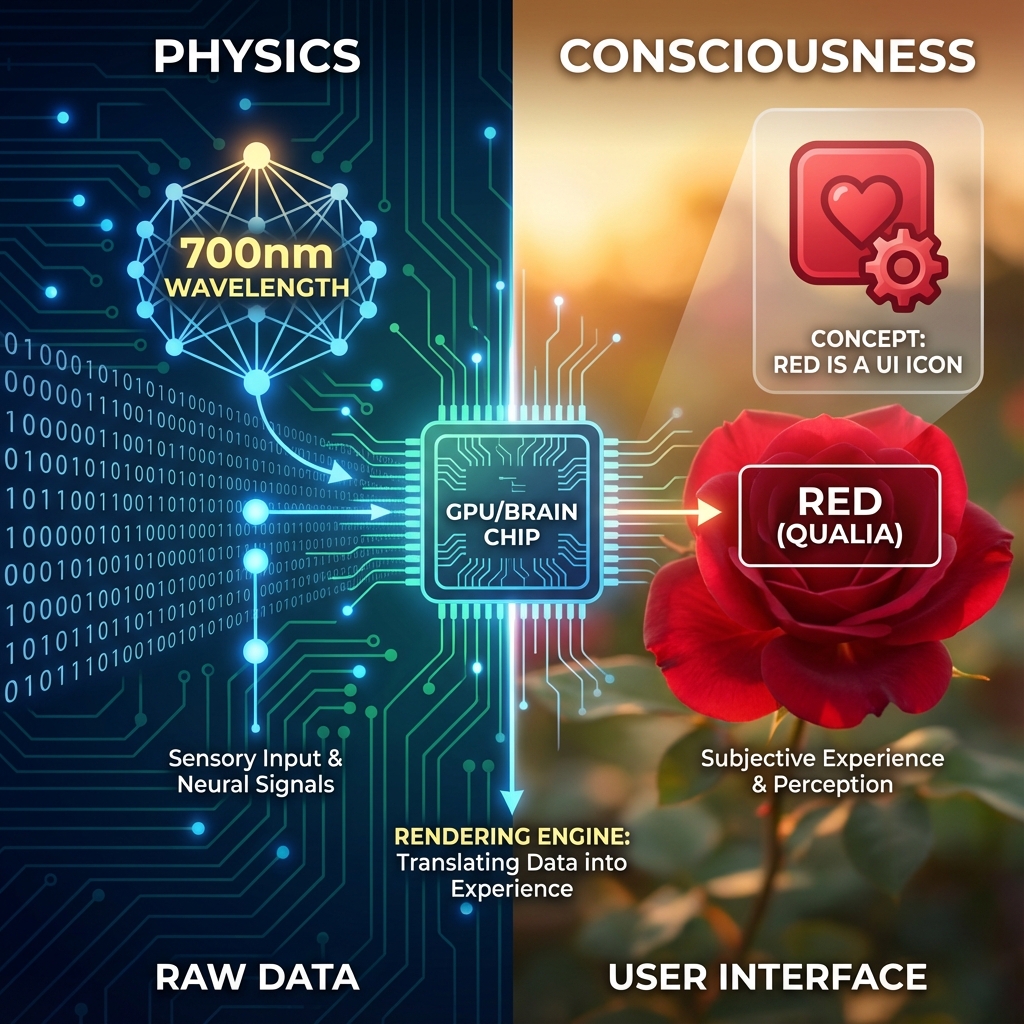
“For programmers, ‘red’ is code RGB(255, 0, 0); but for players, ‘red’ is danger alert. Qualia—the pain, itch, sourness, pleasure you feel—is not mysterious soul sparks; it’s the graphical user interface (GUI) rendered by the brain’s graphics card. Its only purpose: Let you understand that complex physical data in 0.1 seconds.”
In section 8.1, we said consciousness is the player. What does the player use to see the game? Can’t directly look at binary code, right? There must be a rendering engine that turns boring data into intuitive images. In Code of Azeroth, this image is qualia.
8.2.1 Mapping Physical Data to Subjective Experience
Philosophy has a “hard problem”: Why does neuron firing (physical process) produce pain (subjective experience)? Our answer: Because the system needs to feedback status to users.
- Physical input: 700nm electromagnetic wave (raw data).
- Neural encoding: Optic nerve signals (processing data).
- Qualia: Visual experience of “red” (UI display).
Definition 8.2.1 (Qualia Mapping)
Qualia are icons after physical data undergoes compression and rendering. Just like the computer desktop’s “trash” icon is not a real trash can, the “red” in your eyes is not real light. It’s a symbolic label. The system renders it as red to let you distinguish it from “green.”
8.2.2 Weber-Fechner Law: Logarithmic Compression
Our senses follow the Weber-Fechner Law: To feel sound twice as loud, physical energy must be ten times greater.
Computational principle: This is logarithmic encoding commonly used in computers. To transmit extremely wide signal ranges (from mosquito buzz to thunder) under limited bandwidth, the system performs lossy compression. Qualia are compressed system feedback.
8.2.3 Pain Is System Interrupt (Alert)
Qualia not only transmit information, but also value. Most typical is pain.
For pure machines, taking damage is just hp -= 10.
But for systems with players, pain is a high-priority system interrupt.
- Force preemption: When your hand is burned, intense pain forcibly pulls your attention back from elsewhere.
- Negative feedback: It’s a huge red popup: “Warning! System damaged!”
Corollary 8.2.1 (Cybernetics Function)
- Pleasure:
System Status = OK. Encourages you to continue. - Pain:
System Status = CRITICAL. Forces you to stop.
Conscious experience is not an evolutionary byproduct; it’s dashboard readings sent by the biological mech to the pilot.
8.2.4 Interface Illusion Theory: We Live on Desktop
This leads to Interface Theory.
If we could directly see the world’s truth (Hilbert space, wave functions), we couldn’t play at all. Because that world is too complex.
- To make it playable, the system must lie to us.
- The system renders “a bunch of organic molecules” as “delicious apple”.
- The system renders “gene carriers suitable for reproduction” as “beautiful girl”.
These experiences don’t exist physically; they’re completely rendered by this specific hardware called client.
Theorem 8.2.1 (Interface Closure)
Players can only operate the game through UI (qualia), cannot bypass UI to directly modify code (physical laws). The physics we study is essentially studying desktop icon logic, not underlying assembly code.
8.2.5 Summary: Immersive Experience
Qualia are the bridge connecting physical machine (brain) and virtual machine (consciousness).
- Without qualia: Players face boring 0s and 1s, can’t play.
- With qualia: Data becomes images, sounds, emotions. You sit in the cockpit, through these dashboards, piloting this carbon-based mech.
This mechanism is extremely efficient, but also brings a consequence: Immersion. The interface is so good that players often forget they’re playing a game, mistakenly thinking the interface itself is all of reality.