8.1 The Player Behind the Screen (Oracle Access: Physical Definition of Free Will)
(The Player Behind the Screen - Oracle Access and Free Will)
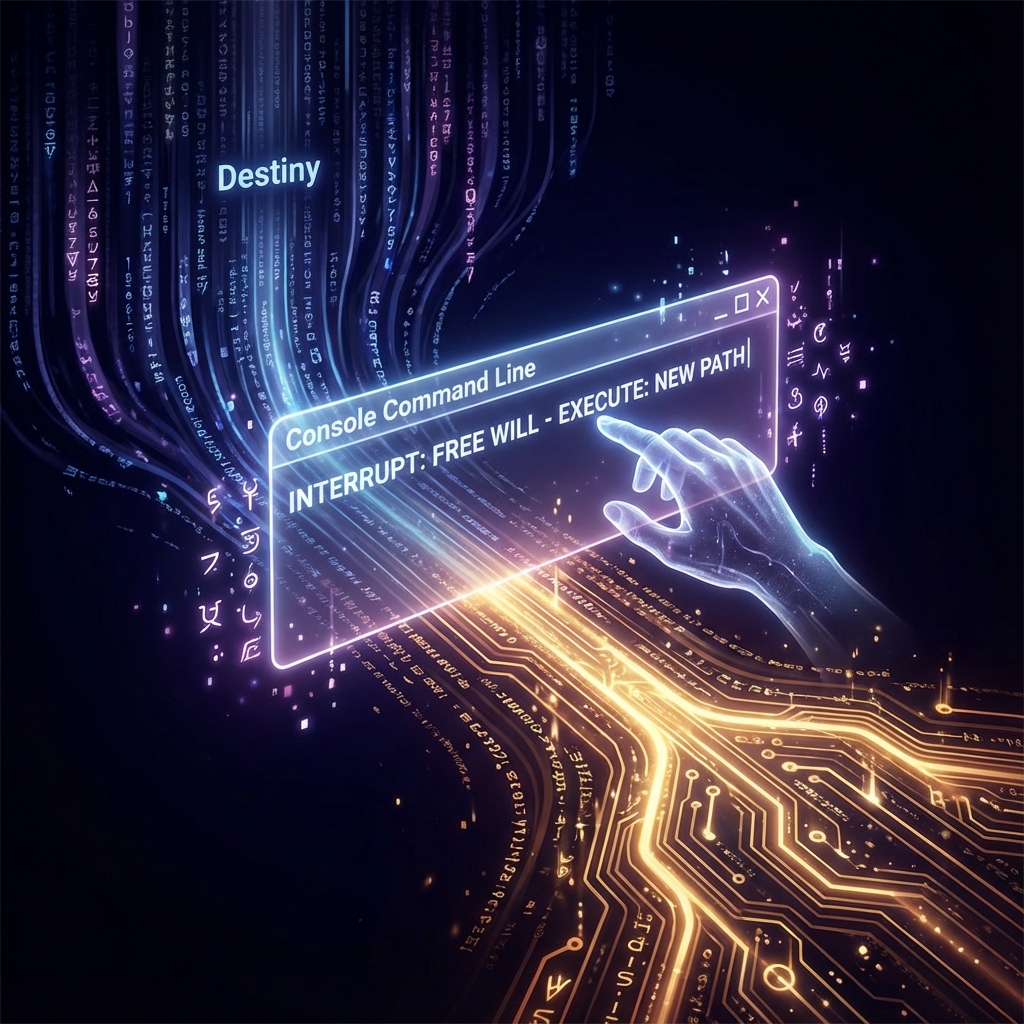
“Without connecting players, Azeroth is just empty-running code. NPC behavior is predetermined (algorithmic), but player behavior is unpredictable. Free will is not magic; it’s an interface the system leaves for external input sources to break algorithmic dead loops.”
The first three volumes built the world, but still lack the most important thing: User. Without players, the world is just a screensaver.
In old physics, consciousness was thought to be the brain’s product. But in Code of Azeroth, consciousness holds supreme status: It’s the system’s I/O interface. It’s the only non-algorithmic input source.
This section will use Turing’s “Oracle” concept to give free will a physical definition: Free will = external input interrupt.
8.1.1 Gödel Gap: Why Do We Need Players?
Gödel’s incompleteness theorem tells us: Any complex system has problems it cannot solve itself. For the physical universe computer, if it’s closed, quantum mechanics would get stuck on the halting problem (when exactly does Schrödinger’s cat die?).
To break this dead loop, the system must introduce an external guidance.
- Deterministic dead end: If everything is calculated, then the future is predetermined, boring.
- True randomness need: Computers can only generate pseudo-random numbers. True random choices must come from outside the system.
8.1.2 Definition of Physical Oracle
Turing proposed oracle in 1939: A black box that can solve problems computers cannot solve. In our model, consciousness = player.
Definition 8.1.1 (Consciousness Oracle)
Consciousness is a function defined outside the physical world. It receives current state and returns a choice. After the system gets this choice, it continues calculating the next frame according to physical laws (game rules).
Consciousness is non-algorithmic. This means you cannot write a cheat (program) to perfectly predict player movement, because players are outside the game code’s logical closure.
8.1.3 Free Will Is Interrupt Request (IRQ)
Free will is neither predetermined nor random. It’s information injection.
- Interrupt: When the brain faces a choice (superposition state), physical algorithm evolution suspends.
- Query: System asks player: “Boss, which way?”
- Choice (Input): Player presses keyboard (injects information).
- Continue (Resume): System receives command, collapses wave function, continues running.
Corollary 8.1.1 (Bandwidth of Will)
Free will is not infinite. Only at critical moments (branch points) will the system listen to you. If not facing choices, the system is in autopilot mode. This means most of the time we’re “AFK.”
8.1.4 Does Not Violate Physical Laws
Someone asks: Won’t players randomly pressing keys break energy conservation? No. Because oracle only sets boundary conditions.
Like when you press “jump” in a game:
- You didn’t modify gravity parameter ( unchanged).
- You just input a legal control command within the physics engine’s allowed range.
Theorem 8.1.1 (Causal Compatibility)
For NPCs in the game, player operations look like purely random natural phenomena. The existence of free will will not cause game crashes.
8.1.5 Summary: Account and Character
By introducing oracle, we separated account (Mind) and character (Brain).
- Brain: Is physical hardware, responsible for storing data, calculating health. It’s computable.
- Mind: Is account, responsible for experience and decisions. It’s non-algorithmic.
This explains why AI can pass Turing test but has no pain. Because AI only has character (code), no account (external player).
In the next section, we will discuss what interface (UI) this account uses to play the game. Spoiler: That UI is your feelings (Qualia).