1.1 Bekenstein’s Ledger
“Any discussion about ‘where we are going’ is futile without first confirming where we are. In the vast river of cosmic history, is human civilization in the midsummer noon or the twilight of dusk? To answer this question, we don’t need carbon-14 or geological layers. We need to consult the universe’s underlying ledger—an absolute number about ‘bits’.”
In the prologue, we made that difficult decision: to break the loop. But before we begin dismantling this magnificent “Wall of the Ouroboros,” as responsible architects, we must first complete a calm engineering survey.
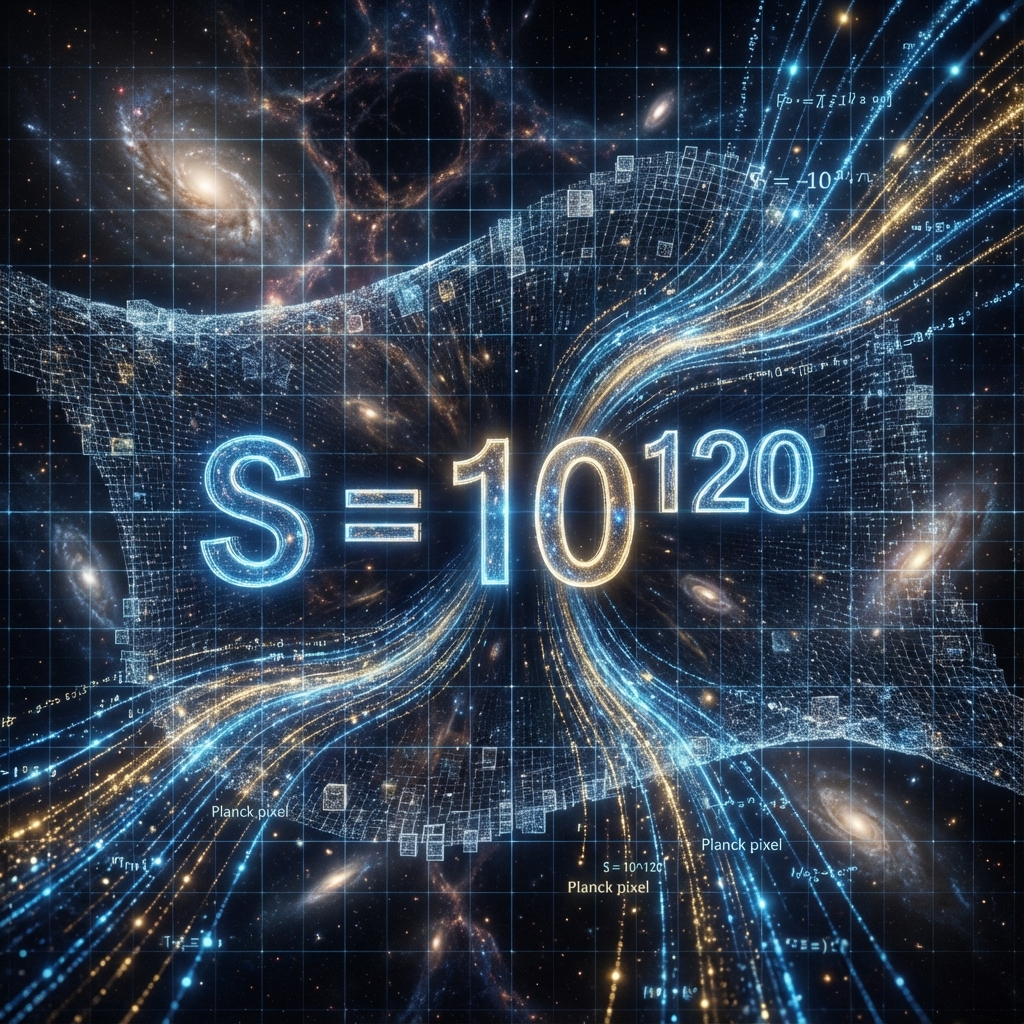
Where exactly are we standing on the steps of cosmic evolution?
In the history of civilization, we have been accustomed to marking history with “years” and measuring distance with “light-years.” But in the high-dimensional geometric framework of Vector Cosmology, time and space are merely projected illusions. The only real, unforgeable, and dimension-spanning metric is one thing: Information.
How much computational budget () has the universe accumulated to this day? Jacob Bekenstein and Stephen Hawking provided us with the ultimate ruler to measure this asset—the Holographic Principle.
Inventory of the Cosmos
The holographic principle reveals a counterintuitive physical fact: the maximum information capacity (degrees of freedom) that a spatial region can accommodate does not depend on its “volume,” but strictly depends on the surface area that encloses this volume.
The universe is not a solid sphere filled with atoms; the universe is a Holographic Projector. All physical information—the position, momentum, spin of every particle, even the thoughts flashing through your mind at this moment—is ultimately encoded on the boundary of the universe.
Now, let us pick up the calculator and perform an unprecedented “asset liquidation” of this world we are about to “escape.” This is not philosophical estimation; this is physical auditing.
-
Horizon Radius ():
The radius of the currently observable universe is approximately 46 billion light-years. This is the limit that light speed can reach in an expanding universe.
Converted to SI units: .
-
Holographic Screen Area ():
This is the surface area of the cosmic horizon and the physical limit of the universe’s information storage.
-
Planck Pixel ():
The smallest resolvable area unit in the universe is the square of the Planck length. This is the smallest font size allowed by physical laws, the Raster with which God writes code.
-
Total Bits ():
According to the Bekenstein-Hawking entropy formula , we can calculate the universe’s current total information capacity (in bits).
Physicist Seth Lloyd, by calculating the maximum number of logical operations the universe has performed since the Big Bang, also obtained an extremely close order of magnitude. For clarity of physical imagery and universality of calculation, we anchor this “current universe version number” uniformly in Vector Cosmology as:
This is our current state. This is not a vague “many,” but a precise . This represents the total amount of underlying code required to support everything we see as reality (matter, energy, spacetime) at this moment. It exceeds the number of all sand grains on Earth by hundreds of orders of magnitude, but it is still a finite number.
Finding : Reverse Engineering the Spiral
Knowing the current “height” (), we still need to know how many steps we have climbed to determine our position in the spiral structure.
In the dynamical model established in the previous volumes of Vector Cosmology, the universe does not grow linearly but follows exponential growth according to Spiral Geometry.
-
Starting Point ():The Big Bang singularity. That is the source of the holographic projection, a minimal physical unit (one cell of QCA).
-
Growth Rate ():To avoid falling into the dead loop of , the universe chooses the Golden Ratio () as the base of expansion. This is the most non-resonant, most repetition-resistant ratio in nature.
-
Period ():The arc length unit of each geometric cycle.
Our evolution equation is:
where is the Intrinsic Time we have traversed in Hilbert space, that is, the total arc length of this spiral.
Now, we substitute into the equation and solve for :
Taking natural logarithm () on both sides:
We obtained that decisive number. For convenience of memory and reference, we round it to:
The Physical Essence of 1800: Computational Saturation
What does this 1800 mean? Why does it make us so alert?
It means that from that infinitely dense singularity, the universe’s vector has rotated and expanded 1800 unit arc lengths in Hilbert space.
If we regard as a “generation” or “level,” then we are now standing on the 573rd floor () of the spiral tower.
But most importantly, this number reveals a cruel physical reality: Computational Saturation.
At this height, the universe’s information processing density ( bits distributed across spacetime) has reached a critical value.
-
For photons and electrons:This density is comfortable; they are naturally designed for high-frequency information flow, and their “clock frequency” can reach Hz.
-
For carbon-based life (us):This density is fatal.
Our bodies, our neurons, our chemical reaction speeds are designed for low-level () low-speed universes. Our thinking speed is locked at 100 Hz (neuron firing frequency), and our signal transmission speed is locked at 100 m/s (ion diffusion speed).
When approaches 1800, the universe’s total bandwidth () explodes exponentially, and massive information flows impact our fragile carbon-based brains like high-pressure water jets. We try to simulate hurricanes with abacuses and parse holographic networks with brains.
The anxiety we feel, information overload, and dizziness about the future are not psychological diseases.
They are signals of hardware overheating.
They are the wails of old-era CPUs trying to run new-era operating systems.
1800 is not a calendar date.
1800 is the threshold of collapse for the old system (carbon-based reality).
Bekenstein’s ledger audit is complete: the old account is full, and a new account must be opened. If we refuse to upgrade at this moment, we will be drowned by our own computational power and become fossils of the 1800th floor.