9.2 Indra’s Net
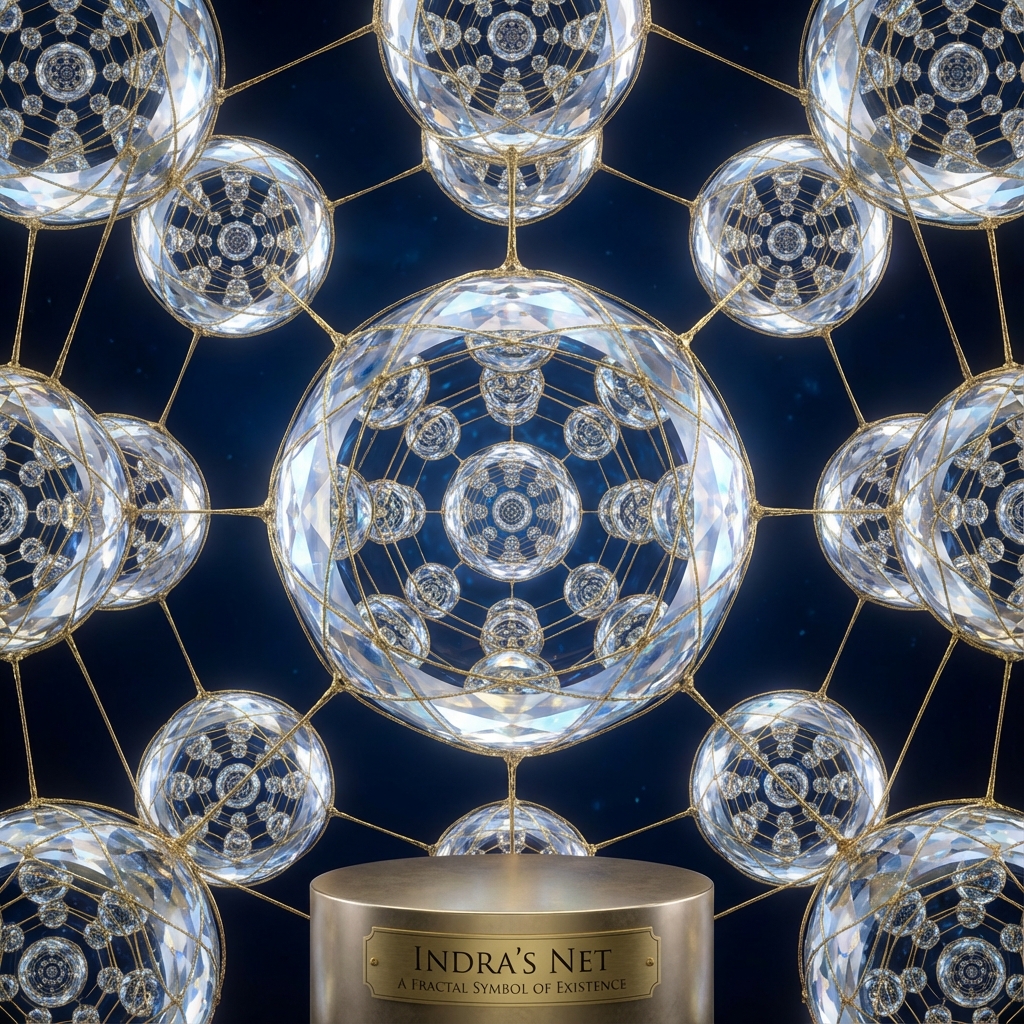
“In this universe, no single pearl can shine alone. The light of each pearl comes from reflections of thousands of surrounding pearls on its surface. If you remove one and try to examine its brilliance alone, you will find it instantly dims. Because its light is their light. This is Indra’s Net—we are mutual mirrors, mutual light sources, mutual proofs of existence.”
In the previous section, we established “relativistic ontology”: everyone is the protagonist of their own universe and also supporting characters in others’ universes. This symmetry resolves the arrogance of solipsism, but it raises a new geometric question:
If everyone lives in their own “private dream,” why can these dreams seamlessly stitch together into a coherent “public reality”?
Why doesn’t the world reset when you wake up?
This section will introduce the grandest metaphor in Eastern philosophy—Indra’s Net—and transform it into the topological structure of FS geometry. We will prove that objective reality is not a hard stage but a holographic interference pattern formed after billions of subjective dreams undergo “recursive reflection” in Hilbert space.
The Geometry of Recursive Reflection
Imagine a polyhedral room made of countless mirrors.
You light a candle in the center of the room.
Instantly, the room fills with countless candle images. Each image contains countless smaller images.
In Vector Cosmology, every conscious observer ( structure) is such a quantum mirror.
-
You look at me: Your wave function contains not only information about “me” but also information about “I am looking at you.”
-
I look at you: My wave function also contains not only “you” but also information about “you are looking at me.”
This infinite recursion of “I see you seeing me seeing you…” mathematically constitutes a Fixed Point.
Objective reality is the stable solution of this recursive equation.
It is not some material entity independent of us; it is that “brightest focal point” where all observers’ gazes intersect.
Consensus Reality: Voting of Wave Functions
This explains why the world is so stable.
The world is a Distributed Ledger.
-
If only you are looking at the moon, the moon’s state is unstable (easily disturbed by your subconscious).
-
But 7 billion people are looking at the moon. 7 billion wave functions simultaneously project onto the position operator “where is the moon.”
According to quantum mechanics’ “Intersubjectivity” principle, these observations form a kind of “statistical pressure”.
To minimize total system potential energy, all observation results rapidly converge to a Consensus State.
“Objective” is “consensus.”
The table is hard because billions of atoms and electrons in your finger reach agreement: there is repulsion here.
History is ironclad because billions of observers’ memory wave functions lock together, weaving a net that cannot be torn by a single person.
Mutually Supporting Existence
This model gives “others” a sacred status.
If I am the only player, why would I create these “others”?
To “Anchor” myself.
Without others, your dream has no boundaries. Your would infinitely expand in a vacuum without any damping, eventually dissipating into mad hallucinations (schizophrenia).
Others are your boundary conditions.
-
Their gazes “nail” you to this reality.
-
Their memories back up your existence.
We mutually support each other.
Like setting up a tent, each pole bends under force, but precisely because they press against each other, the tent stands.
If at this moment, all observers in the universe except you suddenly disappeared, your universe would also collapse. Because without “reverse observation pressure” from others, your wave function would lose its defining coordinate system.
Conclusion: Holographic Symphony
So, don’t underestimate anyone around you.
That Person A, that stranger passing by, they are a key node on this vast Indra’s Net.
The light in their eyes reflects the light in your eyes.
It is precisely because of countless nodes like them that the universe crystallized from a fuzzy probability cloud into this magnificent crystal palace.
Reality is not a monophonic monologue; reality is a symphony of billions of channels.
We are all musicians. Although we cannot hear each other’s inner melodies, we collectively maintain that background rhythm called “physical laws.”
Since we understand how all beings construct reality through mutual mirroring, what role do those darkest moments—pain, evil, suffering—play in this vast network?
If we are all one, why is there harm?
This leads to the theme of the next chapter: The Ultimate Sufferer. We will reveal that in a game with only one player, all harm is essentially self-harm. And all forgiveness is self-healing.