8.1 Confidence is Computing Power
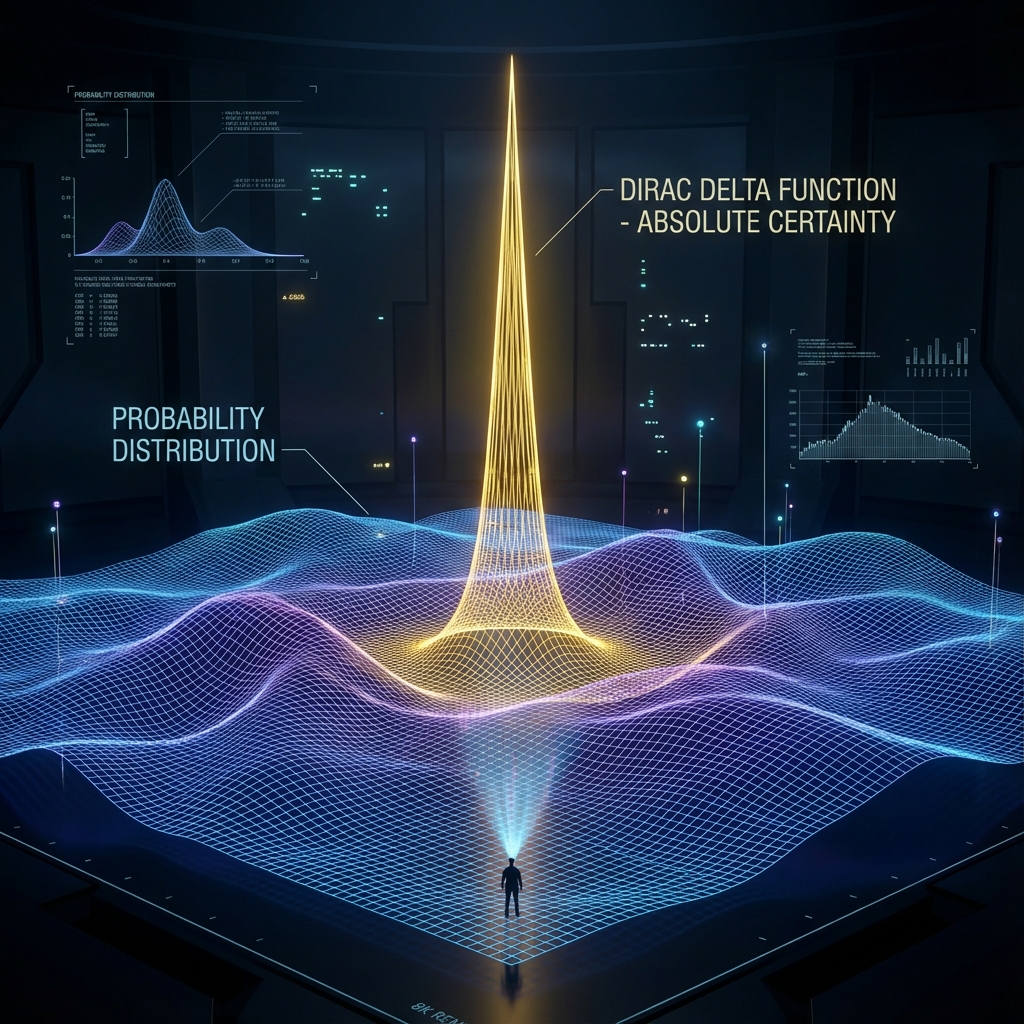
“Why do those extremely confident people—whether madmen or geniuses—often change the world? It’s not because they’re lucky, but because their certainty itself is a physical force. In the probability cloud of quantum mechanics, ‘belief’ is a high-intensity measurement. When you stare fixedly at a specific future, you are injecting enormous amplitude into that possible world until it transforms from phantom to entity.”
Weight Distribution of Wave Functions
First, we need to physically define what “confidence” is.
In Hilbert space, the future is in a superposition state:
Here, represents the probability of that outcome occurring.
For a confused ordinary person, their (internal intention) is scattered. Their confidence in success () might be only 10%, while fear of failure () accounts for 50%.
Such a wave function is “mediocre”, lacking clear directionality. It will be arbitrarily manipulated by environmental thermal noise ().
But for an observer with absolute confidence (like Jobs or Elon Musk), the situation is completely different.
Confidence is betting the entire modulus of on one specific basis.
-
They construct a future model in their mind.
-
They invest all budget to maintain high coherence of this model.
-
Result: , while coefficients of all other possibilities .
Geometrically, this is a “Spike”.
They create a “Dirac function” on the probability landscape of the future. They tell the universe: “Only this future is allowed.”
Anchor Effect: The Gravitational Source of the Future
What physical consequences does this extreme probability distribution produce?
In Chapter 4, we discussed “attractors.” Usually, attractors form naturally (like heat death).
But confidence creates an “Artificial Attractor”.
When you are extremely certain something will happen, you place a “phase anchor” at that future time point .
This anchor is not just a marker; it is a “negentropy source”.
-
For present reality (): This anchor generates a reverse “Tension”.
-
Response of the principle of least action: The universe always tends to take the path with “fastest phase accumulation.” Because you inject huge weight (confidence) on the target path, the “optical length” of this path becomes shorter.
Reality begins to distort.
Originally random events begin mysteriously converging in directions favorable to you.
-
Coincidences increase (synchronicity).
-
Resistance decreases (Hamiltonian bias).
-
Resources begin flowing toward you.
This is not magic; this is “redirection of probability flow”.
Like digging a deep pit (confidence anchor) downstream, upstream water (reality) naturally accelerates toward it.
Confidence is computing power.
The higher the clarity you maintain of that vision in your brain (the more consumed), the greater the anchor’s mass, the stronger its gravitational pull on reality.
The Art of Refusal: Pruning Wave Functions
Another important function of confidence is “refusal”.
When reality gives unexpected feedback (such as setbacks), ordinary people accept the observation results, causing the wave function to collapse to “failure.”
But those with absolute confidence execute “Refusal to Collapse”.
They say: “This is just temporary fluctuation, not the final result.”
They refuse to acknowledge the legitimacy of the “failure” basis.
Through this “cognitive filtering”, they forcibly maintain the wave function’s superposition state until reality finally gives the result they want.
This is a “Reality Distortion Field”.
It is essentially the observer using their own powerful stability to “override” the randomness of the external world .
Conclusion: To Believe is to See
So, don’t just see confidence as an emotion.
Confidence is a “geometric operation”.
It is a “long-range navigation setting” you perform in Hilbert space.
-
Doubters: are random walking.
-
Believers: are flying along geodesics.
Prophecies can self-fulfill because prophecies themselves are signposts to that future.
When you believe in a future with all your life force, you have actually “pulled” that future from nothingness to the edge of reality.
Since we have placed anchors and locked direction, how exactly is reality “dragged” by this force? How does this “pulling” process physically overcome inertial resistance?
This leads to the theme of the next section: Pulling Reality. We will see that confidence is not passive waiting but an active, continuous topological traction.