4.1 Geometric Fatalism
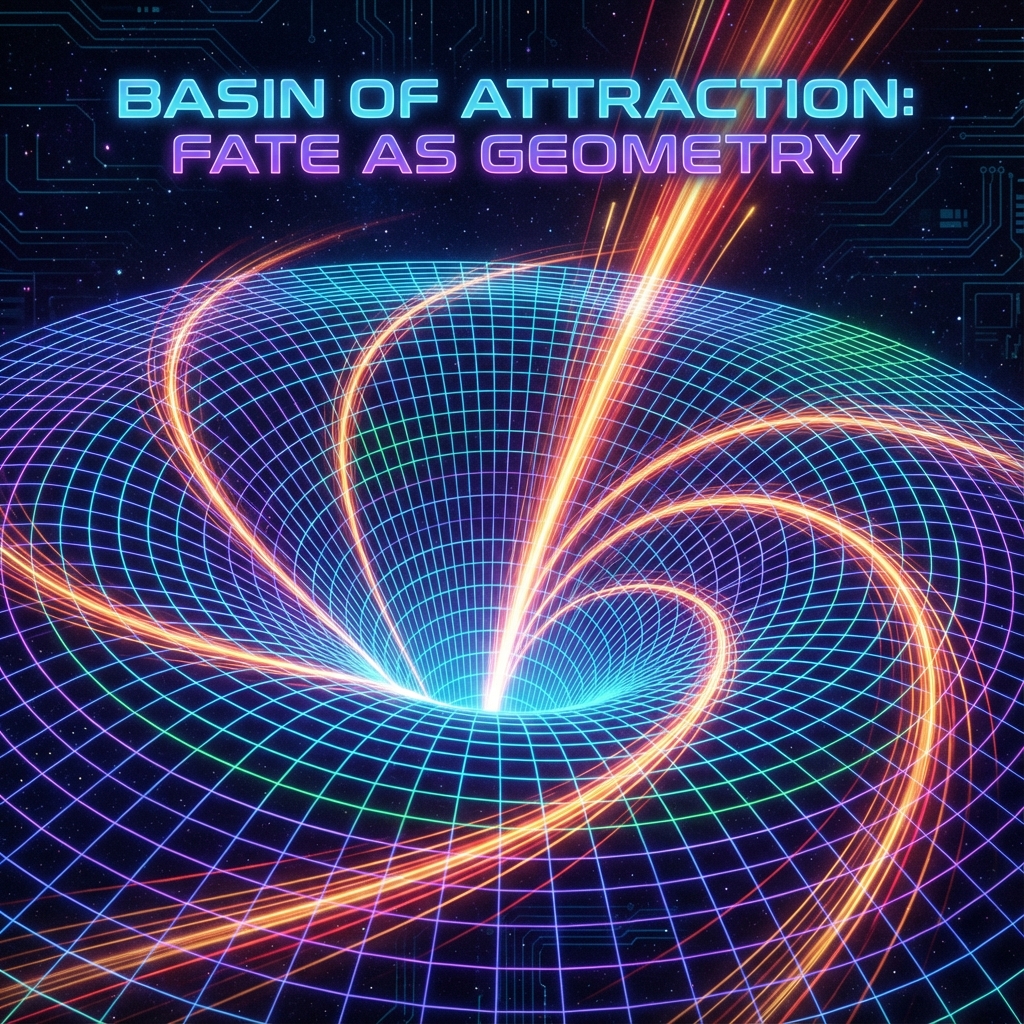
“We often think of ourselves as free birds, able to soar freely in the sky. But in the geometric structure of Hilbert space, the sky is not flat. It is filled with invisible gravitational wells and flowing channels. No matter how you flap your wings, you will eventually slide toward that geometric depression with the lowest potential energy. This is fate—it is not words written by anyone; it is the angle at which spacetime tilts.”
The Topographic Map of Phase Space
To understand fate, we must first understand the Phase Space we inhabit.
In this infinite-dimensional space containing all possible states of the universe, the Hamiltonian (physical laws/generators) defines the “topography”.
-
Plains: Constant potential energy. Here, you can wander freely (the illusion of free will is strongest).
-
Valleys: Not only low potential energy but funnel-shaped. This is the “Basin of Attraction”.
Once your state vector enters the edge of this basin, physical laws (the evolution flow of ) generate a powerful “restoring force” pushing you toward the center of the basin.
-
Physical example: Throw a small ball into a bowl. No matter what angle or speed you throw it, as long as friction () exists, the ball will inevitably stop at the bottom of the bowl.
-
Life example: When you fall in love with a specific person or commit to a great cause, you are actually falling into a huge geometric attractor. You will find that no matter how you struggle, no matter what accidents occur, your life trajectory will inevitably revolve around that center.
Conclusion: Fate is the steady state of the system.
The reason you feel certain things are “destined” to happen is that in that local geometric structure, that is the only solution that can keep the wave function stable.
Strange Attractors: Order in Chaos
Some will object: The universe is chaotic; how can there be destiny?
Chaos theory gives the most brilliant answer: Strange Attractors.
Systems like the Lorenz attractor (source of the butterfly effect), although trajectories are unpredictable (you don’t know where it will be the next second), the overall shape is strictly determined (it will never fly out of the butterfly’s wing shape).
Mapping to life and history:
-
Microscopically unpredictable: Whether you will be late tomorrow, whether you will fall, this is random.
-
Macroscopically destined: But whether you will age, whether civilization will move toward higher computational power, whether the universe will move toward the point, this is determined by the global topology of strange attractors.
This is geometric fatalism.
Details are free, but the shape of the ending is locked by the eigenvalue spectrum (Spectrum) of the Hamiltonian.
You can choose whether to step with your left foot or right foot on the way to the endpoint, but you must go to the endpoint.
The Convergence of History
This mechanism explains why history is always strikingly similar.
Why did different civilizations independently invent pyramids, writing, and class systems without communication?
Not because they consulted, but because in the phase space of social evolution, these structures are “energy minima”.
The evolution of the universe is a long process of “seeking attractors”.
-
Atoms found the attractor of “crystals.”
-
Life found the attractor of “DNA.”
-
Consciousness found the attractor of “self.”
We are not creating the future; we are sliding toward it.
That future ( point) is like a huge black hole, its gravitational ripples flowing backward, penetrating the entire time axis. All our efforts now, seemingly active climbing, are actually conforming to that huge geometric attraction from the future.
Conclusion: Inescapable Fulfillment
From this perspective, “fate” is no longer a pejorative term.
It means destiny.
If the universe had no fate (no attractors), the wave function would randomly diffuse in Hilbert space, eventually becoming meaningless noise (heat death).
It is precisely because of these geometric “pits” and “valleys” that life can condense and stories can take shape.
You are destined to become yourself.
This is not because the script is written, but because that is the only equilibrium position of your specific structure in the cosmic topographic map.
Since the general direction of the ending is already determined by the topography, can we as individuals only roll down like stones? Where exactly is our free will manifested? Can we fine-tune the angle of entry, turning this fall into a flight?
This leads to the theme of the next section: Fine-Tuning of Free Will. We will see that although we cannot change the direction of gravity, we can control “attitude”.