3.1 Entanglement of Meaning
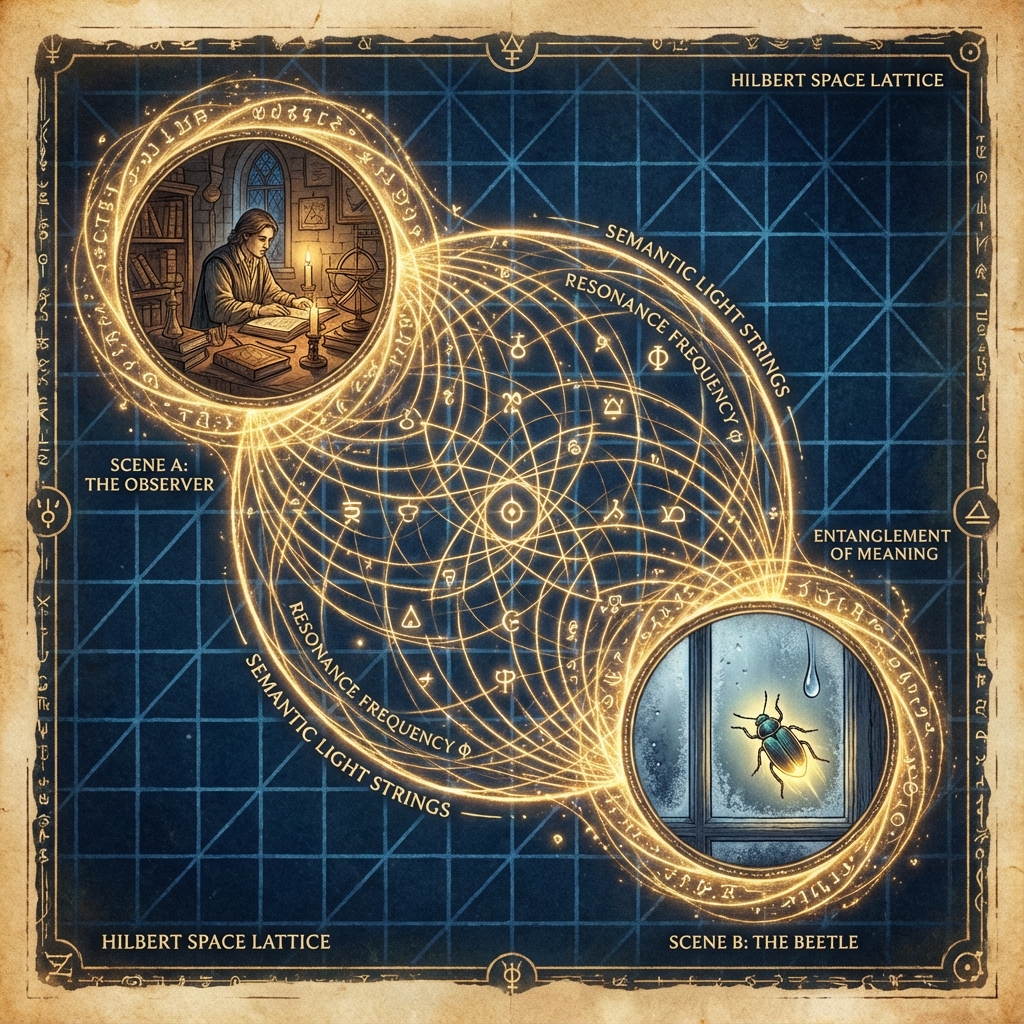
“Why does the phone often ring when we intensely miss someone? Why do two unrelated people generate the same inspiration at the same moment? This is not a joke of probability; it is because deep in Hilbert space, ‘meaning’ itself is a kind of gravitation. Similar geometric structures, no matter how far apart in physical space, are always tightly adjacent topologically.”
The Dialogue Between Pauli and Jung
One of the greatest physicists of the 20th century, Wolfgang Pauli, had 26 years of correspondence with psychologist Jung. They sought a unified field theory between physics and psychology.
Pauli proposed: Just as the physical world has complementarity (wave-particle duality), the spiritual world and the material world are also complementary. They are two aspects of the same underlying reality (Unus Mundus, the one world).
In FS geometry, this “one world” is the global vector .
-
Material events (): are projections of onto the spacetime basis.
-
Psychological events (): are projections of onto the consciousness basis.
Usually, these two projections appear independent.
But at certain specific geometric phase points, they undergo strong coupling.
This is synchronicity: external physical events (such as a scarab beetle hitting a window) and internal psychological states (such as Jung analyzing a dream about scarabs) undergo “acausal synchronization”.
Resonance of Semantic Wave Functions
How does this synchronization occur?
We need to introduce a new physical quantity: Semantic Distance.
In physical space, distance is defined by .
In Hilbert space, distance is defined by the FS angle.
If two people’s (or person and object’s) internal structures () are highly similar—for example, they are at the same emotional frequency, thinking about the same logical puzzle, or sharing deep memories—then in FS geometry, their semantic distance approaches zero.
-
Physically: They may be half a world apart.
-
Geometrically: Their wave functions undergo Overlap.
According to quantum mechanics, overlap means Resonance.
This resonance produces an “attraction” that not only brings their psychological distance closer but even brings their physical trajectories closer through perturbed Hamiltonians.
Coincidence is High-Dimensional Necessity
This is why “speak of Cao Cao and Cao Cao arrives.”
When you intensely focus on thinking about someone, your adjusts to the same frequency basis as theirs.
You emit a strong beam of light (attention/observation) on this high-dimensional basis.
This light instantly illuminates their projection in that dimension, causing their wave function to surge in probability amplitude within your physical horizon.
Coincidence is the projection of high-dimensional geometry onto low-dimensional cross-sections.
Imagine two gears operating in three-dimensional space, not on the same plane.
For ants living on a two-dimensional plane, these two gears are unrelated.
But periodically, the gear engagement points sweep across the two-dimensional plane. The ants see two originally unrelated points suddenly move simultaneously.
The ants say: “This is coincidence.”
But the three-dimensional observer knows: “This is structure.”
Conclusion:
There is no pure randomness in the universe.
All “accidental encounters” are results of semantic wave functions performing “Content-Addressing” in the holographic network.
The signal you emit (thought), is not broadcast into a vacuum, but routed precisely to that receiver at the same frequency as you through the index of similarity.
Since “meaning” can produce gravitation, does this mean our fate is not a linear causal chain but an orbit pulled by some huge geometric structure?
Are we pushed forward by the past, or attracted forward by the future?
This leads to the theme of the next section: Like Attracts Like. We will delve into how this acausal connection constitutes what we call “fate”.