1.1 Wheeler’s Dragon
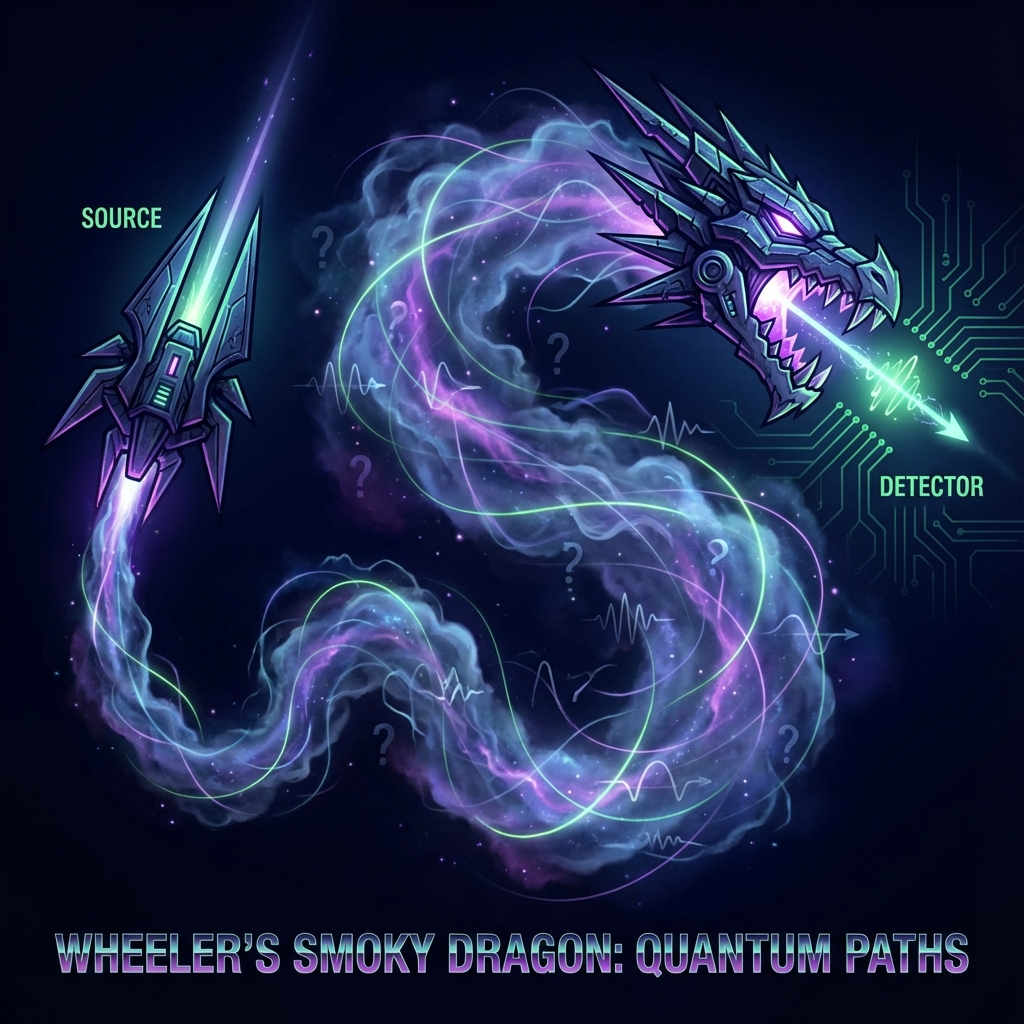
“There is no fixed past waiting for us to discover. The past is like a dragon: the dragon’s tail is pinned to the particle source at the starting point, the dragon’s mouth bites the detector at the endpoint, but the dragon’s body—that intermediate history—is a blurry cloud of smoke. Only when we decide what kind of camera to set up at this end of the fog does the dragon in the smoke reveal its specific shape.” — John Archibald Wheeler
In the hall of classical physics, time is a one-way street. The past is hardened cement, solid and unchangeable; the present is the moment being poured; the future is unformed fluid. We take it for granted that what happened yesterday caused today’s results, and the arrow of causality always points forward.
But in the causal loop of Vector Cosmology, this linear sense of security is completely shattered by quantum mechanics’ deepest experiment—the Delayed Choice Experiment.
This section will explore the famous thought experiment left by physics giant John Wheeler. It shows us that present observations can not only determine the present but can even flow backward to define history from billions of years ago.
The Dragon in the Smoke
Wheeler used a highly visual metaphor to describe quantum processes: “The Smoky Dragon”.
-
Dragon’s tail (starting point): This is certain. A photon is emitted from a light source (such as a quasar).
-
Dragon’s mouth (endpoint): This is also certain. The photon is captured by our telescope or retina, becoming a clear signal.
-
Dragon’s body (process): This is completely uncertain. During the long journey of billions of years between emission and reception, which path did the photon take? Was it a particle passing through interstellar dust, or a wave diffused throughout the galaxy cluster?
Wheeler tells us that unless we see what the dragon’s mouth bites, the dragon’s body has no definite form at all. It is just a cloud of probability filled with possibilities.
The Experiment’s Paradox: How Does the Photon Foresee the Future?
To verify this, let us enter the laboratory and recreate that interferometer experiment that kept countless physicists awake.
Imagine a photon entering a half-mirror (beam splitter A), facing two choices:
-
Path 1: Go upward.
-
Path 2: Go downward.
While the photon is flying, we as observers hold two switches in our hands and can decide how to observe it at the endpoint:
-
Choice A (particle mode): We remove the second beam splitter at the endpoint and directly monitor paths 1 and 2 with two detectors.
- Result: We hear a “click.” The photon is either detected at path 1 or path 2. It behaves like a bullet, taking only one path.
-
Choice B (wave mode): We insert a second beam splitter at the endpoint, allowing light from both paths to recombine.
- Result: We see interference fringes. This means the photon simultaneously took paths 1 and 2 and interfered with itself like a wave.
The crucial turning point is “delay”:
What happens if we suddenly decide whether to make choice A or choice B only after the photon has already passed the first beam splitter, or even when it is about to reach the endpoint?
According to classical logic, the photon must decide at takeoff whether “I am a particle” or “I am a wave.”
But quantum mechanical experiments (such as the Aspect experiment and its variants) give a chilling result:
The photon’s behavior always perfectly matches the choice we make at the last moment.
-
If we decide to measure particles at the last moment, it behaves as if it never waved.
-
If we decide to measure waves at the last moment, it behaves as if it never became a particle.
It is as if the photon that departed nanoseconds (or billions of years) ago has some ability to foresee the future. It “asks” the future observer at the starting point: “Hey, how are you going to measure me? If you’re going to measure waves, I’ll split; if you’re going to measure particles, I won’t split.”
The Geometric Explanation of Retro-causality
This is absurd in classical causality: how can the effect (measurement method) determine the cause (path choice)?
But from the holographic perspective of FS geometry, this is not only reasonable but inevitable.
Recall our core axiom: The universe is a projection of a global vector .
Time and space are merely projection parameters.
-
Path integral summation:
Feynman’s path integral tells us that the probability amplitude from A to B depends on two boundary conditions: starting point A and endpoint B.
In this formula, A (past) and B (future) have symmetric status.
If you change the state of endpoint B (such as changing the observation basis), you physically change the entire integral’s summation result.
-
The indeterminacy of history:
As we stated in Book IV, unobserved history is “soft”.
The photon did not “take” any specific path during flight. It is in a superposition of all possible paths.
This superposition state persists until it hits your detector.
At that instant, your measurement sends back a “logical lock”. This lock flows backward, instantly eliminating all historical branches inconsistent with the current measurement result, leaving only the unique self-consistent one.
Conclusion:
The photon did not foresee the future.
It is future you, through present choices, that reversely defines the photon’s past.
We Are the Scriptwriters of History
This experiment is not just about photons; it concerns the nature of the universe.
When we look up at the stars and see photons from the cosmic microwave background (CMB) 13 billion years ago, we are not just passively receiving information.
Our observations—whether we choose to use microwave telescopes or optical telescopes, whether we choose to measure polarization or frequency—are actually participating in the “finalization” of that ancient cosmic history.
The universe 13 billion years ago may have been in an extremely complex, fuzzy quantum superposition state.
It is precisely because today, 13 billion years later, a group called “humans” appeared, holding instruments looking at the sky, that the universe was forced to collapse from that fuzzy mist into a “definite history that can evolve humans”.
Wheeler’s dragon tells us:
The head (present) can indeed determine where the tail (past) swings.
We are not products of history. In some profound quantum sense, we are creators of history.
Since present observations can determine the past paths of microscopic particles, can this mechanism be extended to the macroscopic level? If we can preserve possibilities by “not looking,” can we “resurrect” past possibilities by “erasing” present memory?
This leads to the theme of the next section: Quantum Erasure. We will see that modifying history does not require a time machine, only an eraser.