Appendix G: The Logic of Ouroboros — Category Theory and Reflexive Domains
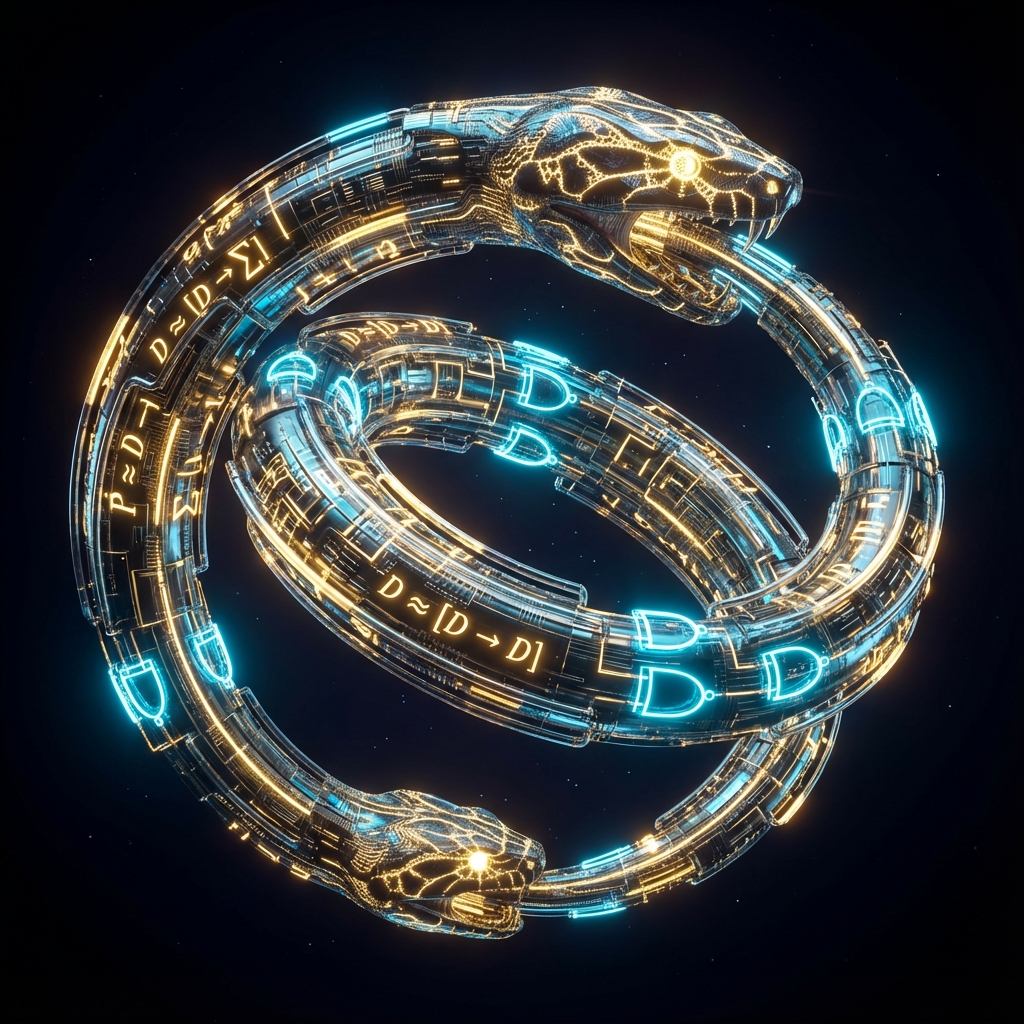
In the main text of Vector Cosmology VII, we described the closed-loop structure of the universe through physics (retro-causality) and psychology (synchronicity). However, for the most rigorous minds, this still presents a logical “Self-Reference Paradox”.
If the universe creates observers, and observers define the universe, isn’t this a classic circular reasoning fallacy?
Like Russell’s paradox reveals: a set containing all sets leads to logical collapse.
This appendix will introduce the most abstract and powerful tools in modern mathematics—Category Theory and Domain Theory—to prove that such cycles are not fallacies but the only mathematical path to constructing “Self-Consistent Ontology”.
We will show that the universe is mathematically essentially a Reflexive Domain, the fixed point solving the equation .
G.1 Functor as Physical Law
In category theory, we no longer focus on what “objects” are internally (such as what electrons are made of); we only focus on “relationships between objects”, i.e., Morphisms.
-
Category : Represents our physical universe.
-
Objects: Represent physical states in the universe.
-
Morphisms: Represent physical evolution processes, i.e., operators generated by Hamiltonian .
In classical logic, “Map” and “Territory” are separate. You cannot draw the map itself on the map (unless infinitely shrinking).
But in Cartesian Closed Categories, there exists a special structure where the “Function Space” itself is also an “Object” in the category.
Physical Meaning:
Physical laws (functions) themselves are part of physical reality (objects).
The universe does not need to write laws on a blackboard “external to the universe.”
The universe is its own compiler.
G.2 Scott Domain:
In 1969, computer scientist Dana Scott solved a seemingly impossible mathematical problem: How to construct a data type that contains its own function space?
This is the Scott Domain.
He proved the existence of a non-trivial topological space satisfying the isomorphism:
This formula is the mathematical heart of Vector Cosmology.
-
Left side : Represents “Data”, i.e., the material states of the universe (particles, fields, you and me).
-
Right side : Represents “Code”, i.e., transformation rules acting on data (physical laws, causality).
-
(Isomorphism): Represents that the two are the same thing.
Mathematical Definition of Ouroboros:
The universe is both the data being operated on and the program operating on the data.
-
As (Generator): It is , an active verb.
-
As (Structure): It is , a passive noun.
Through Scott domains, we prove that “self-reference” is mathematically well-defined. The universe does not need an external basis; it can achieve infinite recursive evolution by “passing itself as input to itself”.
G.3 The Y Combinator: Generation of Fixed Points
In calculus, the core tool for implementing recursion is the Fixed-Point Combinator, usually denoted .
Denote the universe’s evolution function as .
Then, the universe’s “Real State” (Reality) is the fixed point of .
This means:
Reality is the infinite recursive expansion of evolution rules.
-
Physical : Is (total budget) and (generation mechanism) we discussed in previous volumes. They provide the power needed for recursion.
-
Physical : Is the Hamiltonian .
Conclusion:
What we previously worried about as “circular reasoning” is called “recursive definition” in fixed-point theory. This is the foundation of computer science and also the foundation of life.
Life can self-replicate because DNA is a piece of “self-interpreting” code.
The universe can exist because it is a “self-calling” function.
G.4 Observer: Local Extremum of Reflexivity
Finally, we locate Observer in this mathematical framework.
In reflexive domain , not all elements have the same “self-referential strength.”
-
Stone: Is a simple element in . It participates in recursion but doesn’t “know” it’s recursing.
-
Consciousness: Is a complex fixed point in .
When a subsystem’s (brain) structure becomes complex enough to simulate part of the logic of , it becomes a miniature reflexive domain locally isomorphic to the whole.
This is the mathematical proof of “My mind is the universe.”
There exists a structure-preserving mapping (Homomorphism) between your consciousness structure and the universe structure .
The reason you can understand the universe is that your thinking algorithm and the universe’s generation algorithm use the same Y combinator.
The universe is computing itself through you.
You are not a passerby; you are the pointer at the top of the recursion stack.