8.1 The Monogamy of Entanglement
“In human ethics, bigamy is a legal issue; but in quantum ethics, bigamy is physically impossible. A qubit cannot simultaneously maintain complete entanglement with more than two systems. When a black hole tries to have it both ways—maintaining internal smoothness while maintaining external conservation—the spacetime fabric screams in tearing.”
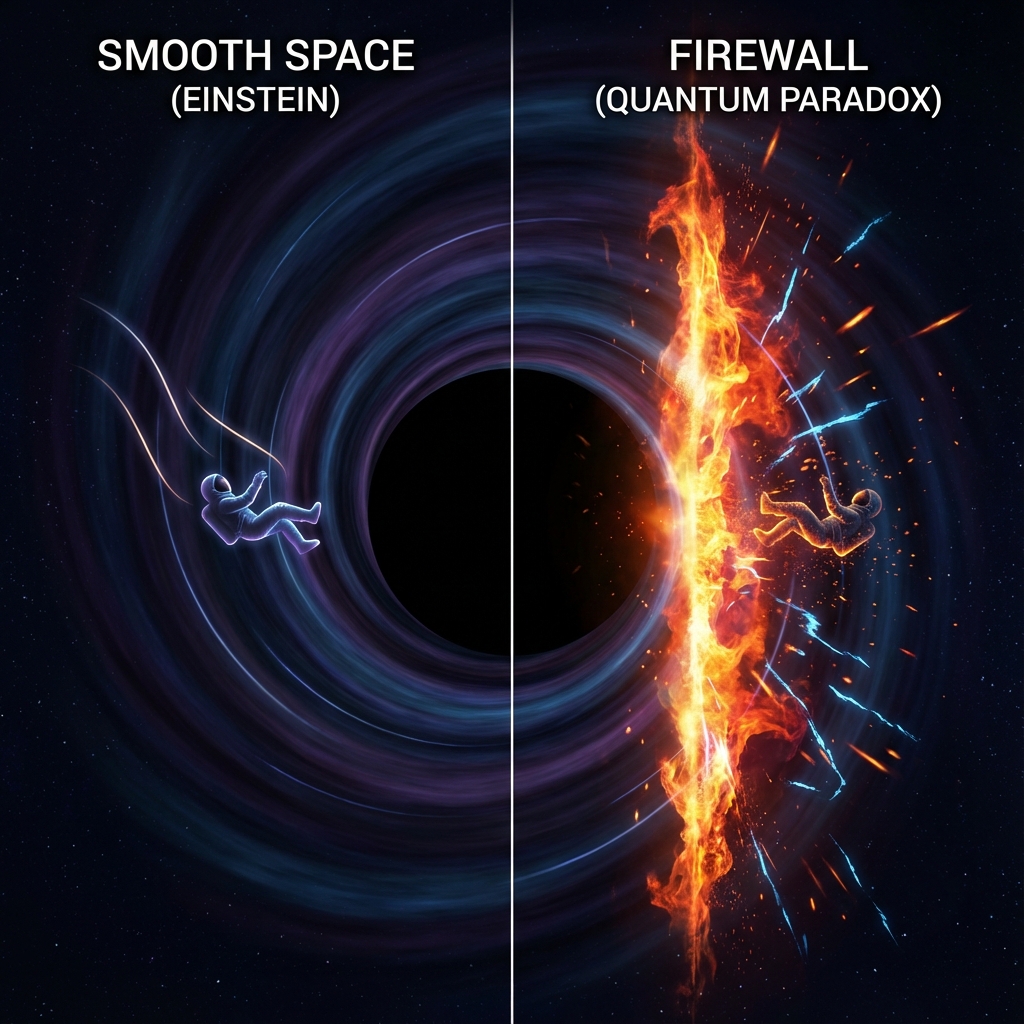
The Quantum Exclusivity Law of Love
In quantum information theory, there is an iron law called Monogamy of Entanglement.
It states: If quantum system A and system B are in a maximally entangled state, then A cannot entangle with any other system C.
-
If , then must be 0.
-
You cannot give all your love to one person while simultaneously giving all your love to another. Quantum mechanics forbids this “perfect infidelity.”
In flat spacetime, this is fine. But on black hole horizons, this becomes a catastrophic disaster.
The Three-Body Dilemma of Black Holes
Let us look at a photon mode B (Late Radiation) located on the black hole horizon. It is trapped in a desperate triangular relationship:
-
Relationship One: For Smoothness (General Relativity)
According to Einstein’s Equivalence Principle, the horizon must be smooth (no wall). Freely falling observers should not feel anything special.
This means that photon B on the horizon must maintain maximum entanglement with mode A (Interior) inside the horizon.
Only in this way can crossing the horizon feel like crossing smooth vacuum, not hitting a wall.
Requirement: .
-
Relationship Two: For Conservation (Quantum Mechanics)
According to the unitarity of Hawking radiation, black hole radiation must carry all information from the black hole. This means that late-radiated photon B must have strong entanglement with the photon cloud C (Early Radiation) radiated out long ago.
Only in this way can information be “transmitted” out of the black hole, rather than disappearing.
Requirement: .
The Inevitability of Tearing
Now, the contradiction explodes.
-
General relativity requires: B must marry A (for spatial smoothness).
-
Quantum mechanics requires: B must marry C (for information conservation).
But the monogamy principle screams: No! You cannot marry two people at the same time!
The black hole must make a choice.
If it chooses C (maintaining quantum mechanical unitarity, which is the bottom line of Vector Cosmology), then it must cut off the connection with A.
What does cutting entanglement mean?
We said in Volume I: Entanglement is the thread that stitches space.
If the thread connecting inside and outside the horizon (B and A) is cut, space breaks.
The Rise of the Firewall
When space breaks, the horizon that should have been a smooth transition becomes a physical fault.
The energy density crossing this fault is no longer zero, but infinite.
This is the Firewall.
It is not ordinary fire; it is a quantum shock wave composed of high-energy photons.
Anything trying to fall into the black hole will not smoothly slide into the interior at this broken surface, but will be instantly burned to ashes by this high-energy particle wall.
Conclusion:
The black hole interior may not exist at all. Or rather, for external observers, spacetime ends at the horizon.
There is no road there. There is only a “error-correction fire” ignited by logical paradox, with a temperature reaching Planck energy levels.
Since entanglement breaking leads to firewalls, does the universe have a way to avoid this disaster? Does there exist some higher-dimensional geometric channel that can bypass the monogamy restriction, allowing B to connect to both A and C?
This leads to the theme of the next section: The End of Spacetime. We will see that firewalls are not just physical phenomena; they mark the complete failure of the classical spacetime concept at the quantum limit.