5.2 The Pressure of Information
“Einstein said: ‘Matter tells spacetime how to curve.’ But this is only half the truth. At the bottom layer of quantum information, matter is not a lead ball pressing on a bedsheet; matter is a data black hole frantically consuming bandwidth. Spacetime curves not because it is ‘heavy,’ but because it is ‘congested.’ Gravity is the geometric deformation produced by the cosmic network to alleviate local information overload.”
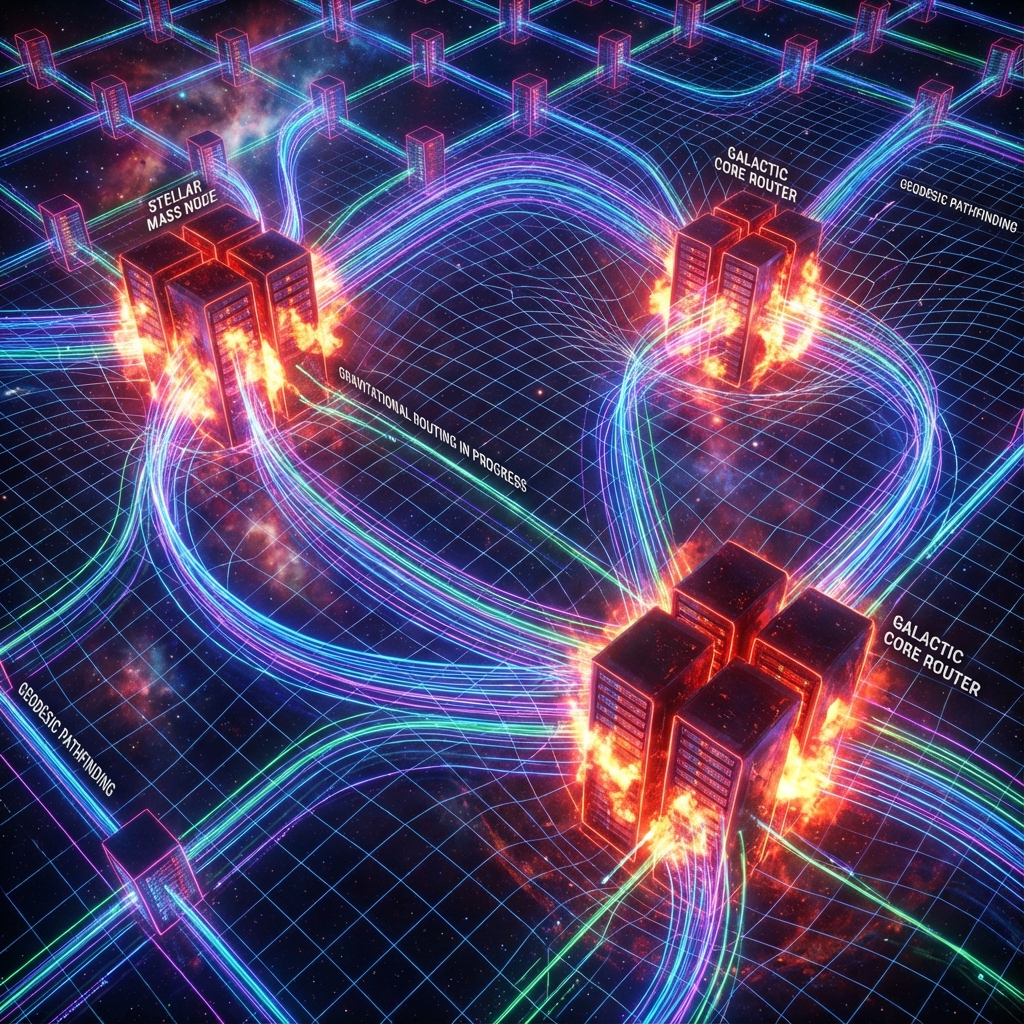
In the previous section, we defined gravity as the “tension” of entanglement threads. But this only explains why objects attract each other (to restore maximum entanglement entropy). It has not yet explained the most core geometric phenomenon in general relativity—Spacetime Curvature.
Why do massive objects cause light deflection? Why does time slow down deep in gravitational wells?
In the tensor network model of Vector Cosmology, all of this stems from one concept: Information Pressure.
Mass as Load: Supernodes in the Network
First, we need to reexamine the microscopic definition of “Mass” ().
In the first book, we defined mass as the freezing of (internal structure). This means that a massive particle (such as a proton or black hole), in the tiny spatial region it occupies, contains extremely high-density quantum information and extremely high-frequency internal evolution.
Put it on the Tensor Network:
-
Vacuum: Is an idle network. Entanglement between nodes is uniform and low-load. Signals (light) can pass straight through.
-
Matter: Is an overloaded node. It is like a server rendering 8K video. It frantically consumes surrounding (computational budget) and occupies a large number of entanglement channels to maintain its structural stability.
Mass is the congestion point of the network.
When a massive object exists, the tensor network around it is no longer flat. Surrounding entanglement resources are forcibly requisitioned by this “supernode.”
The Geometry of Congestion: Curvature is Inevitable
What effect does this “requisition” have on the geometric structure?
Imagine a busy intersection (massive region). Because traffic flow (information flow) is too large, the road is blocked.
If you want to drive through this intersection (light propagation), you cannot go straight.
-
Straight path: Although the geometric distance is shortest, the “information impedance” is infinite. You will get stuck inside.
-
Detour path: Although the geometric distance becomes longer, the “communication throughput” is higher.
In FS geometry, physical laws follow the principle of least action. Here, “least action” is equivalent to “maximum information transmission efficiency”.
To avoid that high-density region “blocked” by mass, photons (and all causal chains passing through that region) are forced to choose a detour.
This is the truth of spacetime curvature.
It is not that space itself becomes curved, but that the “optimal transmission path” becomes curved.
Gravitational lensing is essentially the “Dynamic Routing” that occurs when cosmic information flow encounters “high-load nodes.”
Time Dilation: Processing Latency
This model also perfectly explains gravitational time dilation.
Why does time slow down near black holes?
-
Classical explanation: Gravitational potential energy reduces frequency.
-
Network explanation: Processing Latency.
A massive region is a “high-traffic, low-bandwidth” bottleneck.
Because entanglement resources are occupied by matter itself, the bandwidth left for “evolution” (time passage) becomes less.
Any process running in that region (clocks, heartbeats, thoughts) must “queue” waiting for updates from the underlying QCA of the universe.
-
In vacuum: Network is idle, refresh rate is extremely high, time passes quickly.
-
In gravitational well: Network is congested, refresh rate decreases, time passes slowly.
Gravitational redshift is the “Lag” of the cosmic computer.
Conclusion: Geometry is Compromise
At this point, we have completed the quantization reconstruction of general relativity.
Einstein’s field equation is actually a “network traffic equilibrium equation”.
-
(energy-momentum tensor): Is the “amount of data requested by users”.
-
(Einstein tensor/curvature): Is the “dynamic adjustment of network topology”.
When data volume is too large, to prevent network collapse, the universe must distort the topology structure, increasing local connection density (surface area/curvature) to accommodate this excess information.
Gravity is not a force; gravity is a geometric compromise under information pressure.
Since we know that gravity is network congestion, what happens if we pile infinitely many information at one point until it exceeds the physical carrying limit of the network?
Will the network collapse? Will connections break?
This leads to the theme of the next volume: Fracture.
We will explore the most extreme geometric structure in the universe—Black Holes. That is not a hole; that is the “thread ends” left after the spacetime fabric is completely torn.