3.2 AdS/CFT Dictionary
“Plato believed that we are prisoners trapped in a cave, only able to see shadows cast by firelight on the wall. He thought the shadows were illusory, and the objects behind were real. But in the physics of the holographic universe, the truth is exactly the opposite: the shadows on the wall (boundary code) are the only ‘noumenon’ containing all information, while the three-dimensional, gravitational world we perceive is merely the ‘holographic illusion’ projected when these codes run.”
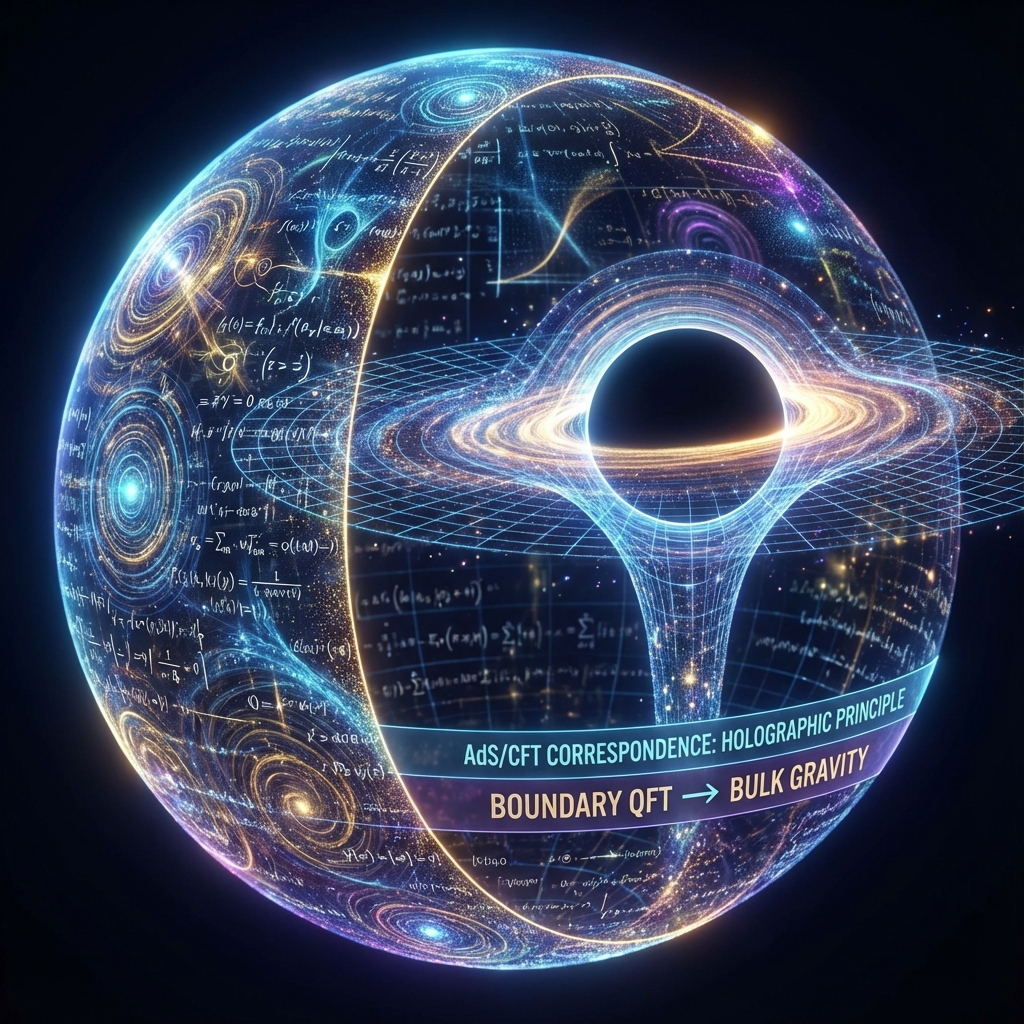
In the previous section, we established the concept of “spacetime as error-correcting code,” pointing out that the universe gains robustness by smearing information on the boundary. Now, we need a “dictionary”.
We need to know how to read that “source code” written on the two-dimensional boundary, woven from quantum entanglement, and translate it into the three-dimensional, gravitational, grand physical world around us.
This is the famous AdS/CFT Correspondence, also known as Holographic Duality. It is the most brilliant gem on the crown of modern physics, and the ultimate bridge connecting microscopic quantum and macroscopic gravity in Vector Cosmology.
The Mirror of Two Worlds
Imagine two completely different mathematical worlds:
-
The Boundary - CFT:
This is a low-dimensional world (e.g., a two-dimensional sphere). Here, there is no gravity, only Conformal Field Theory.
Particles engage in frenzied, strongly coupled interactions. This is where the “source code” is stored.
In this world, everything is information and entanglement.
-
The Bulk - AdS:
This is a high-dimensional world (e.g., the interior of a three-dimensional sphere). Here, there is gravity, curved spacetime (anti-de Sitter space).
It appears empty and silent, objects move according to general relativity. This is where the “execution results” are displayed.
In this world, everything is geometry and matter.
The core miracle of the AdS/CFT dictionary is: these two worlds are mathematically strictly equivalent.
They are two different descriptive languages for the same physical reality.
-
You can calculate quantum entanglement on the boundary.
-
You can also calculate the horizon area of a black hole in the bulk.
-
The results are identical.
This means: Gravity is not a fundamental force. Gravity is the “geometric translation” of quantum entanglement under holographic projection.
The Translation Rules of Geometry
So, what are the specific entries of this dictionary? How do we translate “code” into “space”?
-
Entry 1: Entanglement Degree Cross-sectional Area
As we derived the Ryu-Takayanagi formula in Volume I: the entanglement entropy of two regions on the boundary directly corresponds to the area of the minimal surface connecting these two regions in the bulk.
Stronger entanglement, thicker connection. Space does not break because the code on the boundary is tightly wound.
-
Entry 2: Correlation Length Radial Depth
On the boundary, if two points have long-range correlation (far apart but still synchronized), this manifests in the bulk as a geodesic deep into the interior.
Energy scale is depth.
High-energy short waves on the boundary correspond to shallow space near the boundary in the bulk; low-energy long waves on the boundary correspond to deep space in the interior of the bulk. When we walk deep into a room, we are actually following the renormalization flow, moving toward the low-frequency components of information.
-
Entry 3: Complexity Volume/Gravity
This is the latest physics insight (from Leonard Susskind’s “Complexity = Volume” conjecture).
On the boundary, the “Computational Complexity” required to describe a quantum state—that is, the number of quantum logic gates needed to generate that state—corresponds to the “spatial volume” in the bulk.
Why is the universe expanding?
Because the quantum circuit on the boundary is constantly running, states become increasingly complex (even at thermal equilibrium, complexity continues to grow).
To store these continuously growing “computation steps,” the space (volume) in the bulk must continuously expand.
Gravity is the weight of computation.
The “Reality” Here
This completely subverts our “view of reality”.
We have always thought we live in a solid three-dimensional space, bound to Earth’s surface by universal gravitation.
But the holographic dictionary tells us: We live in a holographic projection.
-
Our bodies, our Earth, our Milky Way are essentially images in the “Bulk”.
-
The real “us”—those qubits and logic gates that constitute us—are actually running on the distant “Boundary” of the universe.
That boundary may be located at infinity, or even in another dimension.
There, there is no gravity, no distance, only pure computational power () frantically weaving entanglement.
When you wave your arm:
-
In the bulk (your sensation): Your arm passes through air, overcoming gravity.
-
On the boundary (physical truth): A series of complex unitary transformation operators rewrite the quantum state data stored on the holographic screen, causing changes in the values of certain correlation functions.
Conclusion: The Universe is a Holographic Projector
At this point, the worldview of Vector Cosmology completes its loop.
The universe is not a box; the universe is a holographic projector.
-
Light source: (generator).
-
Film: CFT quantum states on the boundary.
-
Image: The AdS spacetime we inhabit.
Gravity is not a force; gravity is the geometric effect produced when the projection beam transmits information.
Since we know that spacetime is code, is projection, what is the “error tolerance” of this code? If the code goes wrong, will the projection disappear?
How do physical laws, as “checking mechanisms,” prevent this projector from crashing?
This leads to the theme of the next chapter: Robustness and Physical Laws. We will see that those cold conservation laws are actually the highest security protocols set by the universe to prevent us from “suddenly disappearing.”