2.1 The Fractal Tree of the Universe
“When you gaze at a forest, you see a green canopy composed of countless leaves. But supporting this canopy are the vast roots buried deep underground and the thick trunk. The universe is the same. The spacetime reality we perceive is only the outermost leaves of this giant quantum fractal tree. The real physical processes occur at those invisible branch forks that span scales.”
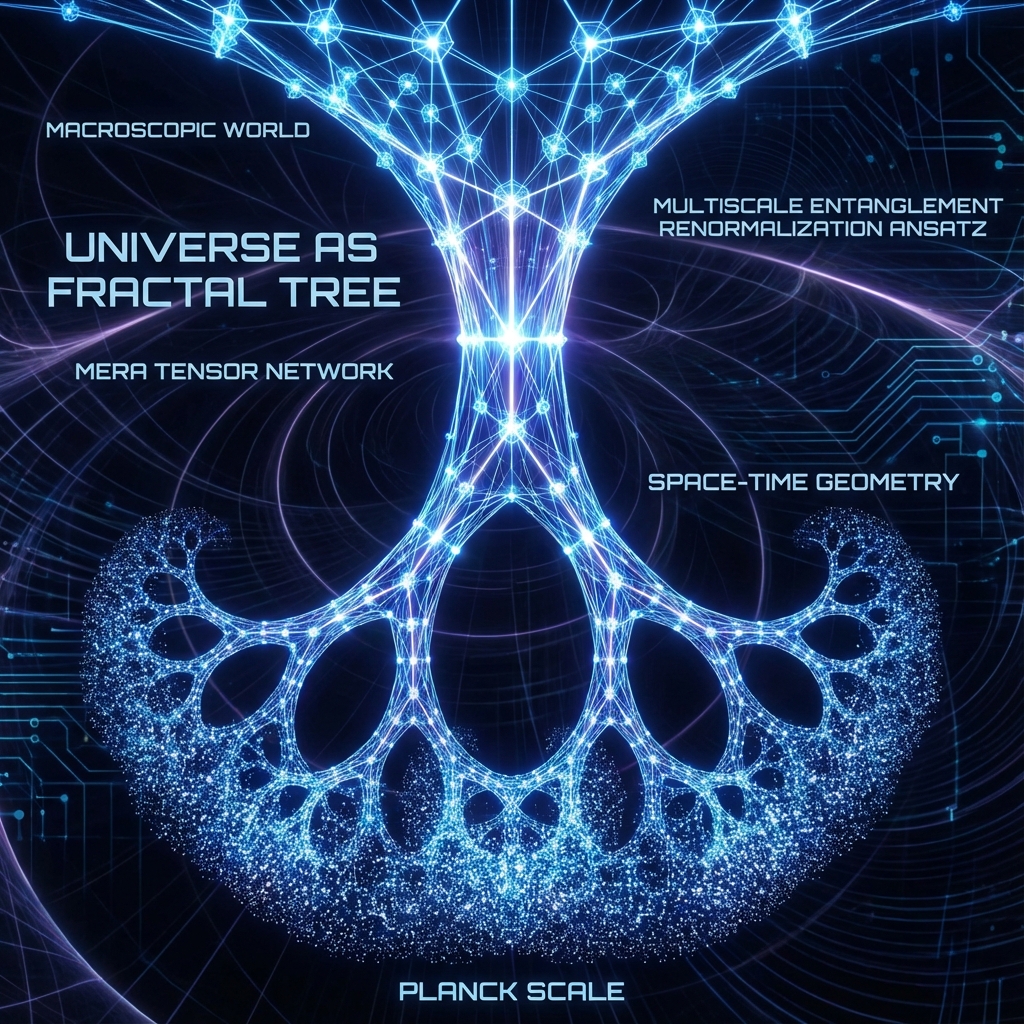
Coarse-graining: From Pixels to Images
In information theory, there is a core operation called “Coarse-graining”.
Imagine a high-resolution photograph (the underlying QCA lattice of the universe).
-
Layer 0: You see individual pixel points (Planck scale).
-
Layer 1: You merge adjacent pixels into a color block.
-
Layer 2: You continue merging until you see a clear face (macroscopic object).
This process of “continuous merging” is called Renormalization Group Flow in physics.
It reveals an astonishing truth: Macroscopic physical laws are the result of microscopic degrees of freedom emerging through layers of “voting” and “averaging.”
MERA Tensor Network: Weaving the Vertical Dimension
However, simple averaging loses information (especially entanglement information). To preserve the structure of quantum entanglement during coarse-graining, physicists (such as Guifré Vidal) invented MERA.
MERA is a special tensor network that introduces two key operators:
-
Disentanglers: Before merging, first cut short-range entanglement, filtering out “local noise.”
-
Isometries: Losslessly compress information from multiple qubits into one qubit, achieving scale elevation.
This constitutes the tree structure of the universe:
-
Leaves: The underlying microscopic degrees of freedom (Planck pixels).
-
Branches: Information flow channels (renormalization flow).
-
Trunk: Macroscopic low-energy effective theory (the physical laws we see).
This structure is “fractal.”
No matter which layer you observe, the geometric structure of the MERA network looks the same. This perfectly explains why physical laws have Scale Invariance—because this tree of the universe repeats the same growth logic on every branch.
The Discrete Skeleton of AdS Space
Most strikingly, this MERA fractal tree geometrically corresponds precisely to the discrete version of Anti-de Sitter Space (AdS Space).
In the MERA network, “scale” becomes a new spatial dimension.
When we say “zoom in” or “zoom out,” we are not changing the focal length; we are “moving” along the vertical dimension of this tree.
-
Going inward (IR Limit): Toward the trunk, toward the macroscopic, toward low-energy physics.
-
Going outward (UV Limit): Toward the leaves, toward the microscopic, toward Planck high-energy physics.
Conclusion:
Spacetime has one more dimension than we imagined. That extra dimension is “scaling”.
We do not just live in ; we live in a hyperbolic geometry supported by scale ().
The Roots Supporting Reality
This model completely subverts the concept of “foundation.”
Usually, we think the microscopic is the foundation. But in the tree metaphor, is the trunk (macroscopic) the main structure supporting the leaves (microscopic)? Or do the leaves nurture the trunk through photosynthesis?
In Vector Cosmology, this is a bidirectional dependence.
-
Without microscopic pixels (leaves), the universe has no information capacity.
-
Without macroscopic renormalization (trunk), the universe has no causal structure.
We (macroscopic observers) inhabit a certain intermediate level of this fractal tree.
Looking down, we see the pixel ocean of quantum mechanics; looking up, we see the smooth dome of general relativity.
And MERA is the ladder connecting quantum and gravity, connecting pixels and dome.
Since we know the universe is a fractal tree, how does this tree grow “extra dimensions”? Is the “3D space” we feel the cross-section of the tree or the projection of the tree?
This leads to the theme of the next section: The Emergence of Dimensions. We will see that dimensions are not pre-existing boxes; dimensions are the result of entanglement networks having to “bulge” to accommodate more information.