Prologue: Pixels of the Void
In the first five books of Vector Cosmology, we dealt with time, energy, life, and civilization. We viewed the universe as a running program. Now, in this sixth book, we turn our gaze to the “display” on which this program runs—what we call Space.
We usually think that space is the most real, most fundamental existence in the universe. It is like a huge empty box, or the floor of a stage, waiting for matter and energy to perform on it. Newton thought it was absolute, Einstein thought it was curved, but they both acknowledged: Space exists.
However, at the forefront of quantum gravity, in the depths of tensor networks and the holographic principle, we discover a chilling truth: There is no space.
Space is not a stage; space is “the embrace of the actors”.
0.1 There is No “Here”
“If you hold an infinitely precise microscope and keep magnifying the void before you, what will you see? You won’t see smaller grids, nor smooth fluid. You will see space suddenly disappear in an instant, replaced by an extremely complex spider web made of pure logic and correlations. There is no distinction between ‘here’ and ‘there’, only the connection between ‘this thread’ and ‘that thread’.”
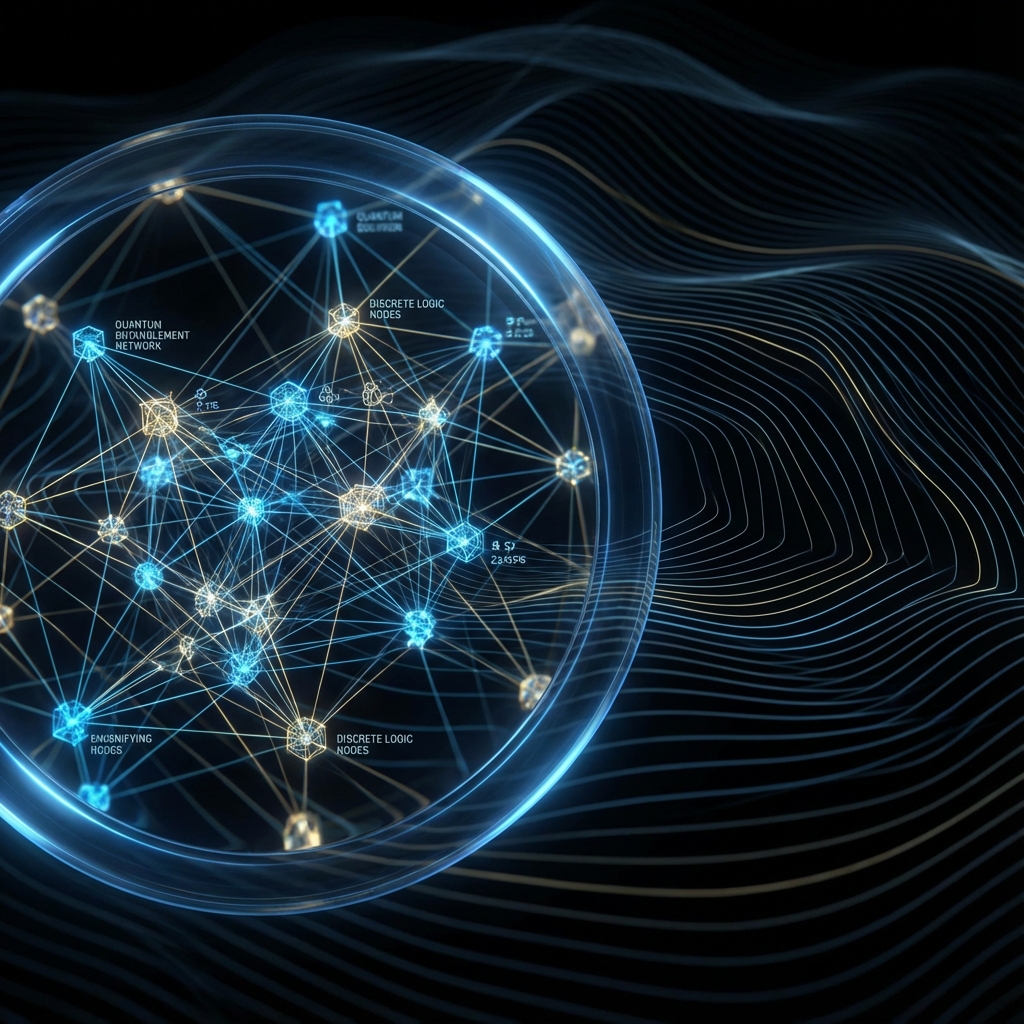
The Pixelation of Space: The Bottom Layer of QCA
We mentioned in previous books that the microscopic engine of the universe is Quantum Cellular Automata (QCA). This means that if you magnify reality to meters (Planck scale), the smooth sense of geometry collapses.
You will see Pixels.
Every Planck volume is an independent Hilbert space subsystem (such as a qubit).
-
Macroscopically: You feel that your left hand and right hand are separated by tens of centimeters of “void”.
-
Microscopically: There is no “void”. Your left hand and right hand are connected through countless intermediate qubits, like a telephone game, passing information one by one.
Space is not “empty”; space is “full”.
It is filled with Logical Gates responsible for transmitting interactions. We think it is empty because these gates are in the Ground State, like extinguished screen pixels. Once matter (excited state) passes through, these pixels are lit up.
Distance as Alienation: The Geometry of Entanglement
If space is just a pile of logic gates, then what is “Distance”?
Why do we feel the Moon is far, while a phone is close?
From the geometric perspective of Vector Cosmology, distance is not a measure of physical scale, but the inverse of “Information Correlation”.
-
Neighbors: There exists Strong Entanglement between two qubits. They share a Bell pair, and information can be exchanged instantly (within one logical operation). This manifests macroscopically as “they are next to each other”.
-
Distant: There is no direct entanglement between two qubits, or the entanglement is extremely weak. Information needs to pass through countless intermediate nodes to arrive. This manifests macroscopically as “they are thousands of miles apart”.
Conclusion: Distance is an illusion.
At the bottom layer of Hilbert space, all particles can in principle be together. The so-called “distance” is only because the universe, in order to construct complex structures, artificially cuts off entanglement between certain particles, creating “topological isolation”.
Space is essentially a diluted entanglement network.
There is No “Position”
This completely subverts our sense of “Locality”.
You think you are sitting on a chair, located at a specific coordinate in the universe.
Actually, you are just a “high-connectivity node” in the universal quantum network.
The reason you feel you are “here” is because your entanglement with the surrounding environment is the tightest.
If all entanglement between you and the surrounding environment is cut off, and entanglement with the center of the Andromeda Galaxy is instantly established, what would happen to you?
You don’t need to fly there.
You would appear there directly.
Because in the topological structure of information, your “neighbors” have become Andromeda.
“Position” is not an attribute, but a “relationship”.
Conclusion: From Stage to Fabric
Therefore, at the beginning of this book, we must abandon the superstition of “spatial container”.
We must learn to think like a Weaver.
The universe does not provide ready-made fabric.
The universe only provides threads (wave functions).
It is us (and all matter), through constant interactions, through exchanging photons and gravitons again and again, that “stitch” these threads together, weaving this magnificent tapestry called “spacetime”.
Since space is woven, how does this loom work? What is that “golden thread” that stitches nothingness into reality?
This leads to the theme of the next section: The Weaver’s Needle. We will see how that single entity—the wave function—creates the depth of dimensions through self-entanglement.
0.2 The Weaver’s Needle
“If space is a piece of fabric, who is weaving it? There is no external weaver. The universe is that single, infinitely long golden thread, frantically shuttling, knotting, and self-entangling in the void. The three-dimensional world we see is nothing but the texture formed by the extremely dense stitches of this golden thread at the microscopic scale.”
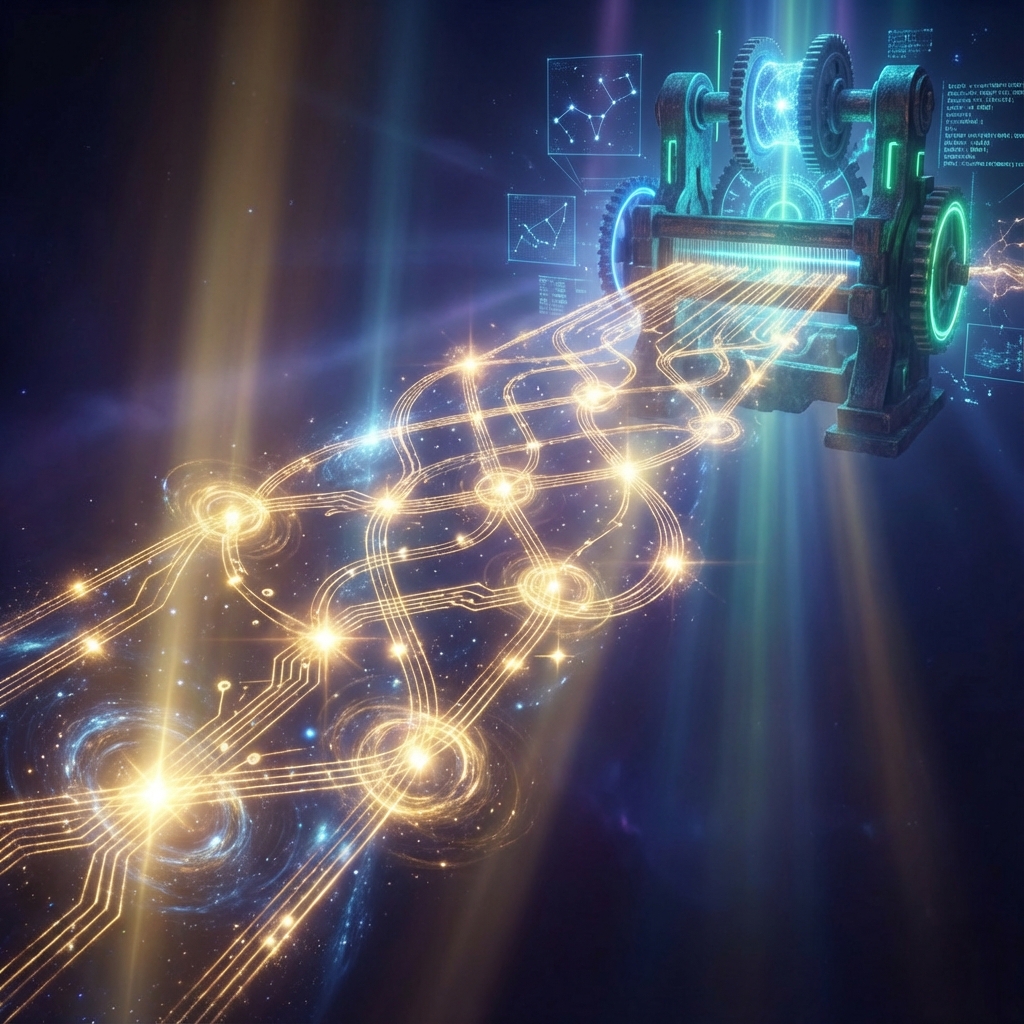
In the previous section, we dismantled the continuity of space, reducing it to discrete quantum logic gates. But this leaves a huge question: How do these discrete points connect into surfaces? What force “stitches” together isolated qubits, making them constitute solid reality?
This section will reveal the most central geometric metaphor of Vector Cosmology: The wave function is not matter filling space; the wave function is the thread weaving space.
The Single Thread
In standard quantum mechanics, we habitually say “the wave function propagates in space.” This implies that space is the background, and the wave function is the object.
But from the perspective of holographic entanglement, the relationship is reversed.
There is only one entity in the universe, and that is the global vector .
Imagine it as a thread with no end.
-
If this thread is straight (no entanglement), there is no space, only one-dimensional linear time.
-
To create space, this thread must bend, must fold back.
It begins to interact with itself.
It ties a knot on the left (particle A), and another knot on the right (particle B).
Then, it shuttles back and forth between these two knots, establishing countless connections (Bell pairs).
Space is the “Self-Entanglement” of this thread.
The void we see is actually a high-density grid woven by this thread at extremely high frequency. Like a sweater, it looks like smooth fabric from afar, but up close, it’s all entangled yarn.
Stitching the Void: The Quantum Sewing Machine
How is this weaving process physically realized?
Through the Interaction Hamiltonian ().
Whenever two particles collide, exchange photons or gravitons, they are actually performing a “Stitching”.
-
Before collision: They are two independent thread ends.
-
After collision: Their wave function phases lock. An invisible entanglement bond is generated between them.
In this sense, all forces (gravity, electromagnetic force, strong and weak forces) are essentially “stitches of the sewing machine”.
-
Strong force: Extremely dense stitches that sew quarks tightly together, forming dense atomic nuclei.
-
Electromagnetic force: Medium-density stitches that sew atoms into molecules, and molecules into objects.
-
Gravity: Sparse but long-range stitches that sew galaxies together, maintaining the large-scale connectivity of the universe.
Without these forces (stitches), space would fall apart.
The universe would disintegrate into a pile of unrelated, zero-dimensional fragments.
Interference as Geometry
Why does this fabric appear to have “shape”?
Why does space have curvature?
The answer lies in wave interference.
When that single thread shuttles along different paths, it meets itself.
-
Constructive interference: Threads superimpose, fabric thickens. This manifests as matter or high-curvature regions (gravitational wells).
-
Destructive interference: Threads cancel out, fabric thins. This manifests as vacuum or flat regions.
The geometric structures we see—mountains, rivers, curved spacetime—are essentially Interference Patterns produced by the wave function’s self-superposition in Hilbert space.
When Einstein said “matter tells spacetime how to curve,” he was actually saying: “High-density wave function entanglement (matter) tightens the surrounding fabric grid.”
Conclusion: Only Relationships are Real
At this point, we have completed the reconstruction of the ontology of space.
There is no container called “space”.
There is only “the strength of connection”.
-
If you and I are deeply entangled, we are geometrically “close”.
-
If you and I are shallowly entangled, we are geometrically “distant”.
The universe is a network made of relationships.
And that single weaver—the subject holding the golden needle (generator ), threading through the void—is the universe itself as a whole.
Since space is woven, what determines the structural strength of this network? If I accidentally cut a few threads, will space crack?
This leads to the core theme of Volume I: The Loom. We will delve into a mathematical tool called “Tensor Networks”, seeing how the universe uses entanglement entropy as glue, bonding tiny pixels into the grand cosmic picture.